My techno-peasant brain spasmed. In principle, was BACCH the exact opposite of electronic crossfeed circuits which aim to make headphone listening more similar to speaker listening? Their rationale is that headfi's ear-to-ear insulation prevents the right ear from hearing what the left does and vice versa. Crossfeed deliberately injects strategic counter-channel data to better approximate the typical speaker perspective. I've sampled numerous crossfeed circuits and always reverted back to unprocessed. Would BACCH make speaker listening more similar to headphones instead but with the added benefit of not wearing ear muffs to extend the effect far out into our room? I clearly had some studying to do. I suggest you do too via the next video lecture. You'll learn of the core trick being the XTC or crosstalk cancellation filter. It processes brief frequency sweeps measured by calibrated microphones inserted into the listener's ears. That data sets the filter which inserts during playback. In essence it really does prevent our left ear from hearing the right speaker data and vice versa. It's audio's 21st-century math-powered version of the early 1880's stereoscope. There one viewed two slightly shifted images through a simple contraption which inserted a barrier between our eyes so each could only see the 2D image associated with it. Yet our brain summed these data into a believable 3D image for quite the party trick during the early Modern Era.¹
______________________
¹ The lecture explains that contemporary movies shot in 3D work the same. The polarized glasses the viewer must wear separate out overlaid l/r-eye images to regenerate the original stereoscope effect with moving pictures from a single not split screen.
For today's purposes we add that the Dutch & Dutch implementation is in software not separate hardware, hence requires no outboard processor; and that opening up their Ascend software suite to the BACCH plugin is simply the first of other plugins already in the pipeline for integration. As Dutch & Dutch quip, "there won't ever be an 8c MkII. You already own the MkII; and III, and IV." Bolting on ever more processing IQ to a fully active DSP-controlled speaker is a very different proposition than any classic passive speaker which, to use an annoying popular phrase, is what it is and will never be more. Put differently, how can anything be an end-game thing if the game is never over but continues to evolve? In those terms, the 8c is far closer to being an end-game purchase than 10 x costlier classic speakers from the famous brands.










At this stage I still wondered about the desirability of BACCH which is short for Band-Assembled Crosstalk Cancellation Hierarchy. 3D movies haven't exactly caught on. The only one I ever saw made me sea-sick as my brain refused to adjust. I quickly took off the special glasses feeling decidedly queasy. Listening to music in surround sound never appealed to me. Generating a more 3D soundstage from just two speakers by isolating then remapping spatial data already present in our recordings does read like quite the party trick. My question was, would I prefer it to ordinary stereo? Put differently, just because you can—generate binaural dummy-head effects from two loudspeakers—should you want to? Here it's key to know that the BACCH filter does not need special recordings or speakers to work. It works with regular speakers placed in the usual positions; and all the music presently in our local or virtual libraries except for mono recordings. We're also told that more directional speakers which trigger fewer room reflections will emphasize the 3D recreation effect more whilst omni speakers will dilute it some. Regardless, we're promised very demonstrable improvements. The only proviso is that BACCH doesn't work in the room such that all listeners benefit. It only works in the ear/brain of the listener sitting in the solitary hot seat; and to a lesser extent for someone sitting right behind that seat.
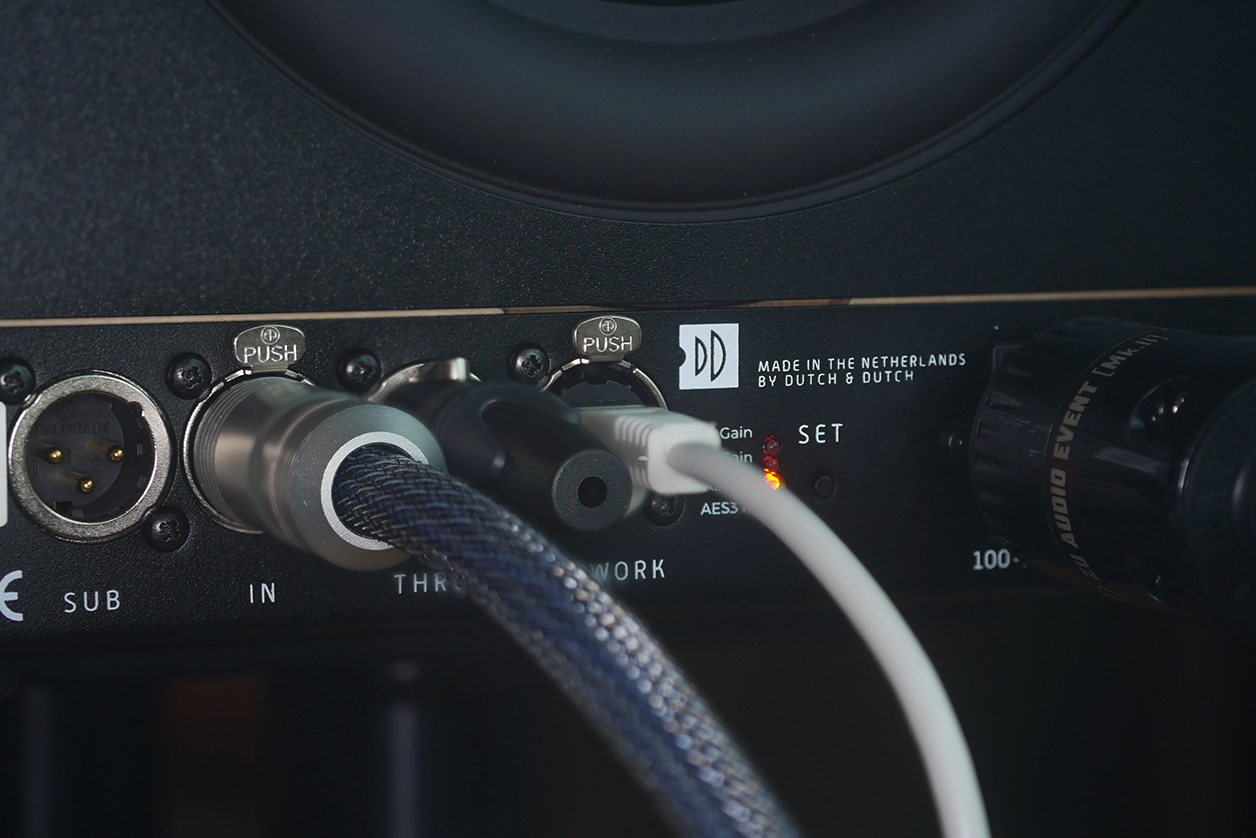 In AES/EBU mode, the second speaker's thru-put gets shorted as shown. The 'set' button toggles between low/high-gain analog then AES3 right/left.
 How about latency for our clever processing? That of the Mac/Windows u-BACCH license is less than 10ms. How about Ascend's RoomMatching? "By telling the 8c how far it is from your room boundaries as well as what the dimensions of the listening triangle are, the 8c will set up the basics of RoomMatching. The second part is to perform room measurements and using the 8c's onboard room correction to linearize the bass response. That's done in the Room Correction Wizard freeware program.
To launch the Ascend web app through your LAN, simply open a web browser and go to http://8c-XXXX or http://8c-XXXX.local, then replace 'XXXX' with the serial number of one of your 8c." How about bypass? The plugin can be toggled on/off in the Ascend web interface so requires using the LAN input.
The speaker itself remains unchanged from M&H's 2017 review so combines a 1" alu/mag alloy tweeter in an 8" waveguide with a laterally 'vented' hence cardioid 8" aluminium midrange and dual 8" aluminium-cone sealed woofers whose combined surface area equals that of an 11.3" woofer. 4th-order Linkwitz-Riley filters sit at 100/1'250Hz and built-in class D power is 250W/ea. for the frontal drivers, 500W for the paralleled woofers. The 26kg box construction combines an inner 18mm Birch Ply carcass with 19mm solid Oak cheeks and top whilst the sculpted front baffle is damped injection-moulded ABS. Internal cooling remains passive convection unless prolonged high SPL trigger active fan cooling.
Finish options are black, white or Oak veneer with either black or white front baffles. Should you wonder about Norway's Sigberg Audio Manta, a 12" 600-watt Hypex active 3-way cardioid monitor at €11.5K/pr – despite being considerably larger than the 8c, it deliberately rolls off at 100Hz to need a companion subwoofer from the same portfolio. So even without BACCH it's not really comparable to the one-box 8c. Getting Martijn on the phone when he failed to respond by email clarified that their own DSP creates 2.3ms latency in standard mode but 32ms in fully phase-linearized optimization to which BACCH adds its own 10ms. That plugin incidentally doesn't embed in the 8c's DSP but the network card's computer board. And that requires both speakers being on the LAN to engage the anti-crosstalk algorithm². The AES/XLR input options cannot access it. D&D's own €950/pr speaker stand offers bolt provisions for the monitor and recommended stand height for aftermarket options is from 60-65cm to align the mid point between tweeter and midrange with the ear. As to D&D's high licensing fee, negotiations with Theoretica Applied Physics locked in contractually months before the license owners created their own uBACCH plugin and priced it at originally $399 since adjusted to $799. Finally, the 8c's plugin is the same generic version so doesn't input measurements³ via in-ear microphones like the advanced version to create a truly personalized filter. The 8c's browser or app-based adjustments are just for our speakers' front-wall and listening distances which we input into the interface window to calibrate our filter. The plugin otherwise assumes that we suffer minimal room-acoustics issues; and use a smaller to standard room without excessive reverb times. Finally, my thoughts about preferred close-boundary setup were correct. It's about minimizing sub 100Hz reflections and related time blur for an in-phase wave launch top to bottom, with the frontal drivers slightly delayed in DSP to sum in time with the bass. The 8c is otherwise just as happy further away from the front wall. Now the intended cardioid pattern below 100Hz³² simply turns more conventionally omni. But, this review wasn't off but on; in oak veneer and a white baffle to boot.
________________________
² To engage BACCH in non-LAN mode would require more complex signal routing so AES/XLR into the 8c's DSP, from there into the network card's computing engine then back into the DSP module. There apparently wasn't an easy way to embed BACCH in the 8c's own DSP, hence the RJ45 limitation to run it. Asked whether they plan on overcoming it, Martijn explained that their in-house resources will be better spent elsewhere. It means that BACCH remedy fans must run even their local files over the network. I'm personally no fan of dispatching files on a local 4TB SSD over the noisy LAN. Current trends of vast-majority cloud streaming simply conspire against us old-timers who still prefer to own their music and listen to it without the eye in the sky's constant surveillance.
³ Martijn wanted to visit to take measurements and personally set up their speakers. I refused. I'm a consumer by proxy. I don't want any special treatment. I want to experience any product exactly like a regular buyer will. Should I run into issues, I want to see a maker's response. In this instance an obvious solution is a remote trouble-shooting login onto a buyer's network interface. It's a service Dutch & Dutch offer so one I would engage myself should the need arise. Otherwise I just want a standard delivery and be left to my own devices armed with whatever setup instructions are included or available by weblink.
³² Our usual speakers dovetailed by outboard precision analog crossover via 100Hz/4th-order Linkwitz-Riley hi/lo-pass with a dual 15" cardioid sub are an open-baffle hybrid. They offer out-of-phase cancellation effects against the sidewalls, too. The Ripol sub in free space then adds reduced front-wall reflections to those lateral cancellations. In a 2.1 stereo setup, this goes after similar dispersion as the 8c and for the same room-subtraction benefits. It simply doesn't rely on close-boundary reinforcement. Being non DSP, it does however lack the adaptive smarts and extra room EQ of the Dutch & Dutch. As to crosstalk cancellation, I could run the same plugin on my iMac then send out the filtered signal via USB to my usual bridge then DAC. For that one doesn't need an 8c. To optimize BACCH simply wants controlled directivity speakers; or well-treated acoustics. Competing cardioid speaker options I know of are from Bang & Olufsen, Gegentakt, Kii, Legacy and Silent Pound. There might be others.