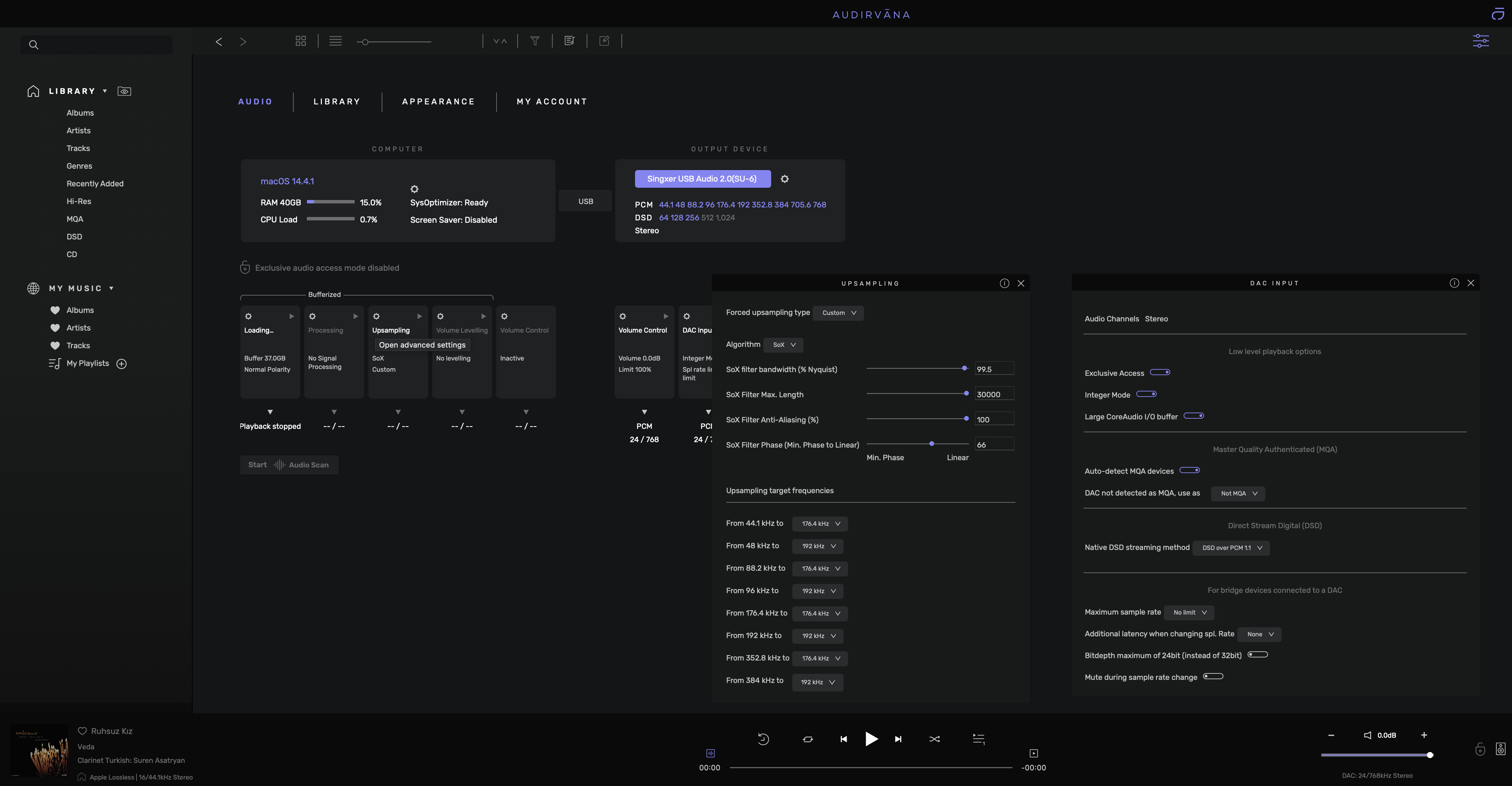
My thing about streaming. Our household is WiFi allergic. So we hardwire all Internet connections and use a classic landline phone. A cell phone remains in the car purely for needs on the road. Using a superior CD transport with built-in upsampler as sonic reference to judge the streaming of local files, I learnt that to equal CD playback required in-situ and post iMac mollycoddling. In situ meant to offboard local file storage to an external SSD. It also meant bypassing Apple's Core Audio sound-controlling software with Audirvana Studio to minimize background computing threads, lock out non-audio programs and perform 4 x upsampling to 176.4/192kHz in Audirvana's embedded SoX engine. Post iMac meant isolating the DAC from the computer via a Singxer SU-6 ultra-cap powered USB bridge. Getting playback of cloud files on par with local files then needed extra elbow grease. It meant preceding the iMac's Ethernet input with the two slaved LHY Audio switches. I subsequently learnt that a 20m fibre-optic spur in lieu of my existing CAT8a copper run could eliminate both switches for sonic parity but would then require send/receive copper⇔fibre media converters. I already had the switches but no media converters so left the more complex hardware in play. The anecdotal moral of all this is dead simple. Contrary to simplistic bit-perfect beliefs and insistence that Ethernet error correction and micro-transformer isolation leave no room for improvement, my ears told a rather different and costlier story. To get local files on par with CD already took some doing. Getting cloud streaming over Qobuz Sublime on par with the exact same files stored on external SSD required even more.
If that offends network engineers, so be it. It's why this paragraph's header didn't say 'the' thing about streaming. It's just my personal experience for which I spent the necessary coin to obey the demands of its observations. If you can manage with WiFi off a smartphone, I salute your modernity, thriftiness and 21st-century brain. Our last-century brains simply don't tolerate the intense microwave radiation generated by our router; or the equivalent receiver in the iMac. It makes things rather more complicated for us with old-style hardwired connections; with replacing a convenient tablet remote with a close-by 27" Retina screen, keyboard and mouse; with accessing streaming services like Qobuz & Bros. through their browser interfaces not apps; with Ivette's PC hanging off a 30m CAT8a spur from my office across a hallway along the floor board of my music room into her office. It explains why headless 'audiophile' servers and us aren't really on speaking terms. To be sure, I reviewed a number of them. I'm perfectly comfortable that our solution gets us just as far even if in terms of hardware complexity, it's a decidedly clunkier approach. But if aging eyes require it, we get prescription specs. For us, hardwiring is the antidote and correction to migraines and brain blur. Until they make effective UHF filters for brains—no tinfoil hats—c'est notre vie.












"In 1978, Derek McNally founded a manufacturers' rep firm. Incorporated soon after as DJM Electronics, we originally concentrated on electromagnetic component lines but soon moved into the capital equipment market. Driven by the military's focus on RF shielding and electromagnetic compatibility or EMC, we established a strong relationship with one of the leading RF shielding companies of the day—Lectro Magnetics Inc. in L.A.—and proceeded to develop a complete EMC product line. For the next 2½ decades, DJM Electronics worked with nearly every RF shielding company and EMC equipment manufacturer in the world. Some companies went out of business, others were bought, many merged but the people in the industry remained largely the same. Our longevity and active participation in local organizations and events gave us a reputation for honesty and integrity and earned us a position as one of the pillars of the close-knit EMC industry. In 2002 we utilized our network of friends and associates to develop new lines of business first buying and selling used shielded rooms; then distributing shielding materials for assembly by others; and eventually designing and manufacturing high-speed digital signal filters. Today we're one of the largest manufacturers and distributors of EMI filters, RF shielding products, RF absorber and shielding accessories in North America. With our proprietary technology, we offer the only 100dB filters available for high-speed digital signals. Whether you need Ethernet, USB, HDMI or other digital signals in your shielded enclosure, we have a solution for you." On the decibel scale, 100dB is 100'000 times louder than perfect silence. So a 100dB noise reduction is big. Again, this is about noise far beyond our hearing threshold. The obvious question is, does minimizing it make any difference we actually can hear similar perhaps to how we can't see ultraviolet radiation but effective sun blockers make all the difference and potentially prevent skin cancer and certainly sunburn?

From Wikipedia, "electromagnetic or radio-frequency interference occurs when a disturbance from an external source between 20kHz to ~30GHz affects an electrical circuit via electromagnetic induction, electrostatic coupling or conduction. This disturbance may degrade the circuit's performance, even stop it from functioning. With data paths, effects can range from an increase in error rate to total data loss. Both man-made and natural sources generate changing electrical currents and voltages which can cause EMI like ignition systems, cellular networks, lightning, solar flares and auroras. EMI in electronic warfare can also be intentionally used for radio jamming." The lead image showed how DJM put their i/o on the narrow ends, placing one RJ45 port adjacent to the DC input. In a rack, most users will install today's filter long side forward to expose less cable; and perhaps even set it on the long narrow side to face the power/speed LED forward for easy view. At less than 15cm wide and half as deep, it will also easily sit behind existing kit to not show at all. That would fit its gizmo aka accessory job description. Out of sight, out of mind? At $2K, perhaps not the latter.