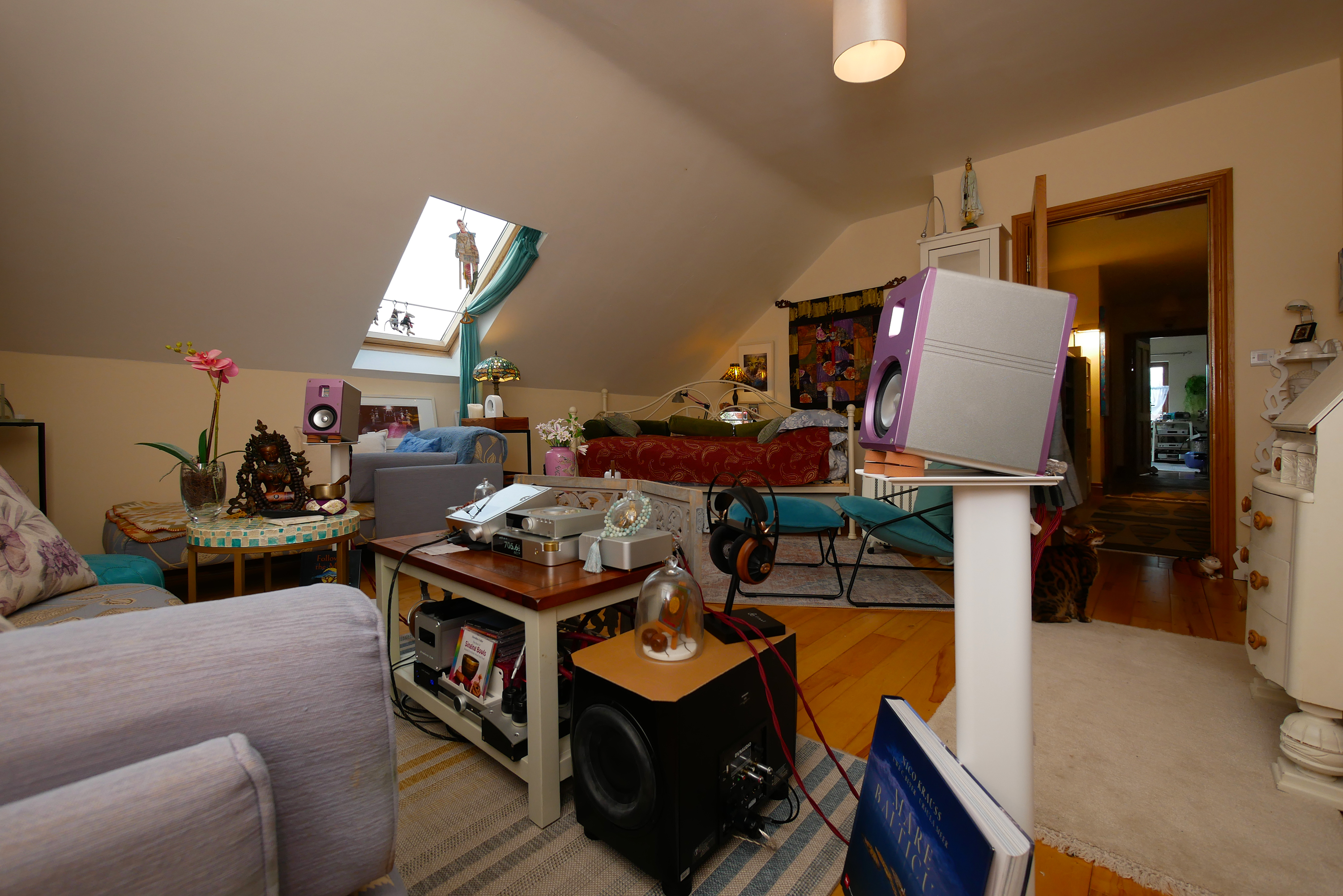
Here's my other small 2.1 widebander rig. This one runs isobarically coupled 4-inch spiderless Markaudio Alpair drivers augmented at 15kHz via small AMT. A Lifesaver Audio Gradient Box II active analogue crossover set to 120Hz/4th-order splits the frequencies. It unloads the small drivers then dovetails them seamlessly with a 2×9½" sealed Dynaudio sub whose own DSP filter bypasses. In this inverted nearfield setup, Ogy could replace my lilac SuperMon Mini for a solo showing. Later I could add my force-cancelling sub, then dock Ogy on its own bass stand for a theme with variations. Options. I had a few whereby to explore a petite Gallic widebander's topolOgy which I'd never yet visited¹. In these two more intimate systems, a small widebander with bass augmentation is fully in its element. It mustn't energize larger spaces at high SPL. Playing those does prefer an active ~100Hz high pass to subtract undue midbass gymnastics. It also exploits the greater cone surface of dedicated woofers for the power zone. In larger cubic volumes that centre of musical vitality wants greater air motion to express itself fully than any 4-incher can excite regardless of clever rear-wave chicane. In a nearfield setup like a desktop meanwhile, Ogy solo could be all one wants. To sign off there, I had my office system. For more common sense, musical choices factor, too. If we apply big-bottom hopes, phat beats at rave levels aren't ideal fodder for small unfiltered widebanders. If we high-pass them actively without passive energy-robbing big capacitors and inductors, that game changes. But it's still other than Full Ogy to only warrant a passing mention. We return to open-backed headfi's minimal energy storage. Whilst it can hit 25Hz, the impact, textures and articulation of its bass differ fundamentally from that of a 15" box-loaded woofer of heavy cone and monster-roll surround which radiates omni to interact with all of our room's solid surfaces for so-called room gain. Hence Jacek's notion of a dipole woofer of just 47g moving mass² from the very same supplier, here loaded just mildly with short sidewalls. It's about avoiding all fat and bloat to maintain temporal continuity with the small driver's unfettered speed and articulation. Those qualities come from a light compact point source run off the leash—sans filter parts. At least that's how I read Jacek's design choices; why I wanted to hear them. It all aligned with how I already do things; including dipole bass whose figure-8 radiation pattern reduces room interactions for less time smear from delayed reflections; and whose freedom from box loading creates a different feel.
_________________________
¹ According to AI, other brands which incorporate Fertin/EMS drivers are Acoustic Cros, Black Forest Audio, MacVoice Audio and Musical Affairs—a decidedly small group. It made my interest in hearing at least one of them even stronger.
² Again from AI, "the moving mass of a top-tier 12" subwoofer driver typically ranges from 180-450g. Because high-end subwoofers require extreme linear excursion to displace air at low frequencies, they rely on heavy multi-layer voice coils, heavy-duty double/triple spiders and ultra-rigid cones of carbon fibre or thick paper composites to resist flexing. This drastically increases the moving mass compared to traditional multi-way hifi or PA woofers which usually have a moving mass below 80g."





My prior experience with unfiltered compact widebanders knew just how critical our correct amplifier choice can be. This type driver often prefers high output Ω for a low damping factor to not dry out, get strident, forward, top-heavy, overdamped then prematurely LF shy. It's why on such loads, high-Z transformer-coupled valve amps of limited HF can be popular. No longer owning such amps, I previously had excellent results with the 0.8Ω Enleum AMP-23R lateral Mosfet champ into the 5-inch unfiltered widebander of Voxativ's Hagen². If Ogy in solo use had similar appetites, this 25wpc transistor amp would likely be my best option.
… to be continued…