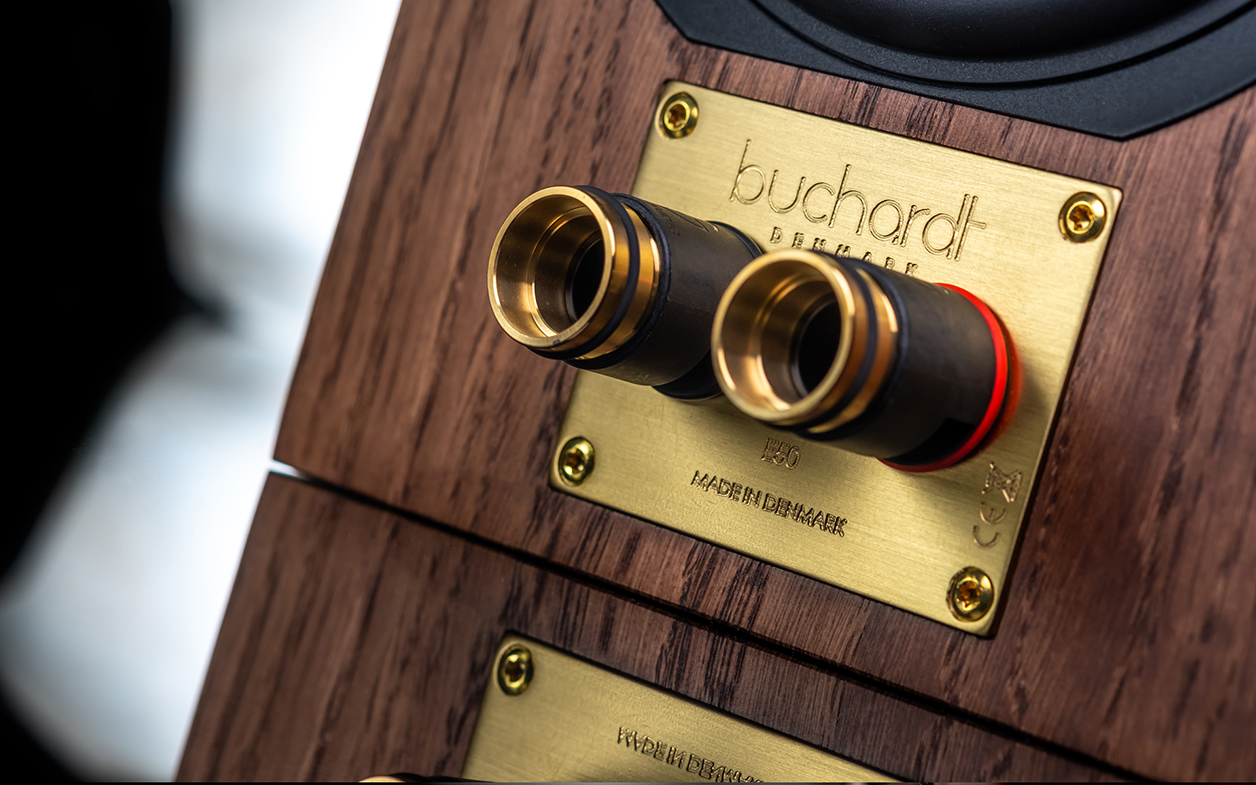
Buchardt's active A10 aside, the E50 is their first passive in solid Oak. I couldn't tell. On machining and fit 'n' finish these execute as expertly as it gets. Finger joints, tight tolerances and attention to detail atop awesome organic aesthetics leave no gaps for complaints to emerge. The E50 is available with straight or rounded edges and in four different stains. The base price gets us stained black, charcoal is €50 extra and natural/smoked oak add €150. The 28mm baffle sports a milled waveguide to minimize edge diffractions and match tweeter directivity to the mid/woofer so that off-axis performance remains consistent across the filter frequency. This short horn also boosts the tweeter's low-frequency output, lowers its workload hence distortion and allows for wider dispersion which gradually narrows at the highest frequencies. The driver is Scan-Speak's well-praised D2905/970000 28mm textile dome customized for waveguide loading. Purifi's 6.5" Ushindi PTT6.5X is the mid/woofer of choice which boasts very high output potential with minimal distortion. It also sells for about €400/ea.

Seeing that kind of artillery in today's price bracket was a sight to behold. But we're not done yet. Twin SB Acoustics passive radiators on the rear also were customized for this speaker. 28mm stroke and 58g cone mass were necessary to match the enormous output of the Purifi. The binding posts just below the passive membranes aren't run-of-the-mill fare either but by local high-end cable company Argento Audio and iron-free for Buchard's special projects of S400 Signature and E50. The core channel of these terminals is silver, all connector types are welcome and the large brass barrels very convenient. Many far pricier speakers could be envious. The internal damping includes natural wool, polyester wadding, Basotect acoustic foam and scatter patterns milled into the wood surfaces. The mid/woofer sees a 1st-order low-pass built exclusively from monstrous 14AWG copper-foil inductors from the Cross-Coil range. The tweeter connects to the 3rd-order high-pass through the same company's Superior Z-Caps, Cross-Caps, Superes 1% resistors and Air-Core wire inductors. Lastly, Jantzen Audio 13AWG OFC and Duelund cotton-in-oil tinned copper make up the internal wiring for the mid/woofer and tweeter respectively. Considering all this, Buchardt's E50 is a true passion project and real enthusiasts who know their beans from Adam will recognize that. Now it's time to take that passion for a spin.












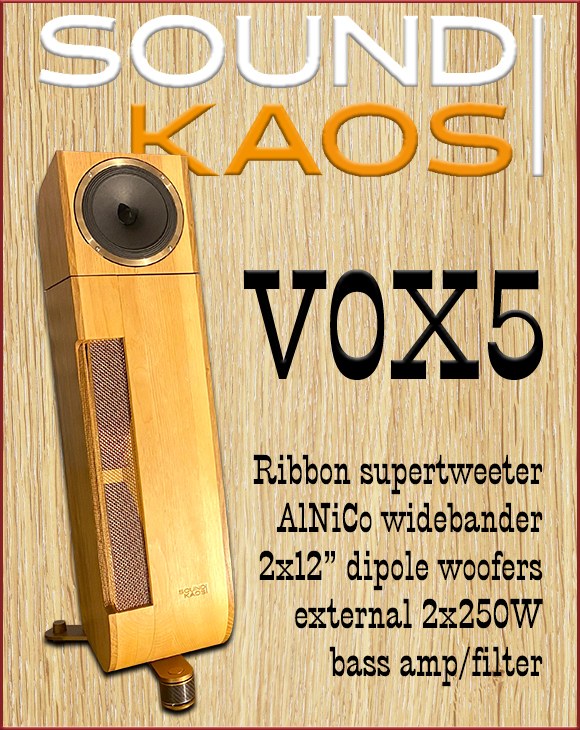
My setup comprised the Innous Statement Next-Gen server/streamer, LampizatOr Horizon360 DAC and Trilogy 915R/995R pre/power threesome. My FirstWatt F7 and Enleum AMP-23R amps were out due to insufficient power. The E50 arrived without stands so I used my trusty Soundstyle Z1 with three LessLoss Giant Steps between each speaker and their top plate. sound|kaos Vox 3afw monitors on Vibra 68 footers were sparring partners. Where ported designs are typical troublemakers in my 22m² room with low ceiling, those without resonant vents integrate easier if positioned right. Then I get to hear more direct than reflected sound to avoid spatial confusion and blur as by-products of timing issues. That nets significantly better performance. Speakers with rear-firing cones fall into the same camp so understanding where the E50 should and shouldn't position didn't take me long.
In small listening rooms like mine, the positioning of speakers like the E50 is a careful balancing act. Their rear radiators enjoy coupling with the front wall to extend reach but insufficiently deep not particularly enveloping imaging that steals from immersion is the price to pay. Conversely, moving such speakers away from the front wall elevates imaging depth and layering at a cost of shallower weaker bass. Individual preferences and listening conditions determine the final compromise between staging and downstairs reach. Some monitors are perfectly happy with lots of surrounding space, others prefer boundary boost. On top of that, some driver concepts have it easier where all-out imaging is concerned. Widebanders and coaxials are brilliant there due to point-source radiation. My sound|kaos Vox 3afw monitors positioned nearly in the middle of my room very close to the seat make that point. When set up thus, these Swiss minis vanish from sight and cast a very HeadFi-type spatial bubble packed with images that on articulation, clarity, intimacy, directness and lifelike feel are second to none. As aggressively toed in as they are in such a scenario, the Vox monitors also aim their rear ports at the side walls which naturally lifts their bass. A spatially fiendish compact that doesn't disappoint down low is the exceptional outcome.