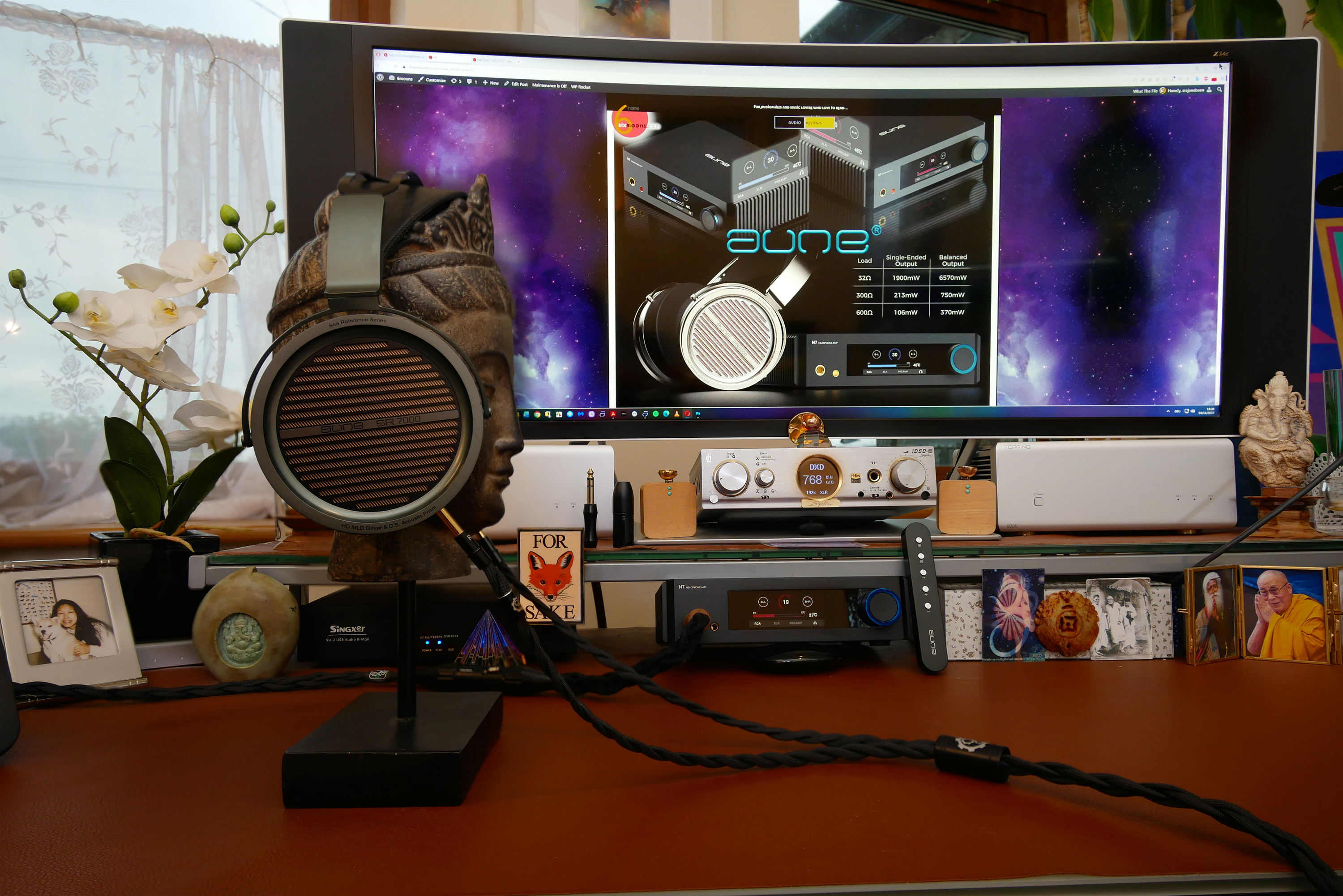
Tracking my sample with the UPS monitor showed passage from Wuhan to Zhengzhou inside China, then Incheon/Korea, Dubai/Emirates, Köln/Germany and Dublin/Ireland. Air-trekking halfway around the world to the Irish lost-sheep zone of the rural west coast took all of five days to my door. What unpacked was so small and lightweight that full-size pure class A Pass amps would be forgiven for thinking it another class D chip chap. Not so. This discrete class A munchkin slipped beneath my monitor shelf with room to spare, a decorative pebble beneath its lower edge to angle the show up a bit. Taking the N7's priestly confession was the companion SR7000 sealed dynamic headphone on a Polish Forza AudioWorks leash. At 19/30 on the low-gain dial I was in full-on pork mode, admittedly coming off iFi's iDSD Pro Signature DAC which in my chosen fixed RCA out delivers 6Vrms. Seeing red to track thermal action on the output transistors not chassis or heatsinks, I hit 37°C after about 20 minutes. That's where the thermometer hovered for a few tracks; exactly at the average body temp of a human adult. Feeling frisky, it eventually rose to 38°C whilst its ribbed cheeks were barely warm to the touch. aune have clearly polished their dissipation game to keep this very compact but powerful deck as frosty as feasible. Switching to blue so low-bias mode shaved off 2°C to suggest a rather mild offset of bias current between either mode. To clear out potential transit cobwebs, I spun up the fiery "Ecos de Albayzin" from Robert Karl Svärd's Del Alma, a stunning slice of spicy Flamenco chorizo from, yes, Sweden. Hey, behind the cool outers of us Norsemen there burns real passion. So tuck into the whole album. Bon appetite!
 Use mouse-over loupe or open at full 3'000px size in a new window.
Whilst I had a cabled 4.4mm male to XLR4 female adapter on order from Amazon.ie, I already tried my Raal 1995 triple-ribbon Immanis flagship via its 32Ω transformer-based impedance adapter on aune's 6.3mm port. Though just 1/3rd of its balanced output capacity, I was back in pork city at high gain's 24/30. By now I saw 41°C. And whilst I only had another six clicks left on the gas, balanced drive would expand my game. By how much I'd find out soon enough. I was in no hurry though. This pairing was shockingly serious already; not that Immanis fanciers would ever dream of slumming it in aune's 'hood. Snobbism. If one enjoys spending loads more than necessary, why not? It keeps fancy-pants purveyors primed, the wheels of commerce greased. Saying so isn't synonymous with claiming the N7 to be the road's end. But with a fine source and true statement loads, an in-between linear driver of these chops goes far already. How far probably only I shall know. Who else would combine these two? So off my high hobby horse and down into loads actual buyers might duplicate such as the AR5000 and SR7000 stablemates and new FiiO FT7.
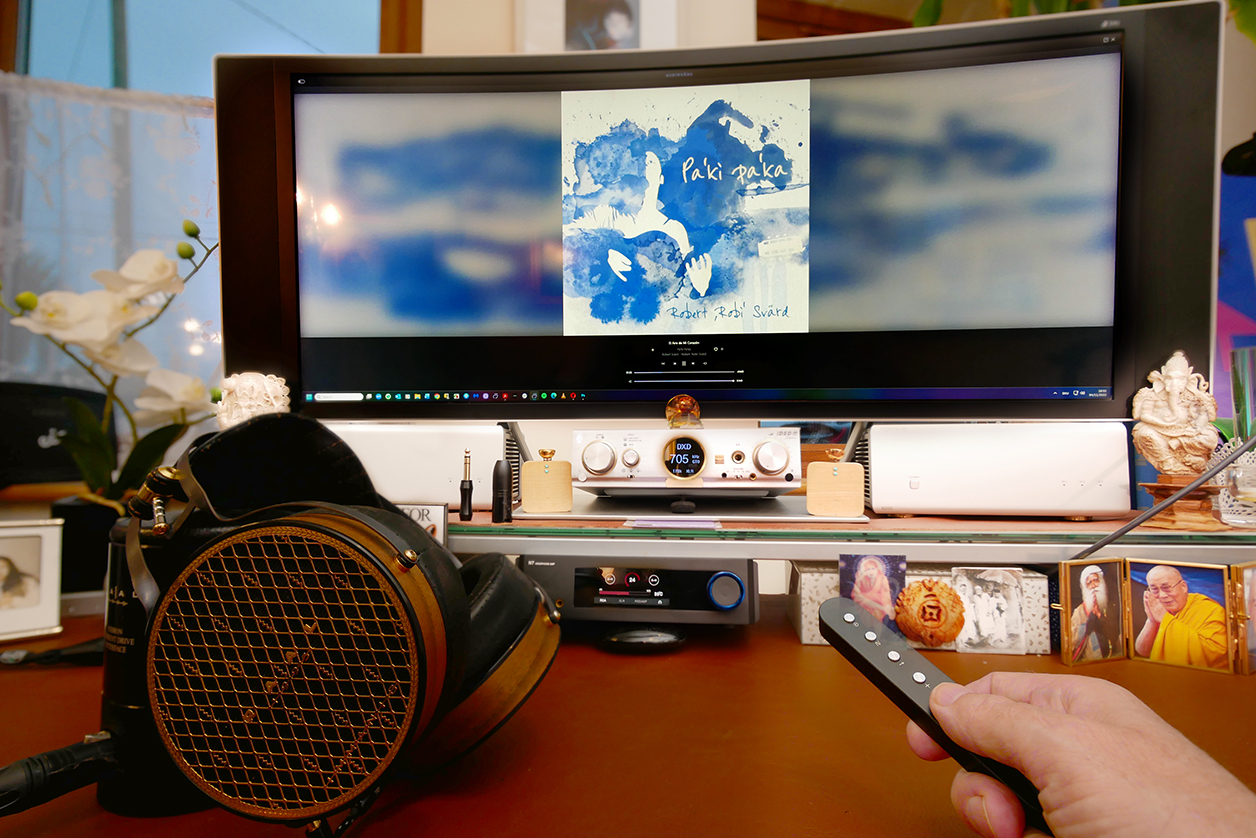
But first, two minor niggles. 1/ the rotate/push controller incorporates no on/off function. Where the N7 installs in a tight nook precisely because it is so compact, getting at its mains rocker on the rear could be fiddly. 2/ the metal cigarillo remote—seriously fab over the ubiquitous plasticky con jobs common with kit twice as dear—is super responsive to ± volume prompts. To advance in single steps requires careful single clicks or you'll jump quite a few of them. As I said, minor niggles. Just so, my critic's vote for the next production run is to relocate the mains rocker to the front of a cheek where it's easily reached no matter what. When set to go off after 30 or 60 seconds—the third option being always on—the only sign of life is a single small red LED on the display's far left. Any prompt on the remote instantly reawakens the readout. Unlike the inputs, switching between headfi and preamplitude can't be done by remote. For that push the control knob for 3 seconds to bring up the mini menu, rotate to select a line item, push to activate. It's perfectly minimalist and intuitive. Did I mention a flawless matte-black fit 'n' finish and clean Scandi chic industrial design? Whilst positioned below aune's 'S' range, I actually prefer the N7's form factor and execution; including the absence of fascia branding. With an S17 Evo on hand, let's compare mates to answer the obvious question: essentially, is the N7 an Evo running off cheap switch-mode power? Other than being bigger, costing double and flying an XLR4, Evo has exactly the same i/o, remote wand and also uses a pure class A two-stage bias/gain circuit though its R2R volume's range spans 63 not 30 clicks. A pair of FiiO FT7 played oracle.






And the oracle said yes; kinda. This played to popular here curiously correct expectations for a quicker wirier more lit-up feel for the SMPS; a fuller smokier more stately vibe for the linear supply. On temperament, the N7 was more youthful, brash and energetic. The S17 Evo was more mature, settled and filled out. The upshot was easy. Whilst similar indeed, these aune brothers express sufficiently different personalities to draw different crowds. The bigger amp puts cream into its coffee, the smaller one keeps it black. Once both thermometers stopped moving in the same high-bias low-gain setting, Evo ran its transistors 15°C hotter. This indicated far deeper bias for that richer creamier climate; and/or less effective dissipation. To my ears, FiiO's current flagship planar fitted with the leather pads preferred the extra gravitas of the elder aune. Meanwhile my bassier fatter Final D8000 definitely took to the spunkier youngster. Punters who hoped for a wishful freebie—spend half, get exactly the same—learn that as usual, material reality bites. Just so, for the right punter it's a love not dog bite. I'd plug my now ancient pre-fazor Audeze LCD2 into the N7 over the S17 any day. It made this AB a sideways not up'n'down move. Common to both was phenomenal colour intensity; a bouquet of rich autumnal hues not the bleached desaturation of a Spanish high summer. This paid homage to what in most people's mind class A is all about. The N7 diverges from that archetype's poncier more massive elements by bolting on quicksilvery reflexes to avoid getting dark or heavy. Perhaps think of it as high-feedback class A? If 'younger' is routinely synonymous with 'smaller wallets' because spending power grows with age and career advancements, it seems perfectly logical that aune's half-priced class A proposition would express a more youthful attitude to cater to its core audience.
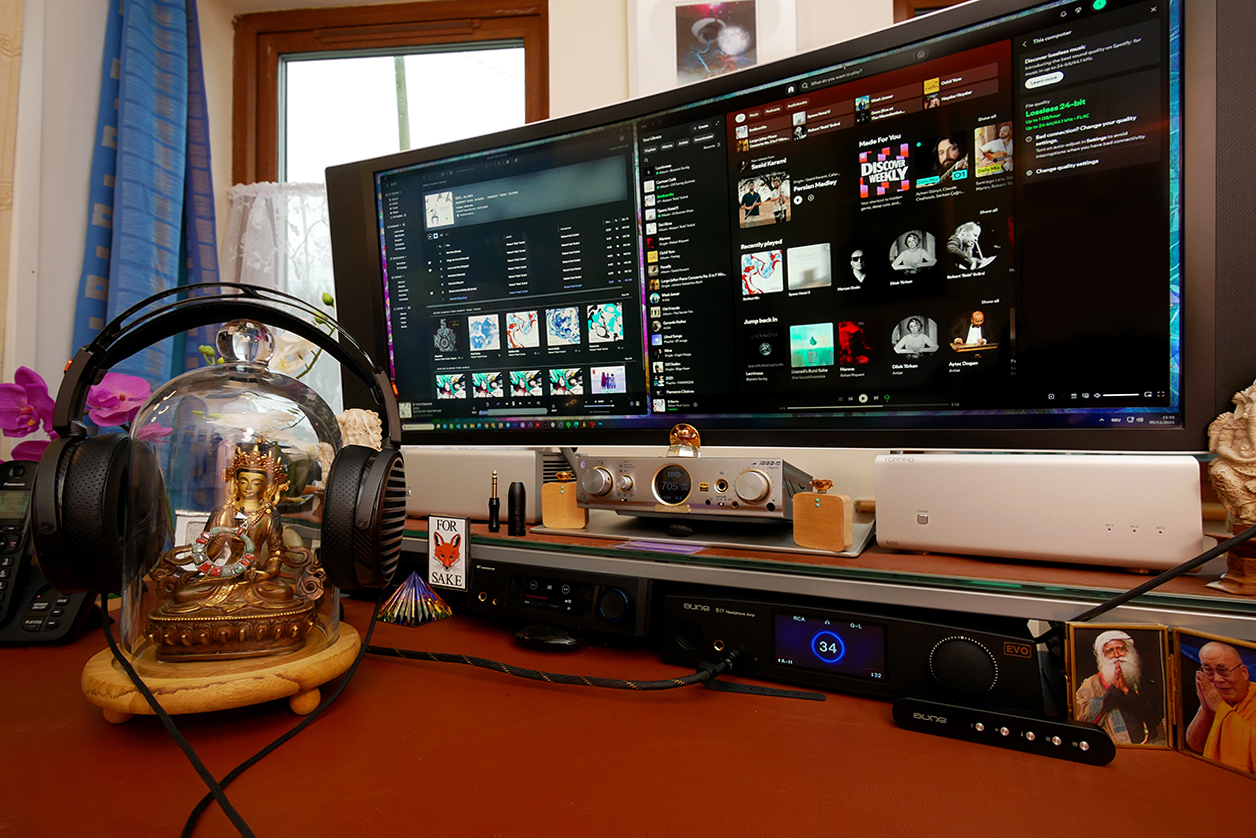
In preamp mode, the silly-steep 11.8Vrms fixed XLR output of my iFi DAC overloaded the N7's input. Its still high 6Vrms RCA feed was fine. Also, hi/lo gain affects the headphone and pre-outs alike. Sadly there's no automated volume reset whilst switching between speaker/can modes. Whatever the volume setting was in one mode transfers to the other where it could be dangerously high. This requires caution. I thus propose a firmware update which lowers the start volume to zero each time we switch output mode to avoid curses and worse. As a preamp my iDSD Pro Signature had more connective tissue or spatial context between images as DSD has over PCM. Yet the noise floor of the aune seemed still lower for even starker contrast; what we might call poppier image pop. The iFi sounded more suave, wet and expansive. The aune did it more crisp, dry and focused. As a preamp, the €3'250 Brit played in a higher league as it bloody well should have. As a head amp however, the aune ate its lunch. That defied math and skipped right back to the brilliant earlier Immanis showing. With headphones in no need of padding or enhancements, just clean power, strong colours and peppy drive, the li'l aune is a smart find. If the word-count fairy allowed me just five letters to shoehorn its performance into, I'd pick drive. With the fairy gone again, I'd unpack it as a certain sense of locomotion or background pressurization which generates powerful musical forward momentum; active engagement which isn't a passive drip-feed; adjectives like propelled, muscular, energetic, intense. It all folds back neatly into 'drive' as the combined qualities of control and motion from when a mechanical transducer is properly driven. It's very often the primary distinction which the insertion of a more powerful amplifier model from the same designer has on our system. The house sound remains but grows more authoritative, grounded and exhibits stronger thrust. In short, for normal headphones the N7 in 4.4mm mode is unusually powerful and acts it. That at 22wpc/16Ω Topping's €1'200 class AB A900 applies the same "über factor" to even the most brutish loads is a tale for another day; and a different audience. Time to change listening stations. In my bigger speaker system, headfi is fronted by a dedicated 27" maxed-out iMac with Audirvana Studio, Qobuz Sublime and Spotify Premium lossless. That outputs USB to a Singxer SU-6 bridge which talks I²S/HDMI to a Laiv Harmony DAC with standard 2/4Vrms RCA/XLR fixed outputs. Local files sit on a 4TB external SSD. Cloud files stream in through two series-connected LHY Audio LAN distributors aka network switches.