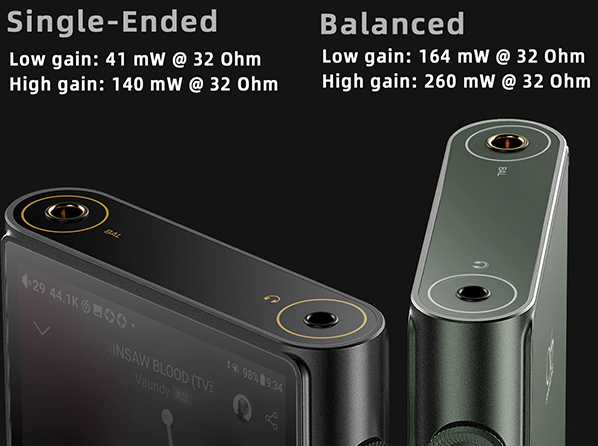
 Low gain, 30/100. That was the lite figure AR3000 threw up on Topping's leader board. The far more pinched mobile Shanling dealt the same score—low gain, 30/100. As befits its entry point and included shorter 3.5mm and 4.4mm cables, this aune goes deliberately light on signal-voltage thirst. Water not vodka. Of course getting plenty loud with little effort isn't the same as with full authority. OG Susvara users learn this quickly. We might say that the more various headphones scale up with ambitious amps of high power, the more demanding they are. Otherwise those offsets should shrink. By that metric the AR3000 went very easy indeed. Scaling up its chauffeur to body guard did something but was inversely proportionate to excess. From my stationary lot, the 2wpc/32Ω baby Gustard under the budget Audalytic banner was the 95% sweet spot. How my obvious DAP happiness translates to smartphones I wouldn't know. My mobile remains tethered to the car for emergency calls. It's not allowed in the house; a dog with fleas. Like conundrumical, I'm archaic and only do asocial media.
Back to watts, voltage gain and their options. Just because a load hits cruising altitude in lowest gain doesn't automatically mean best sound. Depending on how low gain implements—it could apply higher NFB for example—seemingly excess gain might sound better. It just must leave us with sufficient volume granularity to not get too loud too soon. So it's good hifi housekeeping to try out all our options. Don't trust assumptions. We're to please your ears, not generic beliefs.
Now we've arrived at comparative comments. Since I agreed to aune's request about no in-stable juxtapositions, we look elsewhere at the one alternative I had: Meze's €799 109 Pro. It's not really sensible but I had thinned out my headfi harem earlier this year during a mass giveaway. As my favourite Meze in the collection, the 109 Pro had eluded the cull. That made it the closest dynamic I could muster now.
Then I roped in FiiO's €749 FT7 from the planar still rather pricier side of town.
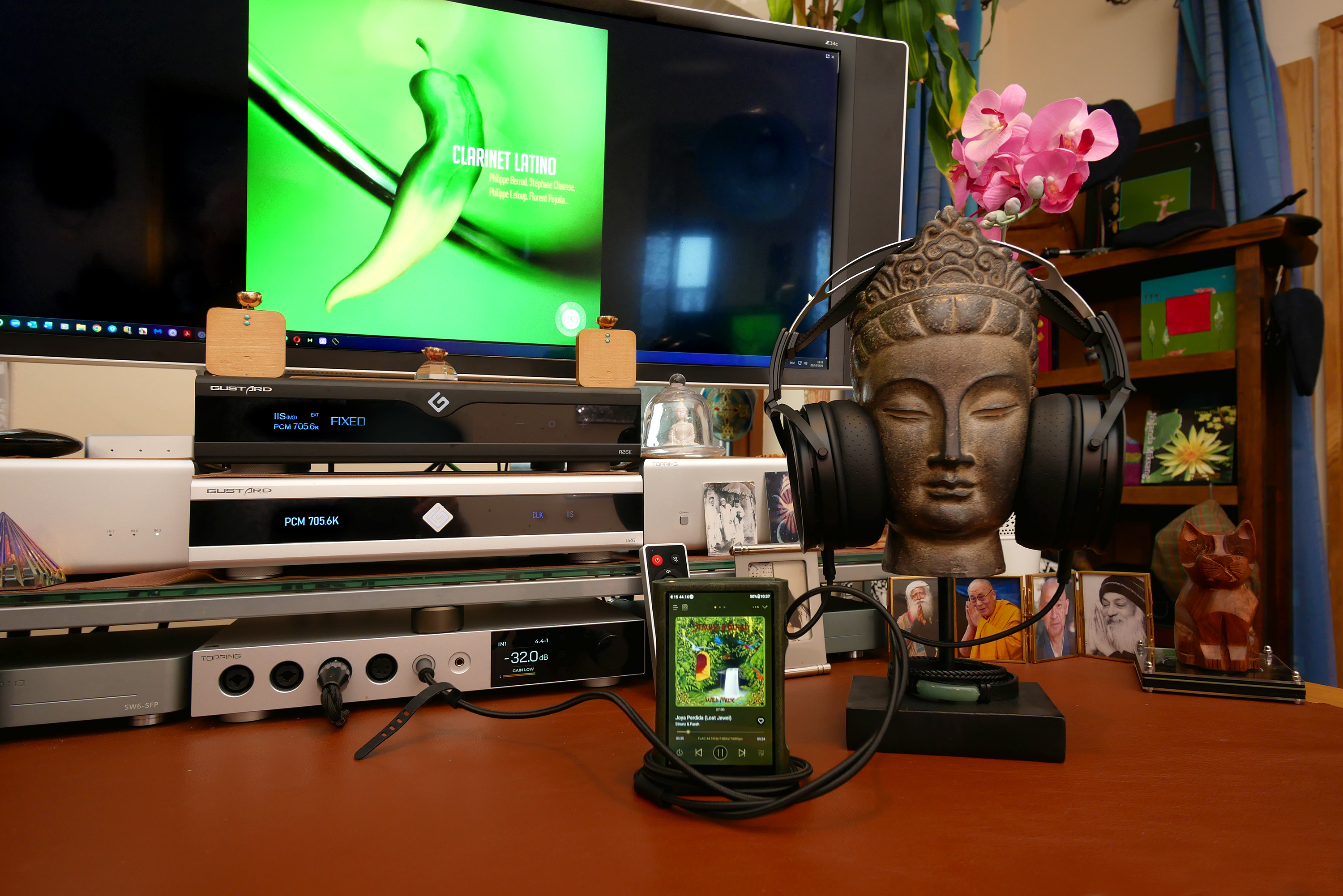 With stock 4.4mm cable.
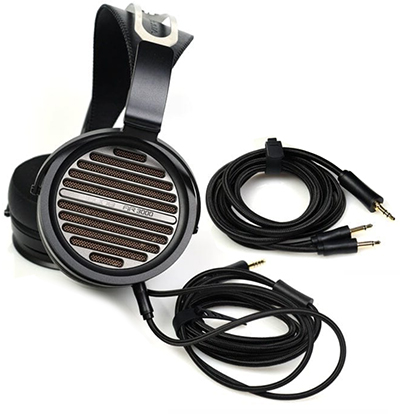
 At 375g the Romanian was never a heavyweight yet here the noticeably stouter. Ditto its clamping force. Voltage thirst as a function of sensitivity+Ω was very close. On style and luxury finishing, Meze win nearly any competition. They did again. It's their super power. On cabling, the 109 Pro's 3.5mm entries are of non-standard depth. Like most others, the standard 3.5mm plugs on aune's cable wouldn't reach. Meanwhile the AR3000's own sockets recable easily with 3rd-party cables. I had a FiiO and Forza Audioworks. Costing more than three times less than the Meze 109 Pro booked zero comfort or sonic compromise—fancy but factual. In no particular sequence, the 109 Pro's bass was less well damped hence bloomier and fattier. If this were sushi, Meze's LF were chutoro. That's medium-fatty tuna from the dorsal and belly area running toward the tail. The AR9000's were akami. That's the lean deep-red meat from the back and spine area of the fish. Both stayed well clear of otoro, the super-fatty cut from the lower belly near the head. Yet Meze's was obviously more resonant and portly; its construction not nearly as fastidiously vented
 to bleed off in-chamber acoustic bounce. Some might call theirs a more fun tuning.
Just so, it wasn't as subjectively even, its stoppage not as punctual despite the aune building in its own slightly richer upper bass. The AR3000's walk on the line continued across the vocal and treble bands. Here too the 109 came off more inebriated. Its midrange played somewhat recessed, its top end lifted to conjure up extra spaciousness and sparkle. The AR3000's treble was milder without telegraphing any lack. Whilst higher coherence could seem at cross purposes with entry-level positioning, the AR3000 manifested hifi's creed—be minimally invasive, minimally interpretative—to stricter tolerances despite its linearly rising bass response which mimics most people's ideal in-room response for loudspeakers. Will the AR3000 target audience appreciate this enviable accomplishment of a less overt profile over one that's more plainly libertine? Will this buyer even recognize it? No matter the marketplace response, I thought of the aune as the more universal headphone. It was unlikely math and I've always sucked at math; but it's what I heard. And I trust my ears far more than math!










 FiiO's FT7—heavier, bigger, harder of hearing and in possession of our award—required extra upward clicks on the volume. Its material mix of carbon fibre, wood, black metal and copperish hex slider isn't everyone's taste. Sonically this was a far closer match. My first difference notice was on articulation; what we might call tone diction or enunciation. How clearly do all sounds pronounce? Though very slight, I thought FiiO's tongue lazier. On the peppery "Blanco del Sal" of Rafael Cortes' Oasis album, the tautly tensioned timing and ultra precise execution of Flamenco guitar attacks felt even more intense over the pistonic dynamic than the stretchy thin-film driver. Trading places between headphone and listener, my own brain seemed to articulate music's constant stream more precisely. We might also flash on how PCM and DSD differ in their transient approach; AMT versus soft-dome tweeters. Very often the former enunciate crisper, the latter softer. They all have admirers. With AMT topping four of my five speaker systems, ribbons the last, I fancy the directness of pert diction. It's also why I adore unfiltered widebanders. In headfi they're the norm, in loudspeakers the exception. Perhaps it was no surprise that I would hone into that quality first. In the lower treble, the FiiO showed more occasional refractions; mini flashes of brightness in Rafael's top register whose guitars by Spanish luthier Javier Castaño typically sport German spruce tops with Spanish cypress backs and sides for strong lit-up projection. The result on this track is a timbre deliberately bordering on but not crossing over into the glassy. The aune's slightly polite lower treble better held that line. It felt like the tighter-sounding headphone which achieved its resolution without a HifiMan-style goosed treble but low overall distortion undoubtedly helped by now proven geometry of very efficient venting not just out the back but also the sides.
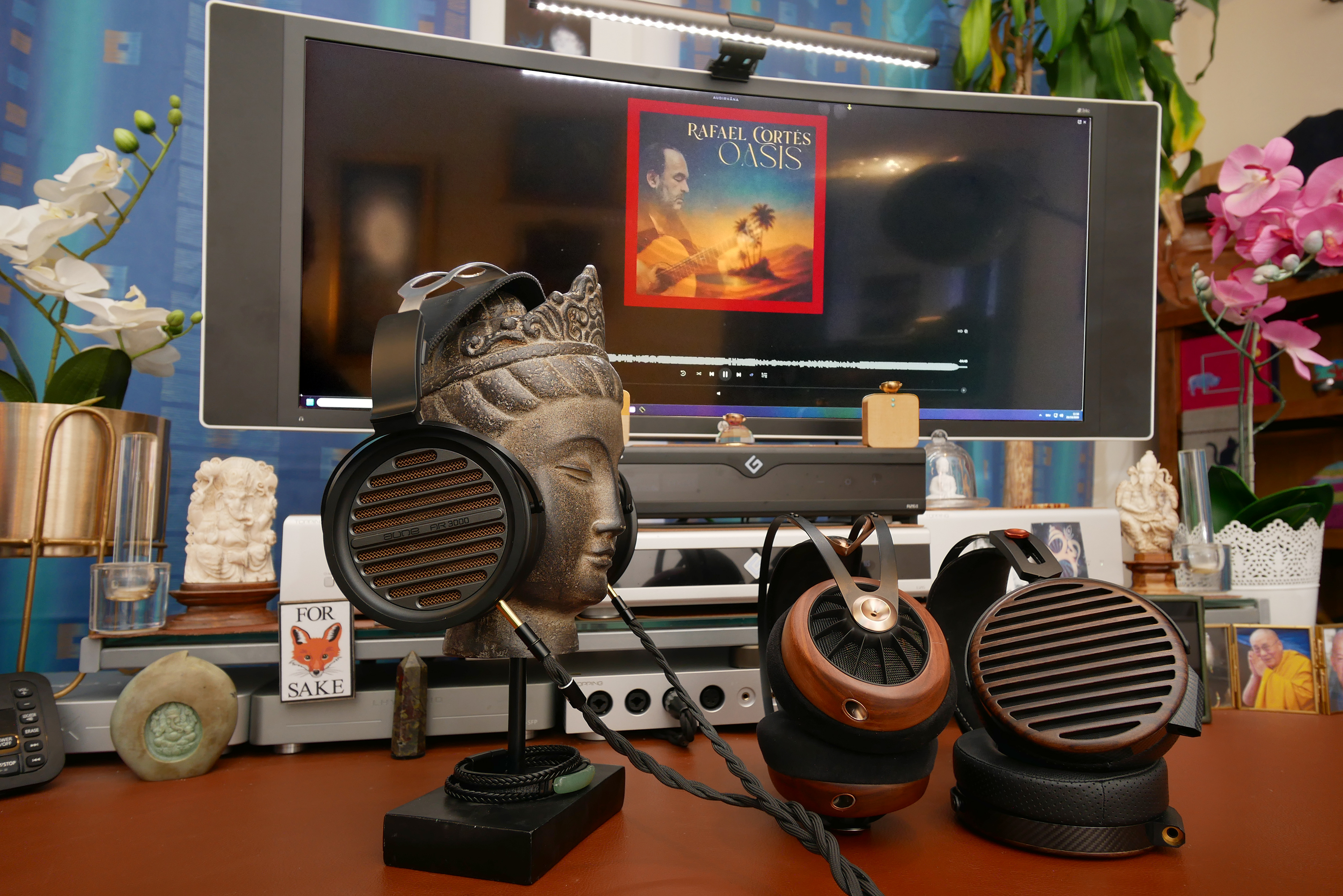 With Forza AudioLab cable which also fit the Meze, FiiO and my upstairs Final D8000.
 On separation, its PCM flavour emphasized superior soundstage sorting. FiiO's DSD gestalt felt more elastic and supple if just a mite less focussed. It also made the AR3000 feel fresher or more forward, the FT7 subtly more distanced or farfield. Just so and wallet bite excepted, this was a surprise encounter of sonic equals tuned on the modestly richer bass-forward side. Rather than get into micro-observational weeds which may not hold in different contexts, that was the takeaway. In its own catalogue, the AR3000's weight and sticker make it an aune lite. Out in the wild it's a far heavier hitter. Yet on price, high efficiency and easy-load behaviour ergo mobile happiness, it aims straight at entry-level buyers. They might not appreciate just how good this aune is in the bigger scheme just because they lack exposure to it.
In the hunger game of perception, a big loaded plate beats a child's portion even where assembled from the same pans. In the fight for greatest skull comfort, the half portion wins every day. Deep pockets could pick up the aune and conflate its material easefulness with lack of seriousness. Three hours later the AR3000 remains a dream to wear whilst raising a plucky eyebrow at that impressively full-metal-jacket affair already docked on its stand. Many could pick up the aune and conflate its absence of EQ triggers—I must first fix this 'n' that before it sounds right—with boring. Old hands recognize its ideal balance between bass warmth of great punchiness, timbre weight and treble smoothness but could still struggle to align it with a €239 ask when they could spend far more yet still feel the EQ itch. Theoreticians could read of a subjectively friendly profile and yawn. Yet I heard nothing whatever boring with the rather matter-of-fact Topping A900 and its complex nested feedback loops; just absence of edginess and energetic reluctance.
 Such is the AR3000's very peculiar portrait. Its true sonic achievement is best recognized by experienced listeners long past paying close if any attention to its price point. Its actual target audience could expect and be drawn to a more overtly colourful tuning. That's at least how I saw the AR3000's quandary. Its sonic profile is too 'normal' for a placement where material mix and presentation are insufficiently glamorous to reflect its actual qualitative standing. As always, perception is reality. A Daimler engine in a Renaud chassis remains a Renaud. Smart shoppers simply don't care. They derive special pleasure from the misdirect and grin quietly all the way to the bank whilst thinking the Mercedes crowd fools for spending so much more.
So—invoking a quandary or conundrum was a thin writerly ploy. Just buy one. It'll earn you a very shiny smart-money badge in the bargain. If this seems like a back-handed compliment, au contraire. I was simply asked to only do half a job by not comparing the AR3000 to the two stablemates on hand. That micro-managing mandate emptied my tank far sooner than usual by running out of sensible comparators. Perhaps fellow reviewers weren't likewise fenced in; or didn't feel bound? Then they might be more informative than I could be this time. For years now aune's SR7000 has been my favoured close-backed dynamic for sound and wear. It's ice-cold—or scalding depending on your perspective—that their AR3000 can undercut it by 2½ times, the AR9000 by more than 6 times yet budge not. Is it a super-impressive sub €250 circumaural headphone which can cause real trouble when compared head-on, head on? Absolutely. As my AR9000 review proposed, today planarmagnetics make the most full-sized noise. That can cause subtext of headphones with dynamic drivers being less capable, desirable or hip—like outdated 20th century tech. Based on aune's latest evidence, nothing could be further from the truth. With the dynamic driver celebrating its 100th Anniversary this year, it packs more experience and developmental data than any other driver type invented subsequently. So yeah, it's still got it—whilst here coming in at a price so shockingly friendly that most will disbelieve what it can go up against. Were it priced like the AR9000, that bit would be far easier. On just that score, the AR3000 really has its work cut out. Otherwise it sells itself.
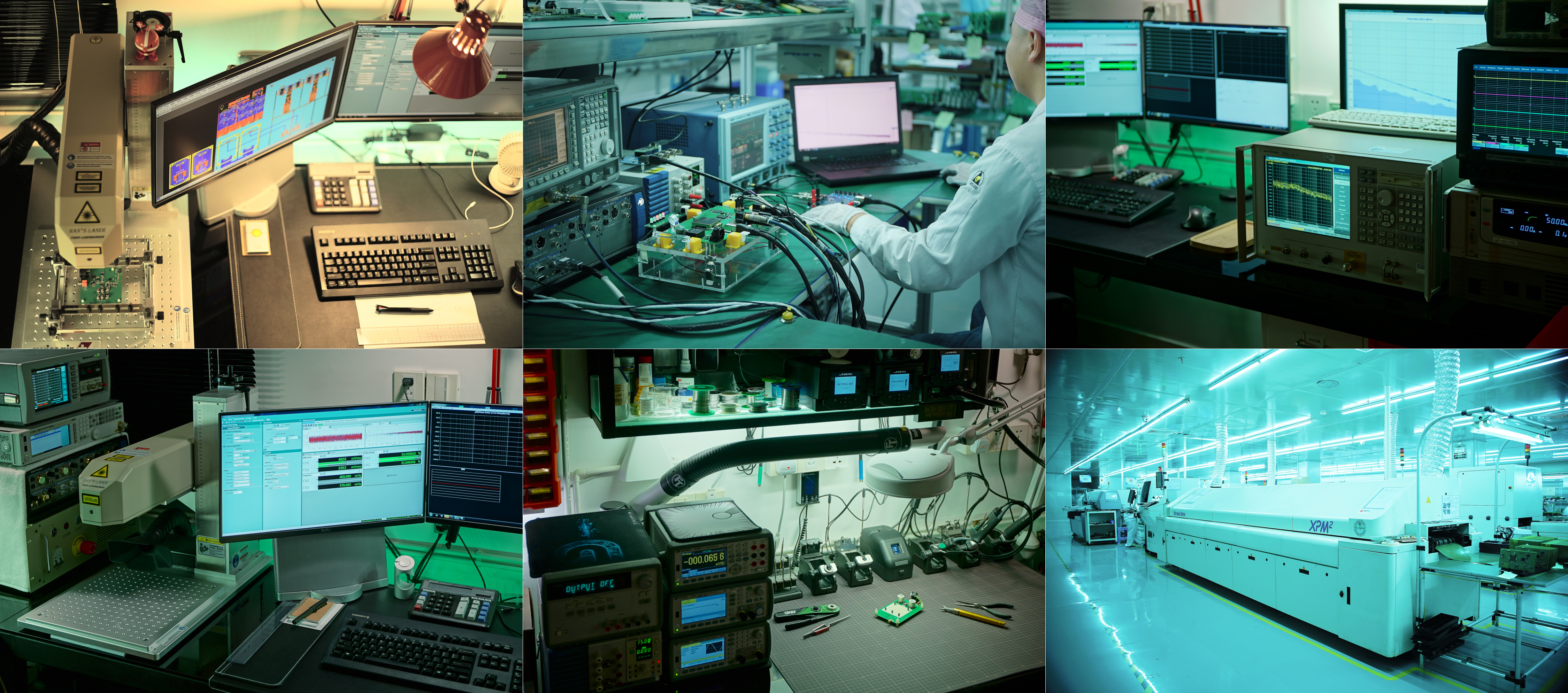
Postscript. Since I couldn't find any on the web, I asked aune for photos of their facility and workforce. I was told that they prefer to keep a low profile and let their products speak for themselves. I did however receive the above set of their ~1'200m² factory which currently runs 42 employees, making aune's operational and physical footprint very similar to Denafrips, the premises 1/10th of FiiO's size. This video then speaks to aune's history starting in 2004 with a DIY forum which grew into an absolutely massive database that then led to the brand's very well-informed formation in 2012.