At heart Hercules is a vanilla DAC without any modern bells and whistles so no volume control, upsampling, wireless or network component. I'm not surprised in the least. Michal is a purist. Each of his products does only one core task. That's it. Hercules fits that profile so is a niche design by today's standards while its topology further reinforces said status. DACs with output tubes not buffers are rare, those with DHT even more so. Manufacturers into them for digital are few and far between. LampizatOr are probably the best known. The most affordable DHT DAC in their roster is the Golden Gate 3 at €18'500. Hercules as reviewed (2 x Psvane 300B UK Design, 1 x Russian NOS 5U4G rectifier) costs €10'900. Emission Labs mesh 300B and 5U4G add €1'100 to the bill. In the grand scheme this is an expensive product. However, if we take into account DHT DACs by well-established businesses and leave out DIY, this one seems to be the most affordable among its elite kin. To my knowledge this also is the only such platform with NOS R-2R chips. That's why I earlier called it a global standout. Michal wasn't even aware of this. During one of our recent discussions he said that to his ears old multi-bit DACs sound great. 300B outputs were a better match for his R-2R of choice than 6SN7 dual triodes which the Hercules project started off with. The rest is history.

Hercules looks as it does for two reasons. One, it matches its integrated siblings. Two, the key components inside require a lot of space for ideal working conditions. To kill two birds with one stone, Michal repurposed the enclosure of his Second integrated amp. The forehead built upon a thick merbau wood panel is modest yet features all necessary bits. A steel knob on the right cycles through digital inputs while its counterpart on the left is the main on/off switch. A green LED in that area blinks for a minute during the soft-start procedure and stays lit when it's done. Normally I'd consider the lack of a remote a drawback. But Hercules omits a volume control and other functions beyond the two basic utilities of on/off and input selection so this was no issue. The product sits on four aluminum feet with rubber O-rings while its business end from left to right houses a pair of RCA outs, five digital inputs (a USB, 2x coax S/PDIF and 2x optical S/PDIF) and a fused IEC inlet.










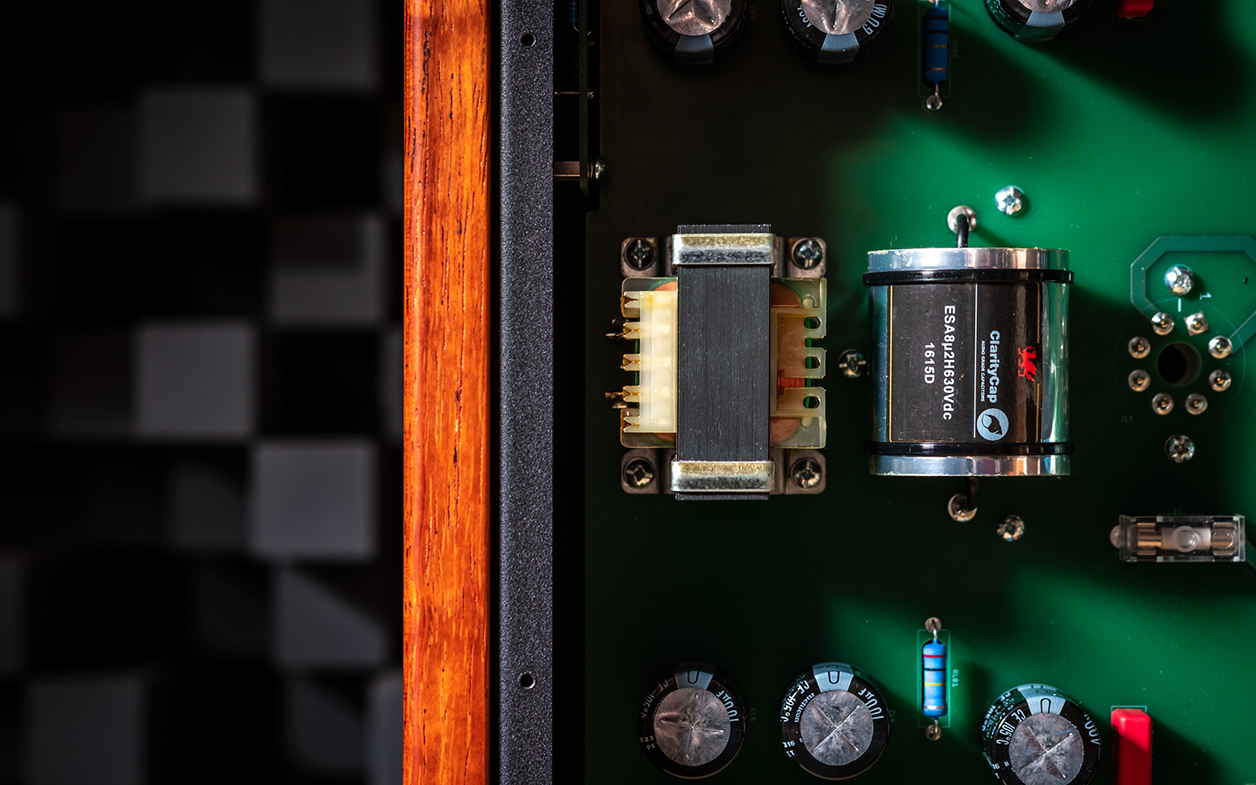
The 2mm powder-coated steel enclosure is generously perforated and slightly rounded here and there. Openings inside two gently floating plates accommodate the power triodes and rectifier tube in-between. The elegant gilded nameplate just a hair below details what kind of a rare specimen Hercules is. A large transformer compartment behind the tubes looks serious and amp-like. Hercules in the flesh and on the shelf feels and looks better than the standard tube routine implies. Only up close can we see how expertly the steel inserts have been laid into the exquisitely machined wood front and how well individual chassis components fit together. The view inside is no less impressive. The digital board houses Amanero's Combo384 USB transceiver and just below it we find the multi-bit heart under a large acrylic screen. Its size suggests more than one R-2R chip but I promised to keep schtum on details. The main PCB almost as large as the enclosure itself houses a small EI choke while two larger transformers of the same type power the digital and analogue sections separately. All are made by local EI transformer guru Leszek Ogonowski. The filtering capacitors are Epcos and Nichicon, those responsible for coupling Clarity Cap. Michal is an electronics engineer with 30 years of experience and a perfectionist. Hercules communicates this very clearly inside and out.
I enjoy testing DACs for several reasons. First, they are easier to get around than most speakers or amps. Second, moving between them is quick and easy. Just unplug the USB cable from one unit, connect it to the other, remotely change the input on your preamp. Done. Most streamers instantly recognize USB receivers so there's no need to turn anything off. Third, at my place differences between DACs are usually very audible. This time around was no different. Hercules and my LampizatOr Pacific saw the same Boenicke M2 power cords and Power Gate AC distributor while LessLoss C-MARC RCA connected them to a Trilogy 915R preamplifier. The battlefield was nicely levelled. The use of identical tubes would have made it even better but that luxury was off the table. The LV300B and KR Audio 5U4G rectifier in my LampizatOr refuse to grow on trees. To overcome this, I swapped tubes to separate their influence from the circuity. That was worth the hassle when Hercules then portrayed from a rather different angle.