 When irrational gets rational. Adding the power-cord half to the Athenamuse signal-cable half for a potential booster, I noted no major changes over my skinny quartet of Exact Express Flame cords. But I soon realized that was because my first stab had started with simple tunes. Once I cued up bass-heavy complex tracks, the Korean quartet no longer coasted. It now worked for a living. Bass impact and LF transient grip took clear steps forward. Even macrodynamics swung harder like a boxer swarms a fading opponent. Hearing Sung Jin's full loom in mutual support mode, I got it. A description presented itself: copper + silver + low-Ω high current on demand. In hifi lore, copper sounds weightier, looser, fuller and bassier. Silver sounds faster, leaner, brighter and treblier. Today, exceptions and qualifications don't matter when this sound amounted to exactly what we'd anticipate when adding copper and silver archetypes into one lump sum. Just as the Miracle range really does combine both metals, the resultant sound really did contain both signatures.
 The Crystal Cable catalogue pushes price well beyond where my two looms of Exact Express currently operate. It makes for a prime what's-next op. As Crystal's portfolio escalates on coin and girth, their core coaxial approach adds ever more conductors. We typically equate more conductive mass with lower gauge so less resistance. That means lower impedance which passes more current. And with power amplifiers, we're always told that the difference between big and small lies in their current capabilities so imperturbability; and more emphatic rising to occasions of stress. It again matters little whether such simplistic views capture the full truth. The expectations they contain played out to the letter. Unless Sung Jin simply feeds his power pythons empty filler and shielding, they must contain more raw conductor mass than my garter snakes. That's certainly how the sound behaved. But rather than non-stop, this bass turbo
 only kicked in when material warranted it. A solitary upright behind a Jazz singer didn't turn into an unrealistic bass monster. The ability to roar and rumble thus was a potential triggered by amplifier response to signal, not a permanent presence which in the wrong context would become an objectionable colouration.
Though seeing the wiry heap behind my gear and recalling the manhandling required to install it tugged at my rational side like a debt collector, I had to admit that blaming the means for the terrific results was just a bit irrational. What made these results terrific wasn't playing either/or. So much system tuning is about walking our ideal line between speed and comfort, precision and mass, resolution and density. How much light do we want versus how much darkness? Usually turning up the light means fewer and paler shadows. The dark saturating elements take a hit. Anyone at this game long enough knows of its endless give and take. Steal from Paul to pay Pete. Yet Sung Jin's recipe managed to combine both without mutual thievery. My mental image is a scale in balance loaded up. The needle doesn't move but the load on each scale is heavy. Here shiny shimmery treble coexisted with slamming bass. Well-sorted staging held hands with image density. Tonal richness and leading-edge bite were friends with benefits. 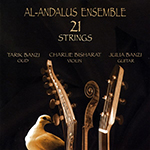 For once polar opposites were complementary. Though I still didn't agree with the involved cost or cosmetics, my ears couldn't deny the results. "If that's what it takes", they calmy whispered, "why belabour the point"? "Because I'm a cranky critic" was the reply.
Whilst still on my job description—with my own speakers and the hi-res Dutch DAC—in August 2025 Sung Jin's loom represented a loaded finely balanced scale of cable justice. The acid test without acid taste came in its complete removal. Returning to my prior status quo, Sung Jin's aural aesthetic was more materialized down to the soles. My loom felt more spiritualized up into the soul; if that speaks to you. Or call it comfort vs speed.
The album covers link to music tracks on YouTube including this opener "Afgano" by the Al-Andalus Ensemble from their album 21 Strings. The title refers to the formation of oud, guitar and violin and the number of strings this adds up to. It's purely acoustic very uncomplicated music of gorgeous timbres in the Moorish style where Northern Africa met Spain during the era of Al Andalus when Arabs, Christians and Jews lived in peaceful harmony on the Iberian peninsula and collaborated artistically. The mix of instrumental tonalities captured on this recording is something the Athenamuse loom materialized beautifully. Should the YouTube link not work in your region, you now have the album/artist names to pursue other sources. The other tracks are Antonio 'Maca' Ramos, Hotel Groove, "How low can you go"; the title track of Lynni Treekrem's Haugtussa; and "One goes there alone" from Jan Garbarek's In Praise of Dreams. And that's where this cable-wrangling session ends.