"All cables I sent burned in for about 200–300 hours." Curiously—or perhaps not?—the sonic shift from Athenamuse signal-cable loom vs. my resident headed for a bassier darker warmer softer climate. Ireland turned Spanish summer evening. With the Storgaard & Vestskov Gro speakers and a Cen.Grand DSDAC 1.0 Deluxe processing DSD256 resampled in Audirvana's A 7th-order modulator, I thought this change too much. Though macrodynamics were stout and textures chewy, my own tastes wished for more microdynamic jump, more upper harmonic resolution, more lucid treble insight. This Korean makeover was pretty and corpulent, sweet and billowy but too polite for my leanings. I wanted more adrenaline, grip, edge, focus and frisson. Having experienced that silly conflations—black heavy fat cables sound dark, thick and bassy—can at times tell correct time like a dead watch does twice a day, I decided on a hardware shuffle. Why not try to play more to my own aesthetic? Out with the Danish loaner speakers whose paralleled Curv® polypropylene-based 5-inch SEAS drivers both cover the same bandwidth to not be a 2½-way pairing but unusual 2-way. In with my resident Polish Qualio IQ 3-ways. Disconnect the DSD-über-alles Cen.Grand DAC to subtract its softer demeanour, more bronzed treble and reverb-weighted presentation. Put in its place the pure R2R so PCM Sonnet Pasithea which is keener on the leading edge and gossamer harmonic shifts. Whilst I did that, here's what Sam O who first hipped me to the brand…
… has to say about it on YouTube.








After my hardware shuffle I felt pleased with myself. As such incidents become rarer, I enjoyed the occasion. Whilst retaining the prior elements of sonority, weightiness and sheer scale which had already been attractive, the new hardware added proper top-end illumination and speed. One of my go-to artists for those qualities is flamenco guitarist Rafael Cortéz. Unlike the vast Spanish majority of his colleagues and the brilliant French outlier Juan Carmona, Rafael lives in and works out of Germany's industrial Ruhrgebiet. Try tracks #1 and #7 from his Cagiñi album for a deep dive into modern classical Flamenco at the highest technical virtuosity. Think immaculate rhythmic strut and swagger, exemplary control of each 16th note, gorgeous melodies, precisely weighted phrasing, blitzing arpeggios, finessed flourishes and a very crystallized tonality with glassy undertones. I find it a difficult mix of attributes to get right; a loaded hand to play to full advantage. In my new context, Sung Jin's loom managed all of these recorded aces in what I thought was ideal balance. It paid proper homage to the fiery crisp energetic elements but underpinned them with tonal fullness to correctly ground them. Acceleration and padded comfort like a classy family limo powered by a responsive turbo engine. Given this pairing and how I knew it would inform subsequent sessions, I was certain that our young cable wrangler could take my finish and consistency criticisms in stride. With mature sonics in the bag, cosmetic items and marketing needs of formal English website pages with how-to-buy interface seemed relatively trivial to sort.

For a primer on cable basics written by a measurement-savvy listener, read this Martin Colloms article in Stereophile. And here's a pertinent quote from his subsequent Kimber Kable review about a power cord: "… I worried that I would not be able to hear what I assumed would be a small difference. However, the change that resulted when I swapped the $2'000 PK10 in this circa £100'000 system wasn't trivial. I enjoyed the gain in transparency and image focus, the enlarged soundstage, improved rhythm and superior bass definition. I remain surprised that inanimate pieces such as terminated mains supply cable can exert such an influence in a highly tuned system. I do not wish to exaggerate but I have heard smaller gains than this when swapping in a new DAC that cost twice the price of the original design." Many find the power cord topic particularly mental. Their heads won't wrap around it. Yet in my experience, mains cables often make more of a difference than signal cables. For me the big equalizer is price. When a 1.5m cord like Athenamuse's best costs twice as much as my very good 250-watt class AB mono amps, many won't care if mains cables do exert a commensurate sonic influence. They choke over the whole notion. So do my wallet and mentality. It's not just down to percentages though Mr. Colloms' €2K cord in a €100K system feels less imbalanced than today's €6K cord on a sub €2K mono amp does which needed another such cord for the second mono.
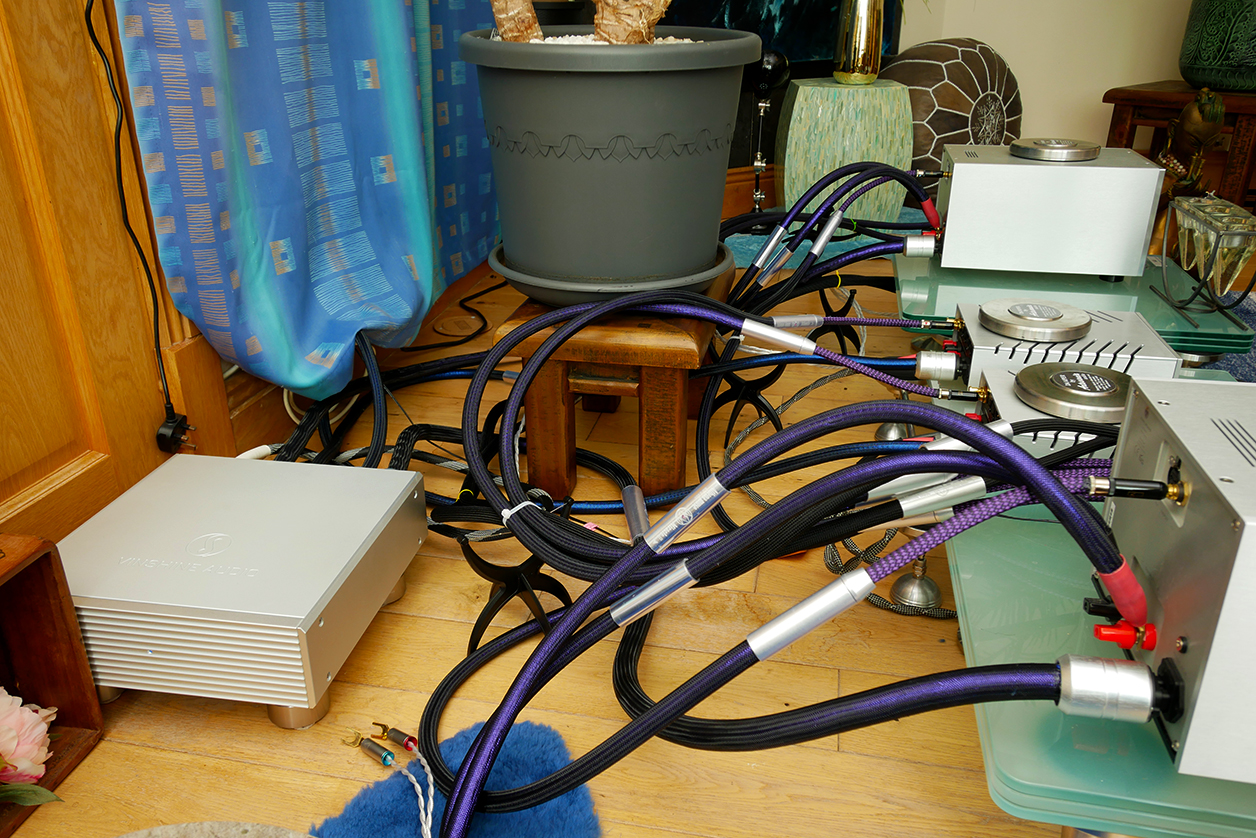 To install the Athenamuse quad of thick power cords meant moving the power filter to reduce bending needs.
It's also a matter of just what could one possibly put inside an audio cable to get so expensive? Of course if raw returns math were neutral, we wouldn't care where benefits originate. We'd only measure their significance against expense. Our math just isn't neutral. We apply deep distortion. We nurse clear preferences on where we're happy to shell out; and where we clam up like a bear trap. If we were open-minded, we'd have to concede that we're category racist. This must be exactly what all hifi cable makers battle. Many of us regard electronics and speakers as objects d'art imbued with totemic powers, even status. Meanwhile we treat the cables which make them sing—or not?—like fungus that feeds on pond scum. Spelled out, it's quite irrational. And yes, that was a partial movie line.