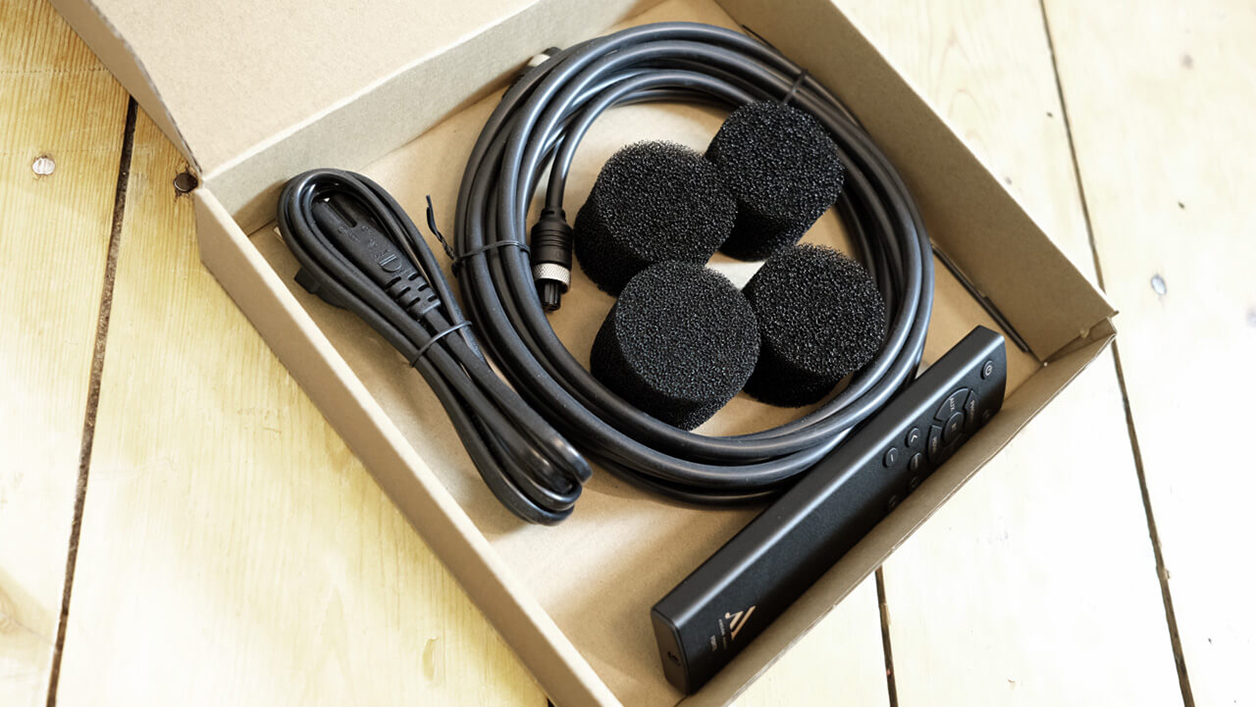
In practice. Remote control, adhesive feet, power cord then 3m 4-pole umbilical link master and slave together to get us started. The master is always the left channel and there's sadly no switch to invert that. The A55 comes with these foam bungs to tune its ports. Some audiophiles may miss spikes or threads for them. However, the A55 at least stands on an enlarged plinth covered with a textile material on the bottom to be less likely to topple. Be sure to experiment with power cords. There are high-quality options with figure-8 aka shaver plugs. I run an Audioquest NRG-Z2 for my desktop's Abacus C-Box 3. It generates more organic tone and a calmer milieu than its stock cord. I find a quality cord nearly obligatory particularly on the A55. The early representatives of my loaners betrayed slight background noise which didn't bother me even in the nearfield but leaves room for improvement. Ditto Chromecast with its brief interruptions. Then Bluetooth pairing didn't work with one of the three models. According to Argon, future updates should remedy this. With the update to Google Cast 2.0, dropouts should be a thing of the past.
The typical Argon Forte Wifi owner will probably use Spotify Connect. If you don't want to be without Qobuz or Tidal, you can use the DTS Play-Fi freeware. It also ropes in local files via UPnP. I never used this app before which includes multi-room use but was happy with its clear design and stability. But there's no gapless and impatient folks will be irritated that it takes more than a minute past power-on for the master box and app to shake hands over the network. Plus, .wav files won't display cover art. My following sound descriptions refer exclusively to streaming Qobuz over my local Melco N50-S38 server via the DTS app then a brief switch to analogue. But be sure to break in even such relatively inexpensive speakers sufficiently, ideally for a few days. The sound becomes more relaxed and pleasant.







First let's put the monitors through their desktop paces. Then we'll go to my regular listening room to work against a typical front wall with normal listening distances and, above all, let the A55 have its say. The A4 was characterized by good off-axis behaviour. We can move about without significant sonic skewing and it's not imperative to tilt the speakers precisely at our ears. In a direct A/B against my resident combo—active €990 Abacus C-Box 3 and €1'700 Keces S3 DAC—the €699/pr A4 rendered high female voice and strings less refined. My reference exhibits above-average talent for showing the ethereal auras of super-fine overtones more open and silkily. But the A4 didn't swallow up important detail. In fact they captured more subtle treble nuance than the stylish Elac Adsum. The A4 simply applies less magnification to miss the last few pixels of harmonic hint. Nevertheless, they do not sound dark or tame but concise. The A4 neither introduces artificial hardness nor exudes a particularly romantic soothing flair. Guitar chords appear a little more delicate and shimmering on the small Abacus. But like the highs, the Argons' mids are nicely grippy and not at all soft. Tonally the A4 favours body and the fundamental tones of vibrating strings that rise up from the bass but at the same time captures the crisp elements of guitar tone in the lower to mid treble. This seems to automatically soften the mids to ultimately create a certain loudness tuning. Vocals too seem a bit brighter due to a relative treble prominence depending on the singer's range without conveying the subtle overtone halo of the Abacus speakers. The A4 is primarily concerned with a catchy, appealing and somehow uncomplicated sound whose cheekiness won't be everyone's cuppa. What it had over the aforementioned Elac was resolution especially in the treble. HF seem comparatively more diffuse with the Elac. That on the other hand has a more linear neutral overall tonality. By the way, if you want the A4 a little smoother and less cheeky, switch to the analogue input to build in extra A/D conversion. That sounds softer and rounder, with the mids a bit more sonorous. The price to pay is a little loss of energy and HF definition.
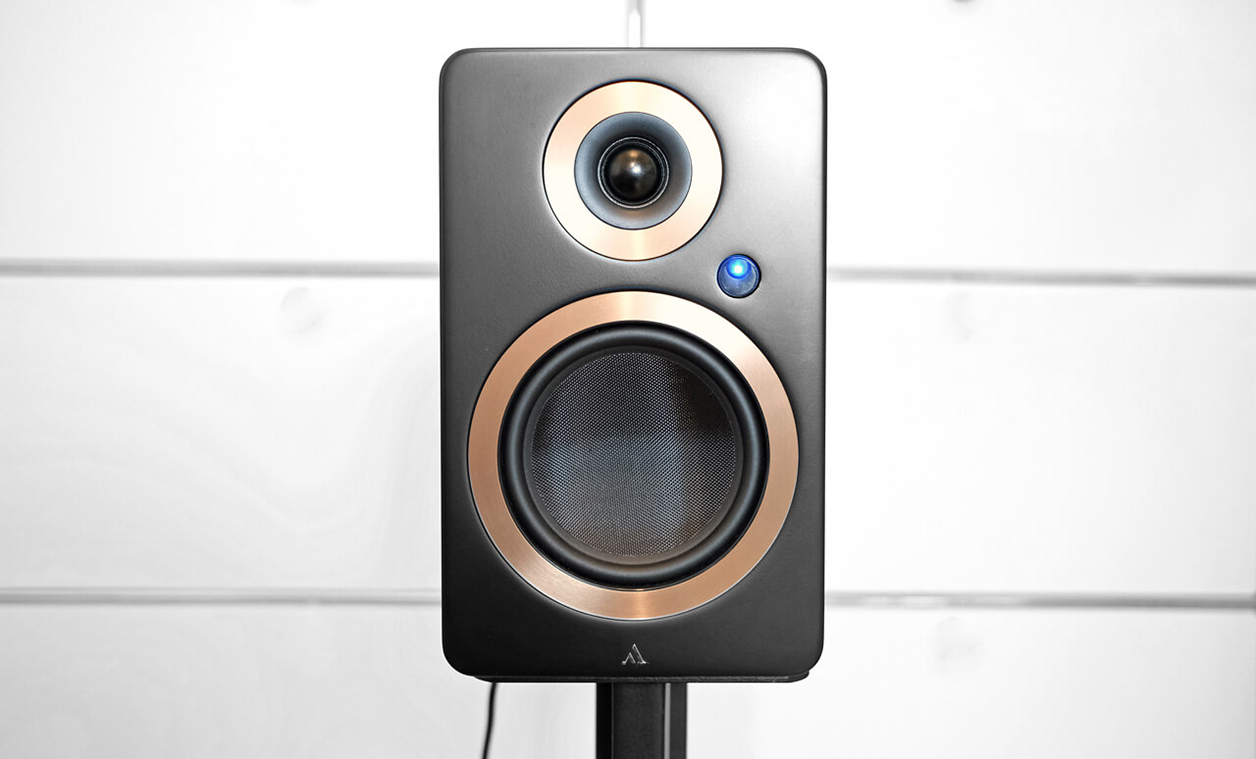
For bass I liked the smallest Argon quite a lot considering size and price. It exaggerates a bit but that's expected with such small DSP actives especially since the bass comes across as properly crisp if not bone dry so well contoured. And I can't pretend that I prefer the flatter slimmer Abacus C-Box 3 for pure musical enjoyment which becomes a different story for home studio use. If I were a designer, I too would probably equip such minis with a slight fundamental tone or bass boost especially when macrodynamic oomph benefits in tandem. Here the A4 has the edge over my C-Box 3 and delivers respectable impact for its class and size. Speaking of oomph, the A4 is just as impressive as the Elac Adsum although the latter is inferior on SPL stability. For the desktop's nearfield—remember how twice the distance equals half the SPL—the A4 is more than sufficient even for this passionate loud listener. So in addition to good just not maximally airy resolution, the SPL-stable bass as a successful compromise between pleasure and precision is one of the A4's best features. They are suitable for free-standing use bracketing a desktop but I generally prefer the more immersive spatiality of the actual nearfield. Here the A4 convince and I could immerse myself in the music on my desk without the Danes besting the Abacus which conveys more reverb and spatial information with more lucid harmonics and added plasticity. The latter also applies to the Audioengine 2+ (2019 model with USB-B socket) which however comes up noticeably short on bass authority and macrodynamic fettle.