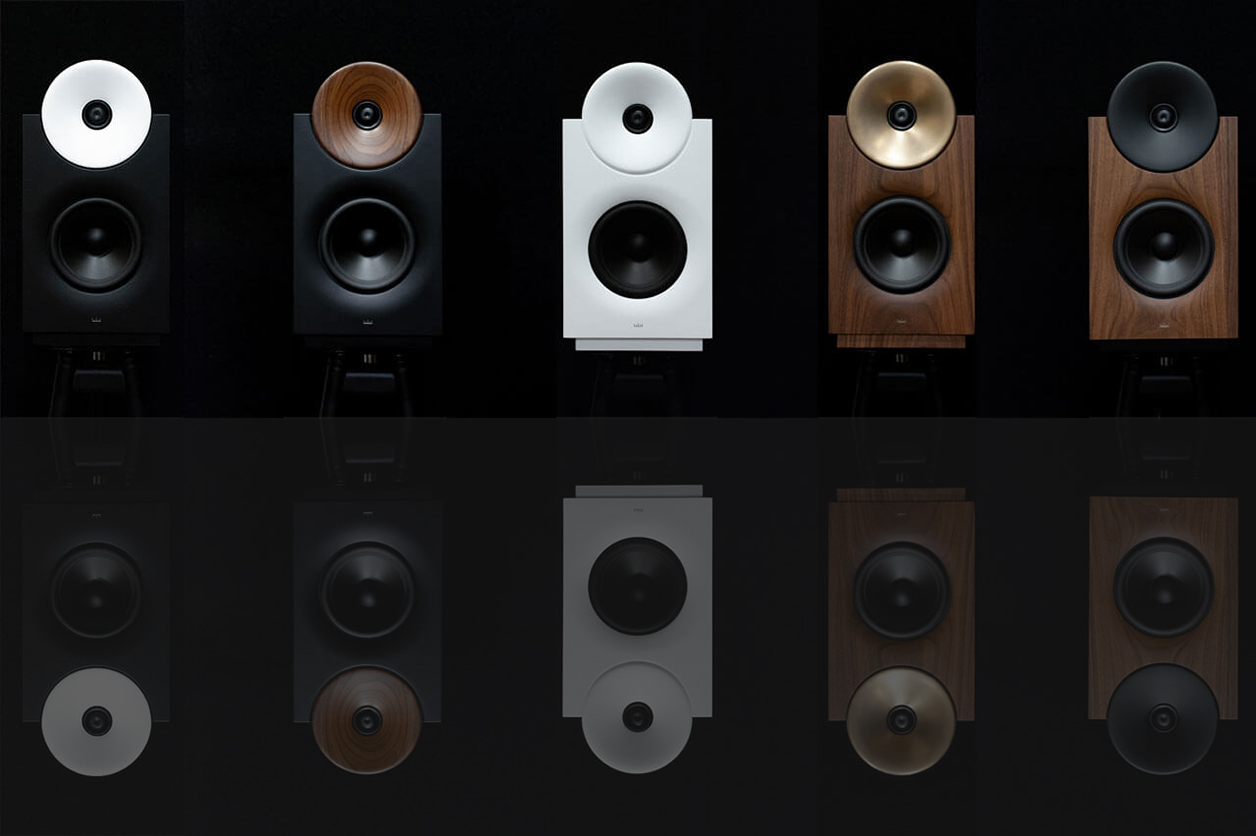
Setting them up required a few extra minutes though the Contra 100S sounded quite pleasing already set up rather casually. However, the soundstage size is highly dependent on toe-in. Straight out it remains of average width between the speakers, starting at their base line and lacking depth. But give the rear woofers some space from the front wall and toe in by 10-20° and you'll be rewarded with a panorama that extends well beyond the speakers’ outer edges. The imagery then starts slightly in front of them and extends nicely, albeit not with record-breaking depth into virtual space. Now sonic shapes defined sharply and pinned precisely to the stage. The monitors themselves no longer were localizable sound sources as ideally should be the case. The entire panoply of audible action enriched with a multitude of micro detail that can be captured with good equipment when recording in a seemingly quiet hall which really is aflutter with the many small noises of several people in the orchestra trying to be truly quiet – a breath, a page turned, the rustling of clothing. Many loudspeakers with clean imaging conceal such information. That’s a shame because it makes the presentation somewhat sterile. The Aretai on the other hand gave it more believability.
Now a word on ideal playmates. With small amplifiers like a Cambridge AXA35, the Aretai already performed very well though this would be a crass price mismatch unlikely to see itself repeated in the real world. And the Aretai do scale with every increase of power and authority. I spent most my time with an Electrocompaniet ECI 6DX MkII, Audio Analogue Puccini Anniversary and Accuphase E-4000, all first-class sparring partners priced in line with the speakers. Since these are very linear in the upper bass, Janis recommends relatively close wall placement to adjust the bass performance centimetre by centimetre to room and taste. The high frequencies presented with fascinating clarity and airiness. Although they were by no means subdued, they didn't cut, dissect or scream. Even though in my estimation the speaker's overall tuning exhibits a slight constant rise from the lower to the upper midrange, this primarily translates into astounding clarity and spaciousness. Aggressive sibilance is completely foreign to these Latvians.











 In Helmut Lachenmann's Contrakadenz [Stuttgart Radio Symphony Orchestra, Kairos] are all manner of sounds that make life difficult for an unsuspecting tweeter: various triangles, piccolo flutes, violin flageolet and my favourite, bowed cymbals. Depending on the cymbal, the results range from a guttural hum to an infernal screech, certainly nothing to please any refined treble maker. The intentionally high-pitched screech becomes unbearable if a speaker adds its own distortion. If you immediately chase your remote to turn things down, something is clearly wrong. The Contra 100S reproduced all of these sounds with exemplary naturalness, rendering the energy realistic and airy so free of additives or artificial intensity. Nothing felt harsh whilst SPL remained high. In the decay of cymbal overtones it was clear that the effort to achieve linearity up to 30’000Hz paid off. All manner of delicate high-frequency nuances floated effortlessly in my room, decaying slowly rather than cutting off prematurely. These tweeters don't just sound relaxed, they also perform their task with remarkable diligence. Such detail resolution combined with this ease is truly rare.
The absolute highlight of the Aretai Contra 100S was—and I'm confident saying so—the midrange. By sealed design, there are no port effects or crossover issues with the tweeter. This results in an exceptionally clean transparent midband the likes of which are rarely heard. Indeed, these small Aretai offer one of the best midrange performances on the market not just within their price range but far beyond. This extreme transparency presented without any harshness allows one to delve deeply into complex musical scores. The prelude to Richard Wagner's Tristan und Isolde is an excellent example of polyphonic orchestration where various voices pursue their lines simultaneously whilst creating a coherent whole. After the first familiar chords, a sustained line emerges in the high strings gradually joined by other sections which initially remain harmonically subordinate and merely accompany but over time contribute their own elements. From a melody with accompanying harmonies the music grows into a multi-layered tapestry in which the listener can easily get lost. A Harbeth Super HL5 Plus for instance focuses on the mix, the overall sound. The main voice is supported by the others, keeping the listener's attention on the central line. Of course the other voices can still be heard if one concentrates but the Aretai took a completely different approach. Like an exploded diagram, the paths and intricacies of all parts laid bare, allowing me to walk through the music almost as if through a virtual 3D projection. Fortunately this meticulousness remained in service of the music. Breath was preserved, the accounting aspect absent. Here you notice the difference in class which correlates with the price.