To quote another preview of an inbound inline Furutech AC noise filter, "whenever our system noise floor drops even a bit, signal portions previously just masked emerge. They now rise above the noise floor like fast-growing dandelions after a lawn mow. What are some of the most low-level signals which our better recordings contain? There are venue reflections whose decay delays contain information on the size of the venue and which also create connective tissue between individual images like intersecting halos. Hearing more of this spiderwebby stuff between, around and behind instruments and voices enhances the aural 3D perception and how specific depth layering becomes. Maximally compressed wall-of-sound productions benefit the least from such gains. Then there are the uppermost harmonics which occur at four or more octaves above their fundamentals at ever more homeopathic doses. Overtone distribution creates timbre differentiation, microdynamic performer adjustments modulate overtone weighting. Gains in this domain lead to more tone variety and better tracking of how dynamic expressions alter tone. In short, a lower noise floor reveals more recorded space and higher timbre specificity. More 3D, more textures. Another takeaway is that instinctive volume hikes—we compensate for a poor S/NR by playing loud so even the weakest signal portions rise above—become less and less necessary. The better our S/NR, the less need to play loud just to hear everything. When background levels can fully engage and hold our attention because tone doesn't wash out and 3D doesn't flatten, we create less listening fatigue. That means deeper longer sessions. We also cause less sound leakage into adjoining rooms or apartments. We get to indulge our hobby earlier in the day and later into the evening without upsetting co-dwellers and neighbours. Whittling away at our system's noise floor has sonic and social benefits. It makes playback more civilized and sophisticated, less primitive and basic."
 Brothers in noise-busting arms, one silver, one black.
"Yet mind the phrase 'whittling away'. Noise reduction seems to be a 20-round match. Multiple devices even from competing brands proposing different tech and theories tend to complement each other. I think that none of them are sufficiently broadband and powerful to become a one 'n' done deal. They seem to operate across different bandwidth. Then consider different sources of noise. There's the AC entering from the wall possibly through multiple outlets which looks back at all manner of water/sewage pumps and motors in our own refrigerator, washing machine, dryer, heater, aircon, solar panels. There are SMPS in our TV, telecom kit and LED lighting. There are the power supplies in our hif gear which radiate noise back into our system's AC loom, its ground and its cabling. There's all of it a house over from us and beyond; or in flats above and below ours in the same building. There might be car-charging stations on our road. There's airborne EMI/RF noise that attacks cable shields which are rendered imperfect by bends. It attacks unused open hifi sockets which become ingress points for their circuitry. Against this bigger picture it feels sensible that different types of noise filters should be effective in massive parallel even series. And my own experience does suggest that noise filters indeed are additive. More of them do more. Ad infinitum? I haven't lived long enough to answer that." For more on how Akiko Audio view it, there's this interview. Meanwhile reader Michael F. had this: "I'm not familiar with any of the Akiko Corelli stuff but I've always loved this quote from the 19th century novelist Marie Corelli: "What a fool cannot learn he laughs at, thinking that by his laughter he shows superiority instead of latent idiocy."












 On a just 16cm² footprint 10.5cm tall but ¾kg on the scale, Castello Solo henceforth simply CS feels disproportionately heavy. Whatever exactly fills it up solid without any rain-stick swish clearly is no floobydust. The demure black enclosure with the oval brand sticker makes it the quintessential black box. Its innards are mysterious, perhaps even its precise MO. But for a black box, that's by definition. "In science, computing and engineering, a black box is a system which can be viewed in terms of its i/o or transfer characteristics without any knowledge of its internal workings. Its implementation is opaque hence black. The term can be used to refer to many inner workings such as those of a transistor, engine, algorithm, government or human brain. The opposite of a black box is a system whose inner components or logic are available for inspection to most commonly be referred to as a white, clear or glass box."
Black and white hats. Green, red, yellow and purple tomatoes. As with that lot, the proof is in the eating. Use. Observe. Then have an opinion. Let's avoid that other Castello's not so latent idiocy which ridicules from the safe distance of a cosy armchair. With its terminal accepting of spades and bananas, do Akiko recommend or advise against using normal spade-terminated jumpers to leash Solo to power distributors with a ground post, even components with one?
"Thanks for the question. Despite us having developed Castello Solo for Corelli, you can certainly experiment with other devices. Many of our clients have and some even connect Solo to their home's central breaker box. It is a very versatile design." To reiterate this point, CS happily takes your money to colour outside the lines of its stablemate. It bolts onto ground posts of kit other than Akiko's own.
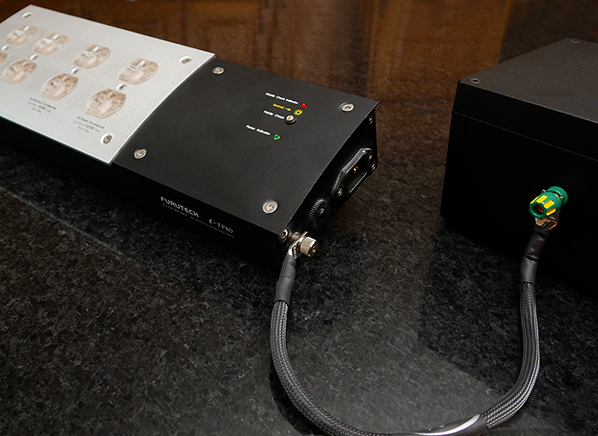
At right I mocked up such an off-brand pairing with an older Furutech power strip. From Stenheim's Jean-Pascal Panchard on their new chassis ground terminals: "In recent years, more and more high-end electronics manufacturers have been investigating the use of virtual grounding systems which don't connect to the mains power supply. We too have conducted promising tests in which we connected our aluminium speaker cabinets to such virtual grounding systems. The results are convincing: a noticeable reduction in background noise, improved separation between instruments and spatial resolution lead to a more natural and immersive listening experience. Therefore, all new speaker models in our Alumine Five, SE and SX series will now equip with a chassis ground post that internally connects to several important points in their enclosure to achieve optimal effects."
 Vibex DC filter fronting Furutech GTO 2D NCF beneath source stack keeps the transformers of the Cen.Grand duo dead quiet on ~245VAC. Without it they hum a bit.
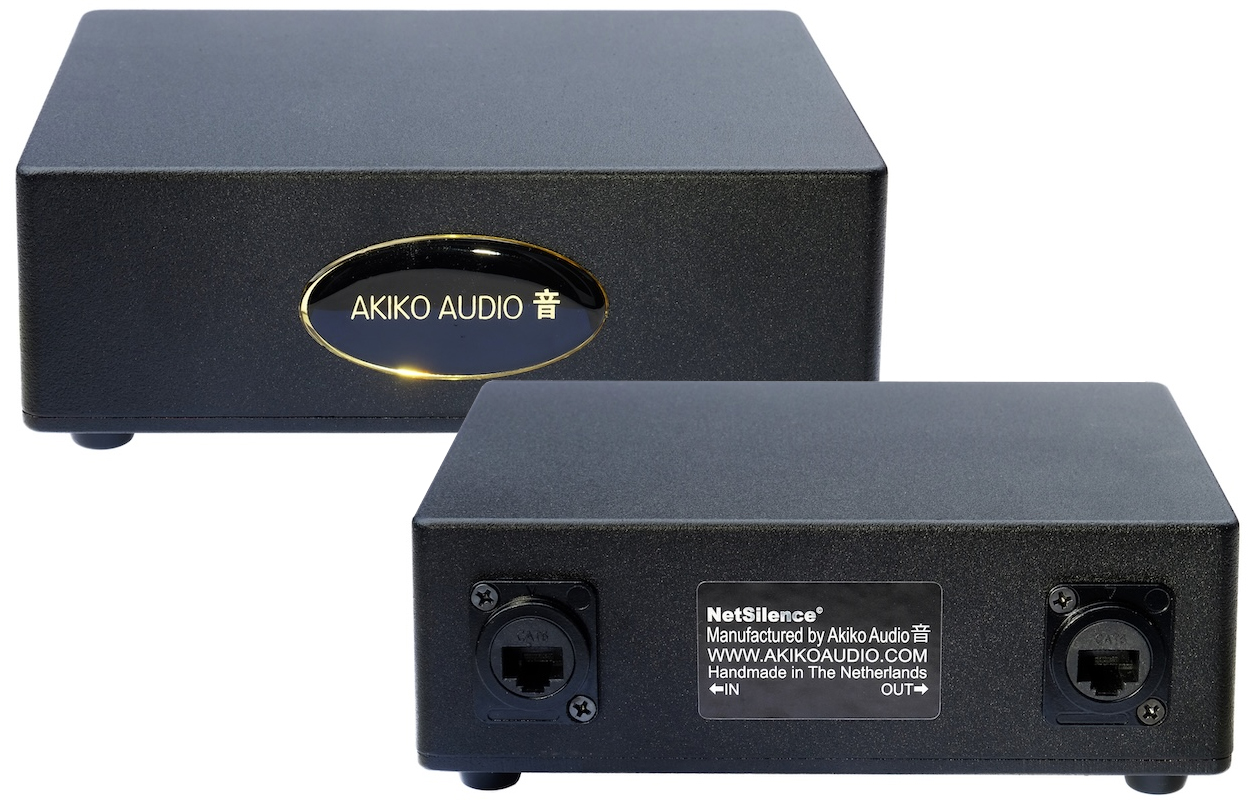
Right at this juncture news of Akiko's NetSilence dropped. That's a €995 purely passive RJ45 i/o inline Ethernet filter. Whilst the brand has strapped their undisclosed crystalline compound to signal cables before via their velcro'd Stick, is this model first to actually run digital signal through it? As with CS, our designer remains vague about details to protect his IP. Why educate copycats? It's why many inventors in this sector don't pursue patents. To be granted one requires sufficient disclosure of the invention to distinguish itself from prior art to even be considered. That gives competitors information they wouldn't have without the patent. Keeping schtum is more effective. It also saves on the costs of the patent application plus the potential high costs of having to enforce a patent in international courts. After all, a patent only protects if one actively pursues all infringements. Many smaller operators just don't find it worth the hassle. And, if you look like a black box, behaving as one is perfectly consistent.