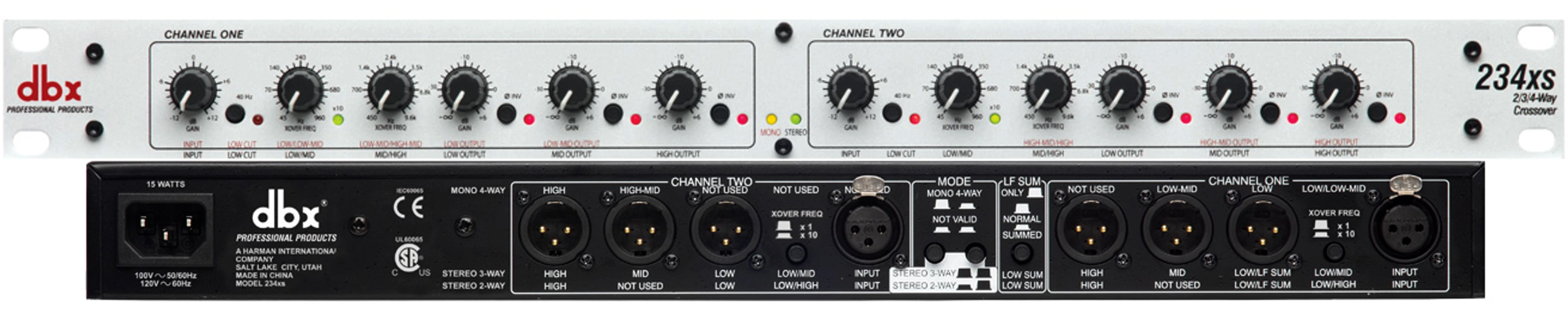
 The writing on the rear splits into three lines: mono 4-way use on top, stereo 3-way use in the middle, our stereo 2-way mode on the bottom—all rather self-explanatory.
Fellow stereo 2.1/2.2 detectorists have heard the siren call of active crossovers yet are unwilling to drop ~€3.4K on an spl, roughly half that on a Behringer or even half that again on a balanced Sublime. At just ~€250—handled by Gear4music.ie here in Eire—comes in a lowrider from Harman Int.'s¹ dbx. It means seriously cost-effective Chinese manufacture. It does what its name says: work as 2/3-way stereo or 4-way mono electronic crossover. We're only interested in the 2-way partition: LF below our filter frequency routes to one or two subs; everything above to our mains now unloaded of bass duties. The divider is always a correctly phase-summing 4th-order so 24dB/octave Linkwitz-Riley function. Our handover hinge can sit anywhere from 45Hz-960Hz. There's adjustable front-panel gain for each channel of the high/low-pass halves. We can sum our bass feed to mono. We won't use the 2nd-order 40Hz low cut. Since pros don't do silly RCA, i/o are XLR only. Our 2-way mode must set via two rear-panel buttons. This disables controls we'd only use in 3-way mode. Output impedance is a nicely low 60Ω, power consumption 15W. There's a green LED; plus two reds if we add unlikely phase inversion. Once we fix relative gain between sub/s and mains and our final frequency split, we leave the lot alone. Let's revisit a key benefit of actively crossing over beyond just unloading smaller mains. We get to set our transition well beyond their native roll-off. Just because a smaller ported monitor hits 45Hz/-3dB doesn't imply not playing cleaner when crossed at, say 90Hz. This bypasses its ringy port tuning and unloads a mid/woofer of another octave's stress. It nets us a fourfold reduction of stroke and related distortion. If we merely tack on a sub, we still run our mains wide open. It forces us to sleeve the sub in where they fade out—45Hz. What if a 120Hz transition is better because the sub has superior command of the upper bass than the mains' mid/woofers? An active adjustable high pass facilitates many such experiments without a passive filter's big caps and coils. That said, there certainly are execution layers, levels and leagues to active filters just as there are for other audio circuits. Where does this one fall; and does it fall as in fail; or for its small coin can be a credible home-audio problem solver? It's 48.3×17.5×4.4cm WxDxH and 1.8kg. With the rack ears integral, we exceed standard 43cm home width by ~5cm. We also get a linear power transformer hence fixed 120/240V designation; and an input gain pot we'll probably set at 0 to bypass. Whilst the sun dial's wide sweep of the frequency adjuster doesn't calibrate finely, it executes our lo/hi-pass turnover in lockstep. Whether our position between the clear 75Hz and 140Hz markers ends up at exactly 80Hz for example rather than 82Hz or 83Hz should be immaterial. We'll be symmetrical regardless. If we want six precise values between 50-120Hz, there's the €3'400 spl. My Gradient Box II units turn to equivalent belly sliders. The Sublime runs fixed cards. Each value change means swapping two cc-sized vertical boards. With dbx it's one continuous twirl. With dbx we cheap out. Something has to give. The pertinent question is, how much give for so little take?
____________________
¹ Now a part of Samsung Electronics, Harman's other professional brands are AKG, AMX, BSS, Crown, Flux, JBL, Lexicon, Martin and soundcraft. dbx Inc. launched in 1971 in Massachusetts. Harman acquired them in the late 1980s whilst itself being absorbed by Samsung in 2017 for a cash deal valued at ~$8'000'000'000.
Whilst contemplating potential outcomes, the hifi deities amused themselves with a game of take. The gear4music terminal showed that my sample had promptly shipped. The dpd terminal kept insisting that they'd received the pickup order but no goods. Phoning the seller, I was promised a same-day call back with an update. When that didn't happen, I called the next morning. I was promised the same only to hear nada again. I called back that evening to be told that they were still awaiting dpd's reply. Three-way communications ping pong. A week later I learnt that dpd had returned my parcel to the seller who rather than reissue it cancelled my order with a refund. I could take a hint. Clearly my hifi deities had other ideas. So this planned review turned mere proof of life. If you're happy to take a punt on it, let me know what you thought and for the benefit of our hifi community, I'll add your findings here…