
Country of Origin

Reviewer: Srajan Ebaen
Financial interests: click here
 Main system: Sources: Retina 5K 27" iMac (i5, 256GB SSD, 40GB RAM, Tahoe 26), 4TB external SSD with Thunderbolt 3, Audirvana Studio, Qobuz Sublime, Gustard U26 USB bridge, LHY Audio SW-8 & SW-6 switch, Sonnet Pasithea; Preamp: Hattor Audio ARP-S; Active filter: spl Audio Crossover MkII; Power amplifiers: Vinshine/Kinki Dazzle & Audiophonics NCx500 on subwoofer; Loudspeakers: Qualio IQ [on loan]; Subwoofer: sound|kaos D15; Cables: Exact Express Flame, Furutech; Power delivery: 2 x Kinki/Vinshine Tai Hang on amps and source stack, Furutech DPS-4.1 between wall and conditioners; Equipment rack: Artesanía Audio Exoteryc double-wide 3-tier with optional glass shelves, Exoteryc amp stands; Sundry accessories: Acoustic System resonators, AudioQuest FogLifters; Room: 6 x 8m with open door behind listening seat; Room treatment: 2 x PSI Audio AVAA C214 active bass traps
1st upstairs speaker system: Source: Shanling EM7 into Soundaware D300Ref SD transport to Cen.Grand DSDAC 1.0 Deluxe with POW; Preamp/filter: Lifesaver Audio iCon 4SE & Gradient Box 2; Amplifier: Kinki Studio EX-B7 monos; Loudspeakers: sound|kaos Vox3awf; Subwoofer: sound|kaos D12 on twin Nord Acoustic NC500 monos; Cable loom: Exact Express Earth; Power delivery: Vibex Granada/Alhambra, Akiko Audio Corelli Corundum & Castello Solo; Equipment rack: Hifistay Mythology Transform X-Frame [on extended loan]; Sundry accessories: Furutech cable lifts, Furutech NFC Clear Lines; Room: ~3.5 x 8m
1st upstairs headfi system: DAC: Cen.Grand DSDAC 1.0 Deluxe with POW; Headamp: Cen.Grand Silver Fox; Headphones: Raal 1995 Magna, HifiMan Susvara
Desktop system: Source: HP Z2 workstation Win11/64; USB isolator: LHY UIP; LAN distributors: LHY AS6 Pro & SW6-SFP; Ethernet reclocker: Stack SmoothLAN; DACs: Gustard R26II & U26; Preamp: Topping A900; Speaker amps: Topping B200 monos; Loudspeakers: Virtual Hifi Viper; Headphones: Final D-8000, aune SR7000, FiiO FT7, HifiMan Susvara Unveiled
2nd upstairs headfi system: Shanling EM5; Headphones: Meze 109 Pro, HifiMan HE1000 Unveiled
2nd upstairs speaker system: Source: smsl PL200T CD transport; DAC: Shanling EM5 w. 1TB microSD; Crossover: Lifesaver Audio Gradient Box II; Amplifiers: LAIV Crescendo Chorus; Loudspeakers: MonAcoustic SuperMon Mini with Dynaudio S18 subwoofer
2-channel video system: Source: Oppo BDP-105; All-in-One: Gold Note IS-1000 Deluxe; Loudspeakers: ModalAkustik MusikBoxx; Subwoofer: 2 x Zu Method; Power delivery: Furutech eTP-8, Room: ~6x4m
Review component retail: €TBA
 |
 |
 |
 |
 |
 |
 In Sanskrit, tirtha is a ford or river crossing.
Crossing over. Today isn't about classical musicians taking on film scores, Astor Piazzolla or other popular repertoire. Today is about interleaving one or two subs with a pair of speakers. The bridge which our mains and sub/s will cross to meet in the middle of is an active analogue crossover. For the most common filter hinges and to keep things discrete not variable state, we want 40, 60, 80, 100 and 120Hz. For the slope and best phase summing, we specify Linkwitz-Riley 4th-order. On RCA or XLR, we enter this line-level device once our signal has cleared wherever we control our system volume. That could be a variable source or preamp. Our crossover follows right after. On RCA or XLR, we then exit it two ways: via high pass to our speaker amplifier/s; via low pass to our sub/s. As a device without voltage gain, we also want a 0 to minus 20dB attenuator on each exit. It's how we compensate for sensitivity differences between speakers and sub/s; and voltage-gain offsets between their amps. If our sub plays too loud, we cut the low-pass signal feeding it. If the speakers do, we cut them. Easy. It sets our correct relative balance between bass and rest. The master volume remains with our current device. We'd ideally control our xover frequency from the seat so by remote. Ditto the attenuators. We also want a display to confirm our settings. Done? If you knew where to send me for such a device, we would be.
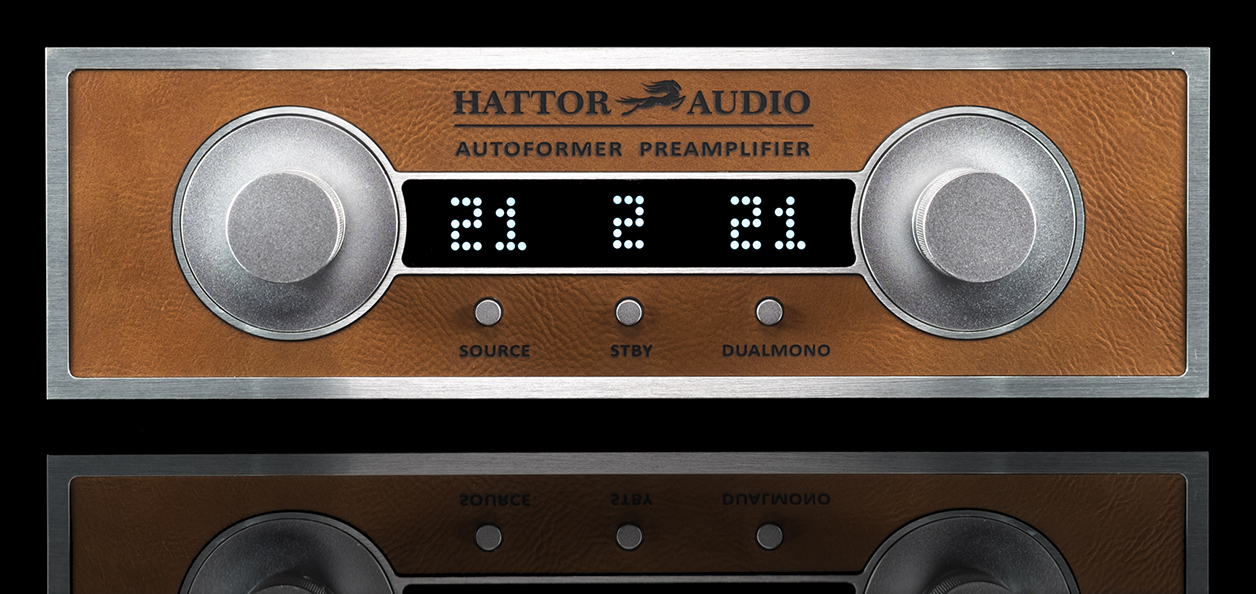 Photo by Dawid Grzyb.
As it happened, I knew just the man who could build it; if he was willing: Arek Kallas of Hattor Audio. He is the Polish maker of my fully balanced quad autoformer passive-magnetic preamp above. When I asked him, I learnt that he'd already designed such a thing, albeit in more complex 4-way guise. All I wanted was a simple 2-way version—no input selector, no phase switch, no mono summing. If he could make the hi/lo-pass frequency selection discrete, perfect. If they switched in sync, fine too. Ditto if my two attenuators couldn't integrate remote access to become manual rotaries. Arek signed off on my wish list then quoted a price. The project was afoot. Other than self gratification, I felt that I couldn't possibly be all alone in belabouring the very narrow choices we have in our space for such devices. The main current options are Sublime, Marchand, spl and Wilson. Adding a quality alternative from the man behind Khozmo attenuators and Hattor turnkey kit seemed like a splendid idea—and perhaps not just for yours truly. Now hear we are. Let's briefly index the rationale for such a device.
♦ it applies mirror-imaged filter slopes for perfect amplitude continuity between speakers and sub/s.
♦ if lo/hi-pass frequencies select discretely, it can strategically diminish a room mode (a 70Hz resonant peak for example could apply a 60Hz low pass and 80Hz high pass).
♦ it unloads the speakers from seeing thus responding to low even mid and some upper bass to play with less distortion and greater dynamic enthusiasm.
♦ with a sub or two fielding the bass, our speakers can be compact. They mustn't reach much lower than 80Hz in fact.
♦ it allows a higher transition point than running speakers wide open. That can exploit greater cone surface in the sub for musically more demanding bands.
♦ being analog, it suffers no DSP latency like conventional plate-amp electronics. It makes for cleaner time-domain performance.
These were six benefits. There are more. Back on usage, with active subs we now bypass their built-in crossovers. Some sport a separate LFE input. Using that accomplishes the same thing. If we position our sub equidistant from the chair like the speakers—we ought to for proper time alignment!—we'll bypass its phase control too. Our external filter type already insures correct phase summing. As to purist notions on stereo bass, AI reminds us. Whilst there's no official figure for an industry-wide percentage of music recorded in mono below ~130Hz, "the vast majority of commercial music intentionally does sum its low frequencies to mono. Mixing engineers mono the low end so that kick drums and sub-bass translate cleanly across club sound systems, mobile phones, Bluetooth speakers and vinyl records, preventing phase cancellation where left and right signals fight and weaken or cancel each other out". Having experimented with twin vs single subs, three of my four sub-assisted systems run a single subwoofer. I have a considered opinion on the matter. Ditto for folded-dipole aka RiPol subs being best in acoustically untreated rooms. But that's a matter much covered in these pages already so here just mentioned in passing.
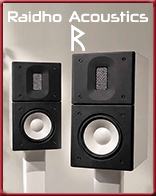








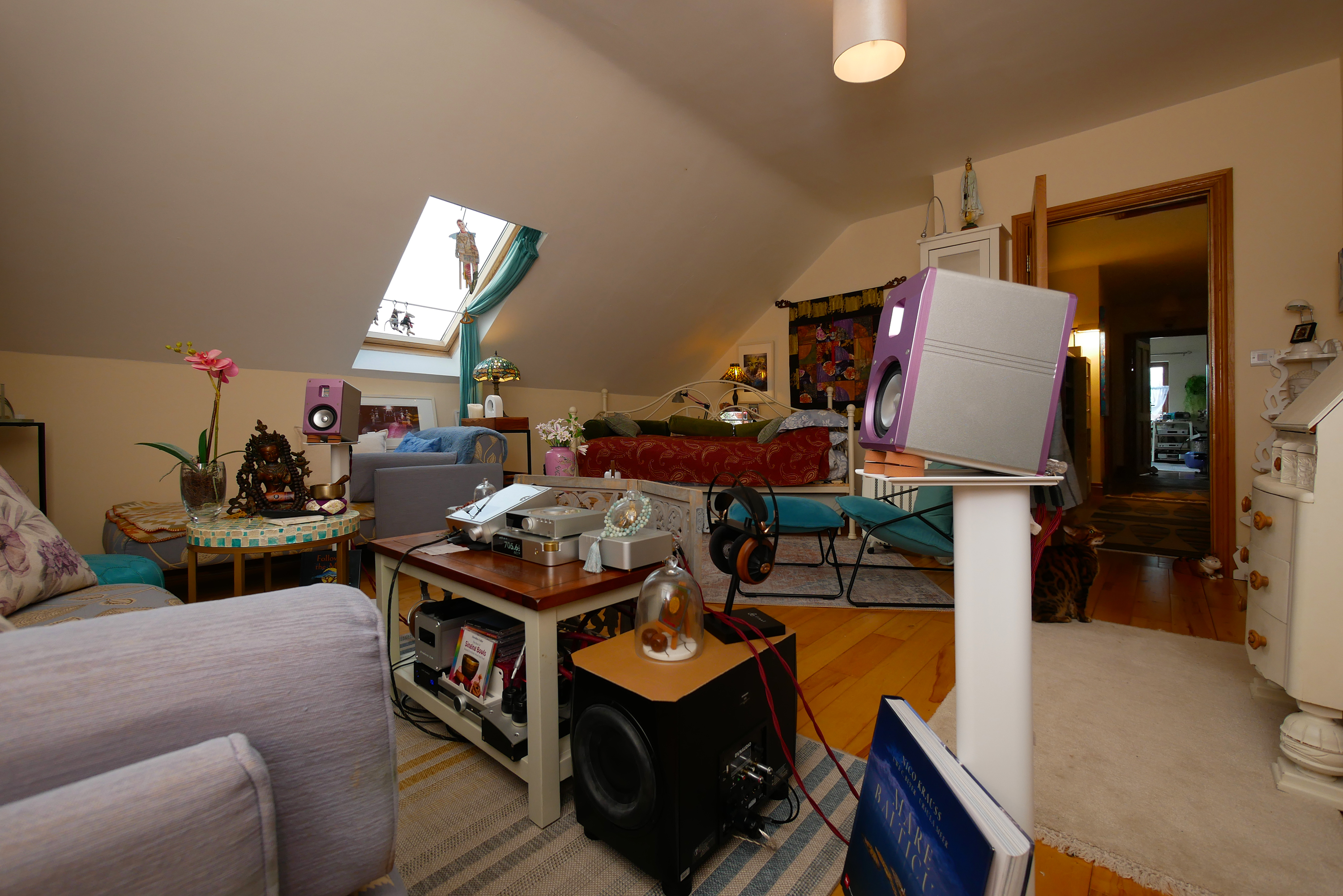
With pictures being worthier than words, here are two examples for how active bass can shrink our speakers, work in smaller rooms but still give us clean 25Hz performance beyond reach of bigger passive speakers under the same untreated conditions.
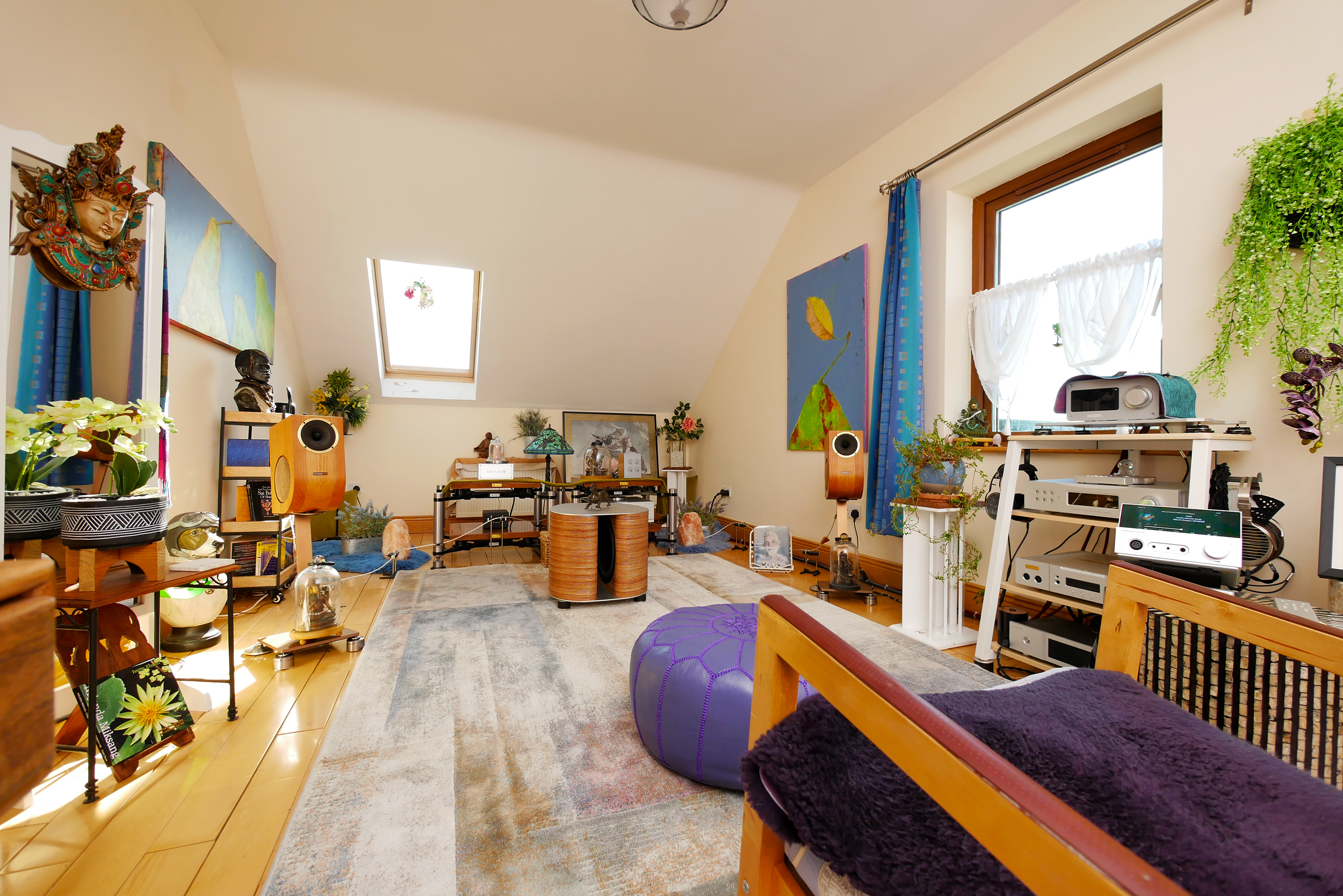
In this inverted nearfield system at the other end of the upstairs hallway, anything much bigger would flatly not work. As always, the right tool does a proper job.
With today's bridge expected ~March 2027, stereo 2.1/2.2 fans could have a new tool to do a superior job of the involved traffic routing? For now, the name Tirtha is just a placeholder. I don't know what Arek will call the device once it's done. After all, his native language is Polish not Sanskrit…
… to be continued…

Hattor Audio website
