
Country of Origin

Reviewer: Srajan Ebaen
Financial interests: click here
 Main system: Sources: Retina 5K 27" iMac (i5, 256GB SSD, 40GB RAM, Tahoe 26), 4TB external SSD with Thunderbolt 3, Audirvana Studio, Qobuz Sublime, Gustard U26 USB bridge, LHY Audio SW-8 & SW-6 switch, Sonnet Pasithea; Preamp: Hattor Audio ARP-S; Active filter: spl Audio Crossover MkII; Power amplifiers: Vinshine/Kinki Dazzle & Audiophonics NCx500 on subwoofer; Loudspeakers: Qualio IQ [on loan]; Subwoofer: sound|kaos D15; Cables: Exact Express Flame, Furutech; Power delivery: 2 x Kinki/Vinshine Tai Hang on amps and source stack, Furutech DPS-4.1 between wall and conditioners; Equipment rack: Artesanía Audio Exoteryc double-wide 3-tier with optional glass shelves, Exoteryc amp stands; Sundry accessories: Acoustic System resonators, AudioQuest FogLifters; Room: 6 x 8m with open door behind listening seat; Room treatment: 2 x PSI Audio AVAA C214 active bass traps
1st upstairs speaker system: Source: Shanling EM7 into Soundaware D300Ref SD transport to Cen.Grand DSDAC 1.0 Deluxe with POW; Preamp/filter: Lifesaver Audio iCon 4SE & Gradient Box 2; Amplifier: Kinki Studio EX-B7 monos; Loudspeakers: sound|kaos Vox3awf; Subwoofer: sound|kaos D12 on twin Nord Acoustic NC500 monos; Cable loom: Exact Express Earth; Power delivery: Vibex Granada/Alhambra, Akiko Audio Corelli Corundum & Castello Solo; Equipment rack: Hifistay Mythology Transform X-Frame [on extended loan]; Sundry accessories: Furutech cable lifts, Furutech NFC Clear Lines; Room: ~3.5 x 8m
1st upstairs headfi system: DAC: Cen.Grand DSDAC 1.0 Deluxe with POW; Headamp: Cen.Grand Silver Fox; Headphones: Raal 1995 Magna, HifiMan Susvara
Desktop system: Source: HP Z2 workstation Win11/64; USB isolator: LHY UIP; LAN distributors: LHY AS6 Pro & SW6-SFP; Ethernet reclocker: Stack SmoothLAN; DACs: Gustard R26II & Audalytic DR70; Preamp: Topping A900; Speaker amps: Topping B200 monos; Headphone amp: Enleum AMP-23R; Loudspeakers: Virtual Hifi Viper; Headphones: Final D-8000, aune SR7000, FiiO FT7, HifiMan Susvara Unveiled
2nd upstairs headfi system: Shanling EM5; Headphones: Meze 109 Pro, Fiio FT3, HifiMan HE1000 Unveiled
2nd upstairs speaker system: Source: smsl PL200T CD transport; DAC: Shanling EM7 w. 1TB microSD; Crossover: Lifesaver Audio Gradient Box II; Amplifiers: LAIV Crescendo Chorus monos; Loudspeakers: MonAcoustic SuperMon Mini with Dynaudio S18 subwoofer
2-channel video system: Source: Oppo BDP-105; All-in-One: Gold Note IS-1000 Deluxe; Loudspeakers: ModalAkustik MusikBoxx; Subwoofer: 2 x Zu Mission; Power delivery: Furutech eTP-8, Room: ~6x4m
Review component retail in Ireland: €257.50 delivered
 |
 |
 |
 |
 |
 |
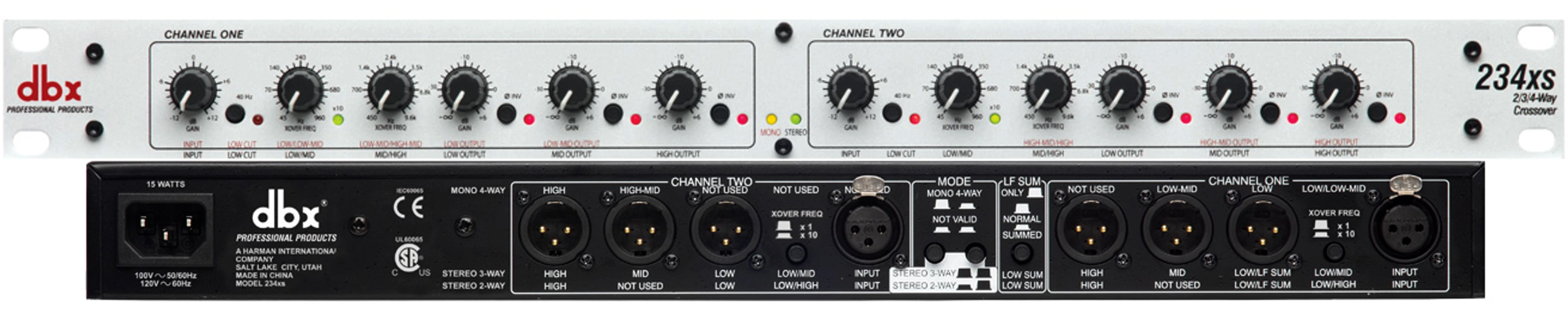 The writing on the rear splits into three lines: mono 4-way use on top, stereo 3-way use in the middle, our stereo 2-way mode on the bottom—all rather self-explanatory.
Taking one for the team. It reads more selfless than feh nosiness. Let's go selfless for pending sainthood. Who would today's team even be? Fellow stereo 2.1/2.2 detectorists. They've heard the siren call of active crossovers yet are unwilling to drop ~€3.4K on an spl, roughly half that on a Behringer or even half that again on a balanced Sublime. At just ~€250—handled by Gear4music.ie here in Eire—comes in today's lowrider from Harman Int.'s¹ dbx. It means seriously cost-effective Chinese manufacture. It does what its name says: work as 2/3-way stereo or 4-way mono electronic crossover. We're only interested in the 2-way partition: LF below our filter frequency routes to one or two subs; everything above to our mains now unloaded of bass duties. The divider is always a correctly phase-summing 4th-order so 24dB/octave Linkwitz-Riley function. Our handover hinge can sit anywhere from 45Hz-960Hz. There's adjustable front-panel gain for each channel of the high/low-pass halves. We can sum our bass feed to mono. We won't use the 2nd-order 40Hz low cut. Since pros don't do silly RCA, i/o are XLR only. Our 2-way mode must set via two rear-panel buttons. This disables controls we'd only use in 3-way mode. Output impedance is a nicely low 60Ω, power consumption 15W. Being used to the fabulous spl Crossover MkII in my main rig and two equally pure no-longer-made Lifesaver Audio Gradient Box II in smaller upstairs systems, I was in good nick to scratch one itch: are the 234xs' pro origins and low price unfit for home hifi because they compromise our speaker signal; good enough to serve as stop gap; good enough, period? Either way there's a green LED; plus two reds if we add unlikely phase inversion. Once we fix relative gain between sub/s and mains and our final frequency split, we leave the lot alone. Let's revisit the second benefit of actively crossing over beyond just unloading smaller mains. We get to set our transition well beyond their native roll-off. Just because a smaller ported monitor hits 45Hz/-3dB doesn't imply not playing cleaner when crossed at, say 90Hz. This bypasses its ringy port tuning and unloads a mid/woofer of another octave's stress. It nets us a fourfold reduction of stroke and related distortion. If we merely tack on a sub, we still run our mains wide open. It forces us to sleeve the sub in where they fade out—45Hz. What if a 120Hz transition is better because the sub has superior command of the upper bass than the mains' mid/woofers? An active adjustable high pass facilitates many such experiments without a passive filter's big caps and coils. That said, there certainly are execution layers, levels and leagues to active filters just as there are for other audio circuits. Where does this one fall; and does it fall as in fail; or for its small coin can be a credible home-audio problem solver? It's 48.3×17.5×4.4cm WxDxH and 1.8kg. With the rack ears integral, we exceed standard 43cm home width by ~5cm. We also get a linear power transformer hence fixed 120/240V designation; and an input gain pot we'll probably set at 0 to bypass. Whilst the sun dial's wide sweep of the frequency adjuster doesn't calibrate finely, it executes our lo/hi-pass turnover in lockstep. Whether our position between the clear 75Hz and 140Hz markers ends up at exactly 80Hz for example rather than 82Hz or 83Hz should be immaterial. We'll be symmetrical regardless. If we want six precise values between 50-120Hz, there's the €3'400 spl. My Gradient Box II units turn to equivalent belly sliders. The Sublime runs fixed cards. Each value change means swapping two cc-sized vertical boards. With dbx it's one continuous twirl. Today we cheap out. Something has to give. The pertinent question is, how much give for so little take?
____________________
¹ Now a part of Samsung Electronics, Harman's other professional brands are AKG, AMX, BSS, Crown, Flux, JBL, Lexicon, Martin and soundcraft. dbx Inc. launched in 1971 in Massachusetts. Harman acquired them in the late 1980s whilst itself being absorbed by Samsung in 2017 for a cash deal valued at ~$8'000'000'000.










… to be continued…

dbx website
