

Country of Origin

Reviewer: Srajan Ebaen
Financial interests: click here
 Main system: Sources: Retina 5K 27" iMac (i5, 256GB SSD, 40GB RAM, Sonoma 14), 4TB external SSD with Thunderbolt 3, Audirvana Studio, Qobuz Sublime, Gustard U26 USB bridge, LHY Audio SW-8 & SW-6 switch, Sonnet Pasithea; Preamp: Hattor Audio ARP-S; Active filter: spl Audio Crossover MkII; Power amplifiers: Vinshine/Kinki Dazzle & mono NC500 Nord Acoustic amps on subwoofer; Loudspeakers: Qualio IQ [on loan]; Subwoofer: sound|kaos D15; Cables: Exact Express Flame, Furutech; Power delivery: 2 x Kinki/Vinshine Tai Hang on amps and source stack, Furutech DPS-4.1 between wall and conditioners; Equipment rack: Artesanía Audio Exoteryc double-wide 3-tier with optional glass shelves, Exoteryc amp stands; Sundry accessories: Acoustic System resonators, AudioQuest FogLifters; Room: 6 x 8m with open door behind listening seat; Room treatment: 2 x PSI Audio AVAA C214 active bass traps
1st upstairs speaker system: Source: Shanling EM7 to Cen.Grand DSDAC 1.0 Deluxe; Preamp: Lifesaver Audio icOn 4 SE; Crossover: Lifesaver Audio Gradient Box II; Amplifier: Kinki Studio Dazzle; Loudspeakers: sound|kaos Vox3awf; Subwoofer: sound|kaos D12; Cable loom: Exact Express Earth; Power delivery: Vibex Granada/Alhambra, Akiko Audio Corelli Corundum & Castello Solo; Equipment rack: Hifistay Mythology Transform X-Frame [on extended loan]; Sundry accessories: Furutech cable lifts, Furutech NFC Clear Lines; Room: ~3.5 x 8m
1st upstairs headfi system: DAC: Cen.Grand DSDAC 1.0 Deluxe with POW; Headamp: Cen.Grand Silver Fox; Headphones: Raal 1995 Magna, HifiMan Susvara
Desktop system: Source: HP Z2 workstation Win11/64; USB isolator: Gustard U26; LAN distributors: LHY AS6 Pro & SW6-SFP; DAC: Gustard R26II; Preamp: Topping A900; Speaker amps: Topping B200 monos; Loudspeakers: Virtual Hifi Viper; Headphones: Final D-8000, aune SR7000, FiiO FT7, HifiMan Susvara Unveiled
2nd upstairs headfi system: Shanling EM7; Headphones: Meze 109 Pro, Fiio FT3, HifiMan HE1000 Unveiled
2nd upstairs speaker system: Source: smsl PL200T CD transport, 1TB microSD; DAC: Shanling EM5; Crossover: Lifesaver Audio Gradient Box II; Amplifiers: LAIV Crescendo Chorus monos; Loudspeakers: MonAcoustic SuperMon Mini with Dynaudio S18 subwoofer
2-channel video system: Source: Oppo BDP-105; All-in-One: Gold Note IS-1000 Deluxe; Loudspeakers: ModalAkustik MusikBoxx; Subwoofer: 2 x Zu Mission; Power delivery: Furutech eTP-8, Room: ~6x4m
Review component retail: €13K/pr standard, €16K/pr Signature (silver wiring, Duelund copper-foil cap on the tweeter circuit)
 |
 |
 |
 |
 |
 |
What's the matter? Particularly below ~200Hz, our rooms fight back; hard. Once audible bandwidth involves sufficiently long wavelengths, those interact with the room's physical dimensions to trigger room modes and their resonances. Hello bloom, bloat and boom from amplitude peaks and time-domain smear. The speaker itself fights back against being pressurized. Unless its enclosure were completely absorptive, at least some rear-wave energy re-radiates through cones and domes delayed in time for more now micro smear of the direct signal. Because successful reduction of such bleed-thru is key to lower distortion and higher clarity, we've seen elaborate internal skyline diffusors executed in wood and metal. We've read of cork absorbers with Sonus faber and sound|kaos; foamed aluminium liners with Audio Physic; 3D-printed inner waveguides with sound|kaos; unusual port shapes to control airflow and minimize turbulence. Particularly for tweeters we've seen meta-material absorbers à la KEF. Alon Wolf's sealed midranges may use semi-spherical rear chambers. Sven Boenicke's equivalents execute in milled solid wood. Pat McGinty uses triangular trap chambers. Michael Børresen has exploited perforated dividers for airflow management, break-up vanes in his vertical slot ports. No matter the details, serious box speakers combat box talk. A classic approach to negate such cabinet conniptions and lower those of the room chucks the box altogether. Enter the open baffle. It's a dipole whose lateral nulls—front-going '+' and rear-going '-' polarities wrap around the baffle to meet and cancel out—eliminate our sidewalls as reflective contributors. Hello reduced room loading. Allowing driver rear waves free passage rather than attempting to contain them in a heroically inert box creates equal loading on both sides of a driver's membrane which avoids the in-cab reflection/compression issues. All gain no pain? No free lunches. Because of lateral LF short circuits and related room-gain loss, dipoles must compensate with raw surface area. Dual 15" woofers or their equivalent divvied out over smaller woofers are a common tactic. Yet below the baffle step of ~200-400Hz—Axiom's width sets it at 300Hz—they exhibit a 1st-order acoustic roll-off. This could want DSP to compensate being down 24dB/25Hz; or baffle step compensation whereby everything above the acoustic hinge rolls off at the same rate. Also, chucking the ubiquitous bass bin and its compressed trapped air means that dipole bass can lack some upper-bass punch which listeners accustomed to box bass consider desirable.
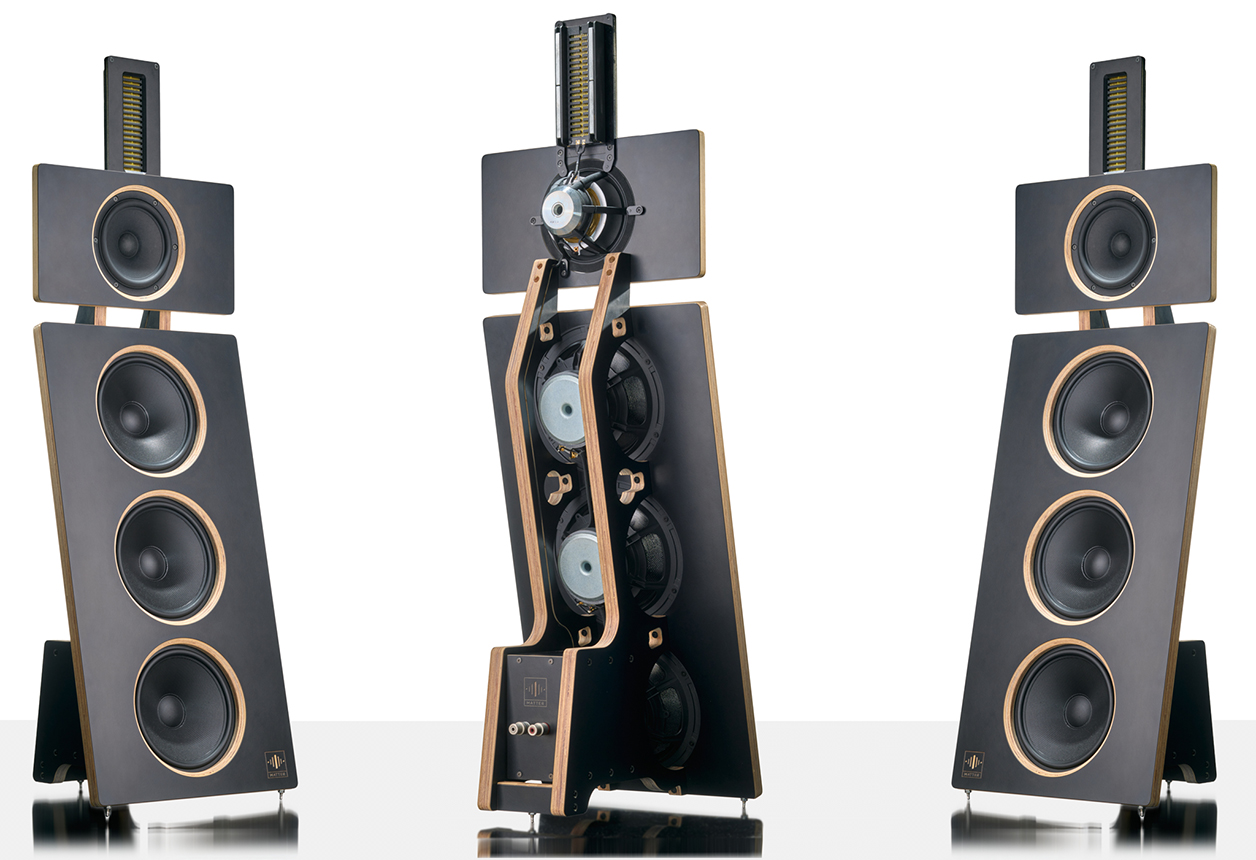
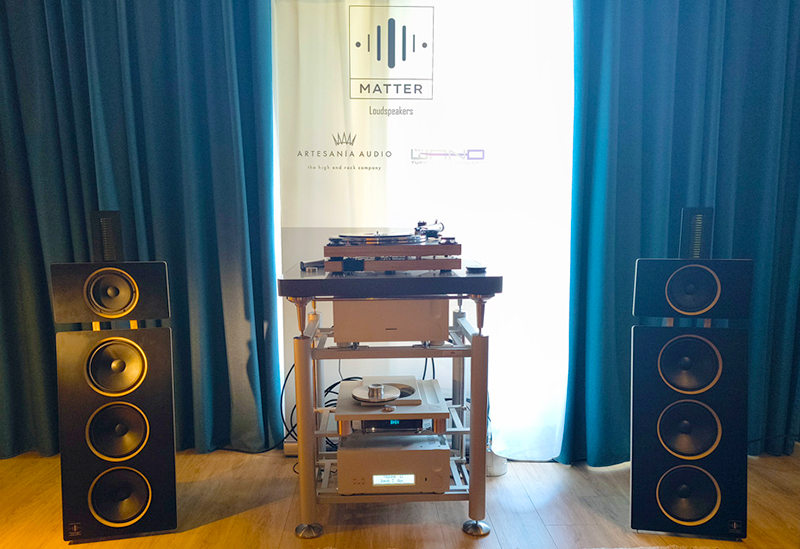 Obviously stacking twin 15" woofers as below the break mandates a broader baffle to present cosmetic implications. Exposed derrières can add to those. Whilst two of Matter Audio's models do embrace fully-hung twinned 15" religion, today's 88dB model prays to triple 8". Where the dual big cones add up to a single 21" woofer, the smaller triplets sum to ~14". It remains beaucoup bass battery but slims visually to play a bit less room divider. The dot on this aye is a dipole AMT which takes over from a 6" midrange. Which begs the question, who is this matter? A Greek brand that has joined the rather small club of European dynamic dipoles which include Diesis of Italy, sound|kaos of Switzerland, Ecobox of Bulgaria, Bombard of Belgium, Hex3 of the UK, daudio of The Netherlands and Lyngdorf of Denmark. Australia have Kyron, the US Spatial, Emerald Physics and Clayton Shaw. Fanis Lagkadinos, co-founder and partner of Ypsilon Electronics, is the man behind Matter Loudspeakers.
In the 1980s, Demetris Backlavas and Fanis met on the benches of a university. Demetris studied electronics, Fanis civil engineering. A common passion for hifi brought them closer. Demetris specialized in amplifiers, Fanis built electronics and speakers. For several years the two future partners worked as sound engineers, acquiring experience with major musical projects from small to stadium concerts, sound reinforcement gigs and stage plays. They finally launched Ypsilon Electronics as a workshop for manufacturing an integrated amplifier and power amplifiers for professional use. At the same time they also made custom speakers. In 2005 they presented the first high-end Ypsilon model in the SET100 amplifier. At the same time they developed their own ribbon tweeter and speakers for in-house R&D assessments. One of these presented at the high-end Heathrow show during the first international presentation of the SET100. Today this speaker remains their in-house reference for the development of the entire range of Ypsilon electronics.












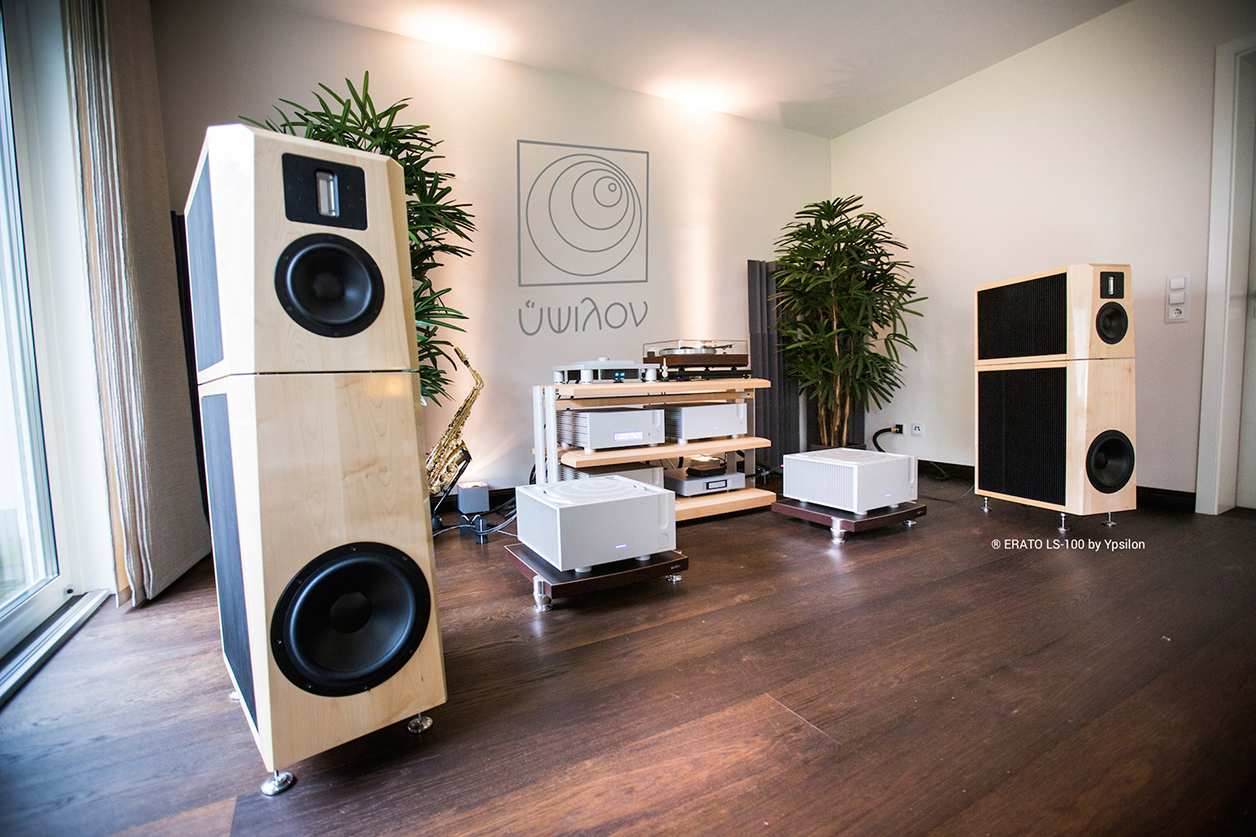
Ypsilon at the time tested all available compression and regular tweeters. They searched for bandwidth so a part that could be taken quite low instead of yielding to the fashion of quasi super tweeters. This birthed the dream of their own planar tweeter inspired by the Raven ribbon. Gradually deepening R&D into the design and manufacture of output/interstage transformers led to very satisfactory tweeters. The end result featured in the above Erato LS-100 during the launch of the Phaethon integrated at 2014's High-End Munich show. However, this speaker never commercialized. Eventually Fanis together with Evgenia Panagiotopoulou struck out on their own with the family business Matter Loudspeakers. Evgenia is a researcher in particle physics, a singer and in charge of Matter administration and marketing. For this brand Fanis now focussed on open-baffle designs. It freed him from the constraints and high costs of cabinet production. According to him, the technical means for a completely neutral box speaker were more or less exhausted by Laurence Dickie's B&W Nautilus and his Vivid descendants already. After a year of R&D, the principle of the electrodynamic dipole suggested itself as the ideal, lighter yet still relatively compact solution. This required a new ribbon tweeter that could operate open-backed, had a larger radiation surface and broader bandwidth to remain compatible with 1st-order filters. This would eclipse the capabilities of the original Ypsilon ribbon.
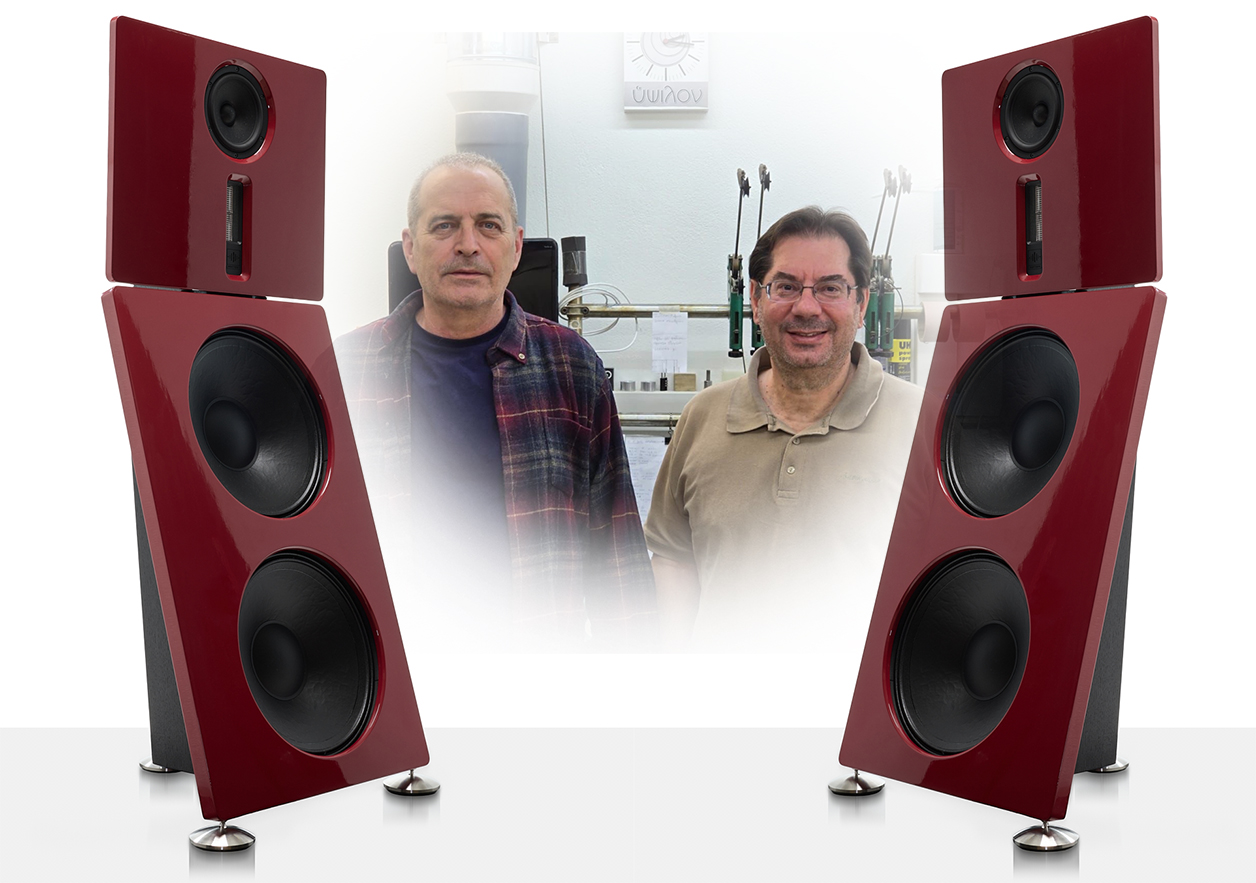 Fanis & Demetris
After the Vienna 2026 HighEnd show closed its doors, I heard from Fanis and Evgenia. "Thanks for mentioning us in your Vienna No-Show report! In a few days Axion is ready to travel to France for a review by Diapason. This loan duration is not yet fixed. We are also in discussion with a UK reviewer who visited our Vienna room. So we cannot currently give you a firm answer. However, we are in production of the new Evolution model in two versions. It's a scaled-up Axion of 6 x 8" woofers. The second version will change the bass drivers to be optimal for valve amps. There's a possibility of one of these being available for a summer review. The Evolution was never at a show to present a first-view alternative. Please let us know your thoughts and/or time frame." I rather thought that six moons of the 8-inch persuasion would be too big a constellation for my room. Wouldn't I be better off putting my name on the travelling Axion loaners once they'd finished their prior engagements? At 115 high, 38cm wide, 34cm deep and 17kg per, Axion rather did have my numbers – unless Evolution went faux isobaric by coupling pairs of woofers one behind the other to use the same baffle size? I had no idea whether such a geometry is even feasible for a dipole. I was grasping at straws. Better to hear back from the team in Kaissariani, a suburb of Athens. Other regional brands I knew of were Aries Cerat, Lab12, TruLife Audio, Tsakiridis Devices. hARt Labs and Tune Audio. When Evgenia's reply pinged my inbox later that day, it was a sideways move; literally.

12
