Country of Origin

Reviewer: Srajan Ebaen
Financial interests: click here
Main system: Sources: Retina 5K 27" iMac (i5, 256GB SSD, 40GB RAM, Sonoma 14), 4TB external SSD with Thunderbolt 3, Audirvana Studio, Qobuz Sublime, Singxer SU-6 USB bridge, LHY Audio SW-8 & SW-6 switch, Sonnet Pasithea, Laiv Audio Harmony; Active filter: Lifesaver Audio Gradient Box 2; Power amplifiers: Vinshine Audio x Kinki Studio Dazzle & Gold Note PA-10 Evo in mono on subwoofer; Headamp: Enleum AMP-23R; Phones: Raal 1995 Immanis; Loudspeakers: Qualio IQ [on loan] Cables: Exact Express Flame, Furutech; Power delivery: 2 x Kinki/Vinshine Tai Hang on amps and source stack, Furutech DPS-4.1 between wall and conditioners; Equipment rack: Artesanía Audio Exoteryc double-wide 3-tier with optional glass shelves, Exoteryc amp stands; Sundry accessories: Acoustic System resonators, AudioQuest FogLifters; Room: 6 x 8m with open door behind listening seat; Room treatment: 2 x PSI Audio AVAA C214 active bass traps
2nd system: Source: FiiO R7 into Soundaware D300Ref SD transport to Cen.Grand DSDAC 1.0 Deluxe with POW; Preamp/filter: Lifesaver Audio Gradient Box 2; Amplifier: Kinki Studio EX-B7 monos; Loudspeakers: Virtual Hifi Cobra [on loan]; Subwoofer: Zu Method; Cable loom: Exact Express Earth; Power delivery: Vibex Granada/Alhambra, Akiko Audio Corelli Corundum & Castello Solo; Equipment rack: Hifistay Mythology Transform X-Frame [on extended loan]; Sundry accessories: Furutech cable lifts, Furutech NFC Clear Lines; Room: ~3.5 x 8m
2nd headfi system: DAC: Cen.Grand DSDAC 1.0 Deluxe with POW; Headamp: Cen.Grand Silver Fox; Headphones: Raal 1995 Magna, HifiMan Susvara
Desktop system: Source: HP Z2 work station Win11/64; USB bridge: Singxer SU-2; DAC/preamp: COS Engineering D1; Headphone amp: Kinki Studio THR-1; Speaker amps: Topping B200 monos; Loudspeakers: Virtual Hifi Viper; Headphones: Final D-8000, aune SR7000, FiiO FT7
Upstairs headfi system: FiiO R7; Headphones: Meze 109 Pro, Fiio FT3
2nd upstairs speaker system: Source: FiiO R7; Integrated amplifier: Simon Audio Lab i5; Loudspeakers: ModalAkustik Musikboxx with Dynaudio S18 subwoofer
2-channel video system: Source: Oppo BDP-105; All-in-One: Gold Note IS-1000 Deluxe; Loudspeakers: Zu Soul VI; Subwoofer: Zu Submission; Power delivery: Furutech eTP-8, Room: ~6x4m
Review component retail: €379
Chi. It's the other half of T'ai, the Middle Kingdom's ancient art of meditation in motion. Any visit to China sees particularly older people enjoy this slow-mo practice in public parks. When preceding the two letters Fi, Chi wasn't just short for China. It implied cheap, cheerful or cheesy. The slightly derogatory connotation applied to mostly early tube kit which enterprising if small Western outfits more dabbling in distribution than crushing it imported from the PRC. It's when the moniker ChiFi stood for basic builds, basic circuits and often scattershot voicing with no consistent house sound. Routinely unsaid but suspected? Internal circuitry brazenly copied Western exports to what in this sector then still was a Sleeping Dragon not Pouncing Tiger. This sentiment mirrored how decades earlier, Japan was believed incapable of originality but ace at copying. Later valve brands PrimaLuna and Mystère designed by a small Dutch consortium harnessed the enviable manufacturing powers at Cayin and Melody Valve Hifi whilst centring distribution in the EU. NAD and many others had already done so for solid state. Mark Levinson the man launched Red Rose Music with Chinese-built transistor gear from Dussun. Later Vinshine Audio of Singapore cherry-picked a catalogue of Chinese performance audio from Denafrips, Kinki Studio and Jay's Audio then Laiv Audio to distribute globally. By 2025, Kinki's 300-watt class AB Dazzle integrated became one of the early harbingers of Sino SuperFi to Western shores. Solid-state über amps from the likes of Audio Music, Cen.Grand and Kinki Studio had launched years earlier but to date still remain mostly confined to sales within China.












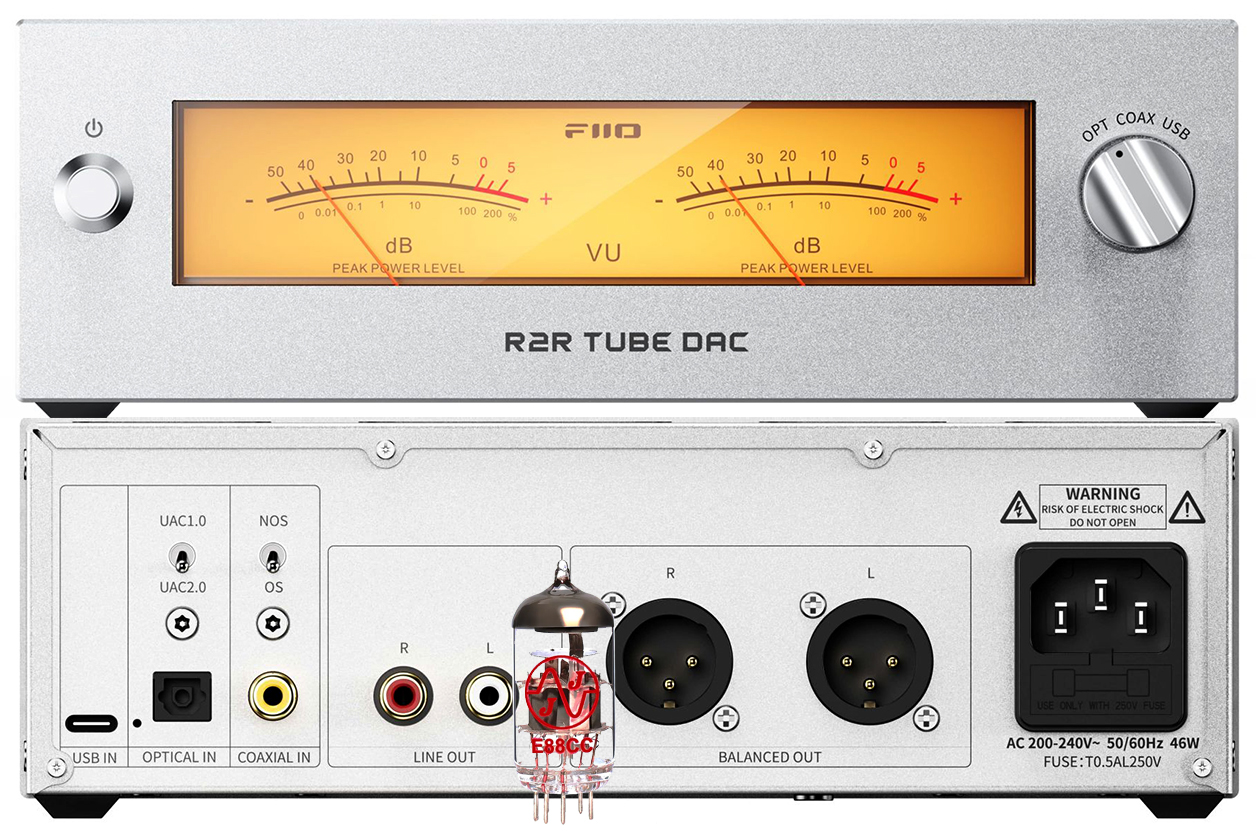
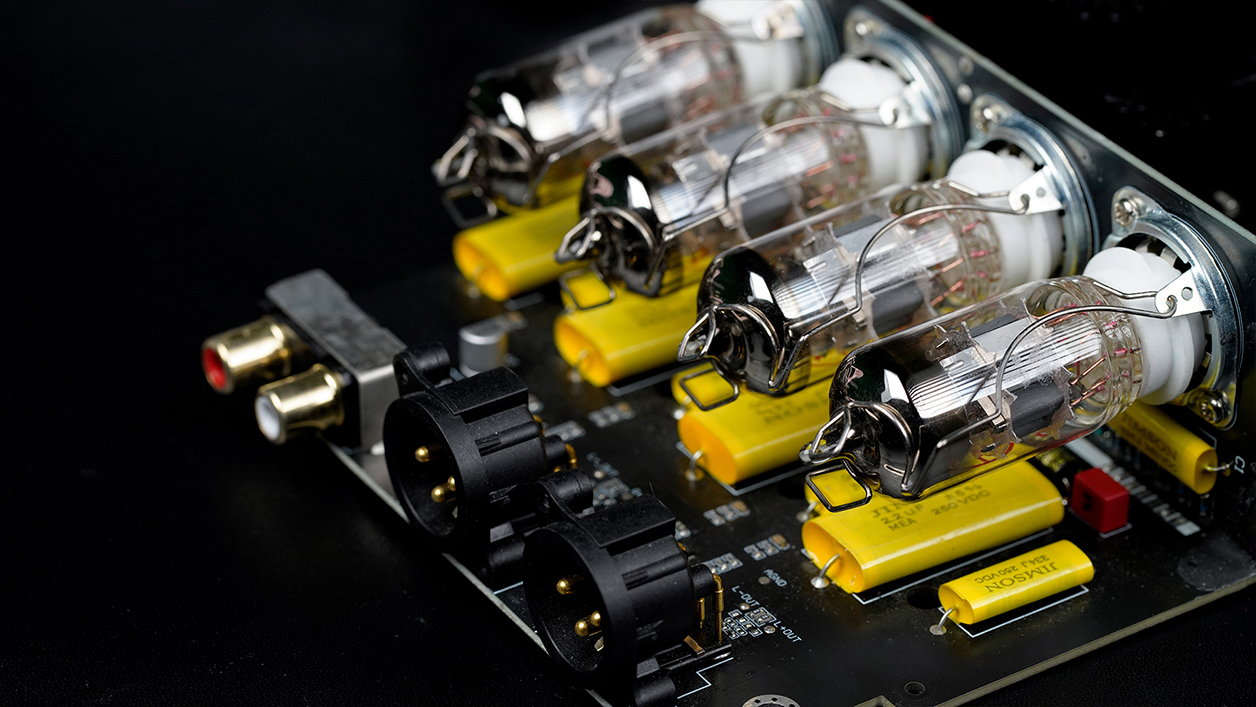
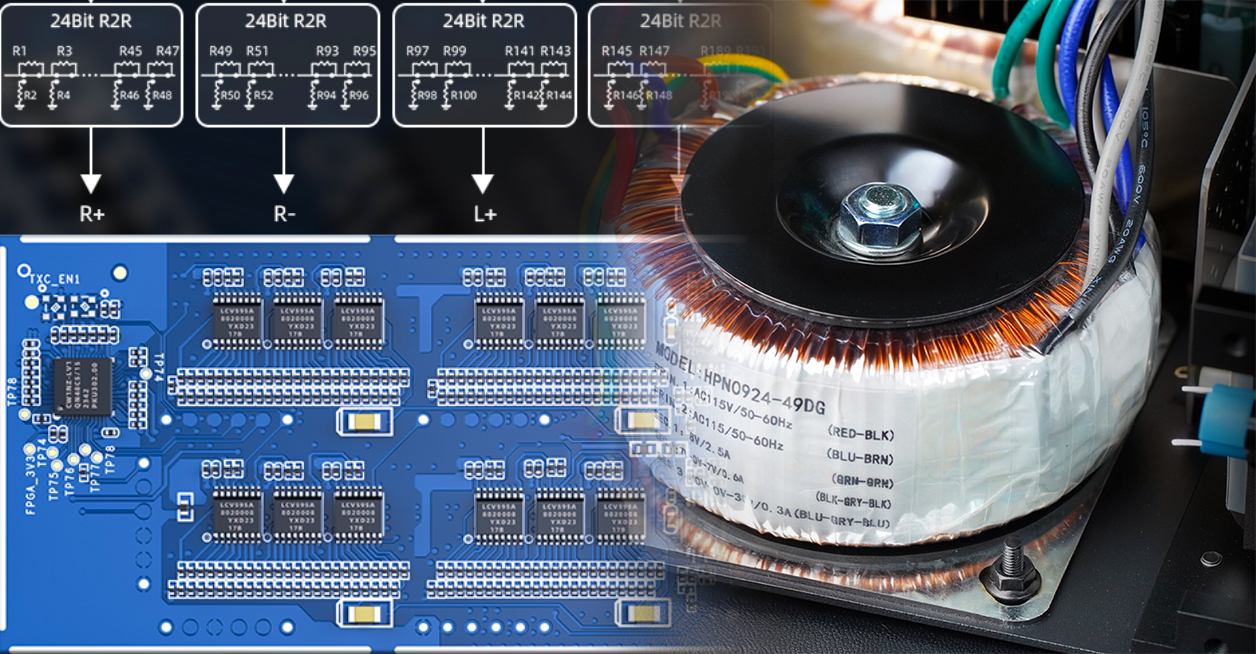
But already by late 2001, Steve Job's revolutionary '1000 songs in your pocket' iPod was primed to reset public perception of high-quality fashionable goods made in The People's Republic. It inspired FiiO's founders who in 2007 kicked off with portable players. 18 years later, FiiO's Warmer DAC tackles ChiFi's early entanglement with tubes. It flies a bona-fide balanced tube stage of four Slovak JJ E88CC aka 6922/6DJ8 mounted clip-loaded military style. "These do amplify a bit but focus only on harmonic magic rather than pushing serious gain to run on gentle ±28V far below typical high-voltage tube specs." It suggests somewhere between a zero-gain buffer and standard voltage-gain stage which can run the 6922 anodes from 90-250V. For more retro, the orange-glow VU meters are mechanical not animated touchscreen. 24-bit conversion is by discrete balanced R2R ladders. Meanwhile the cheerful connection to Chi's life force working in everyone means a prole €379 sticker, tubes included. Global 384kHz oversampling caters to modernity, NOS mode to purists. UAC1.0/2.0 conversion by rear toggle means instant driverless USB-C happiness on Windows.
In a gesture far more sly than the famous Johnny Cash salute, the model name not only tells us what to expect. It calls anyone expecting otherwise a flickering lightbulb without having to spell it out. What do I mean? In hifi discourse, the mere mention of tubes unleashes the 'distortion generator' hounds of the audiophile police inspecting for 0.00001% THD. They call strong tone colours not colourful but coloured hence off-colour to musical fidelity. Having christened their DAC Warmer, FiiO state unmistakable intention. Like Kinki Studio's proud 'we come from China' declaration, the Warmer DAC owns its deliberate voicing like an admiral dons his rank with showy epaulettes. I find this deliciously subversive. It takes little foresight to predict that if Warmer is a success, FiiO will follow up with more valve-enhanced kit. But that's future fun. Present play is the children's game where a parent directs a search for a hidden surprise with 'cold' until the sprout is on the right track. Then it's suddenly warmer; and warmer.
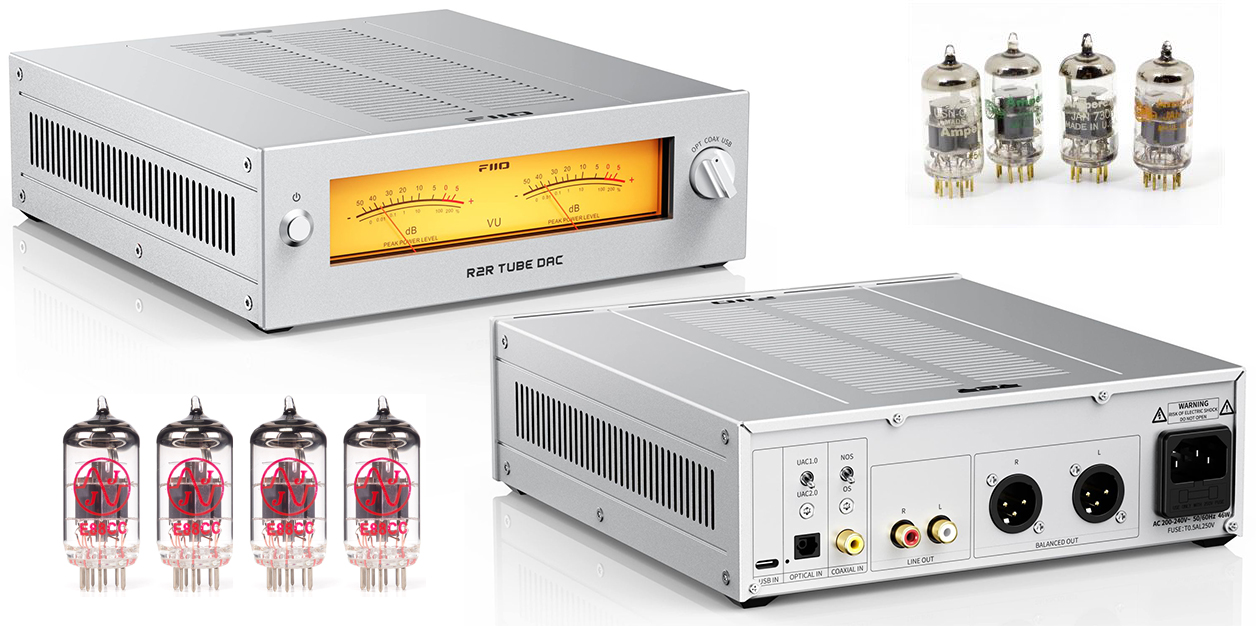
When it gets hot, newbs can even explore the world of tube rolling¹ where cost savings may be had by only running tubes 1 and 3—counted left to right from the unit's rear—in single-ended line-out mode. We can play geopolitics by deciding for or against Russian bottles. As befits today's retroccasion, the power supply is a linear sort with 46W toroidal transformer and Warmer makes zero concessions to touch screens, menus, WiFi, Bluetooth, digital volume or other next-gen riffraff. Turn on, tune in, relax. There's naught to fiddle with other than two toggles. Being on the rear, they'll soon be forgotten. Who needs a remote? Whether the whole concept is querulously quaint or of quickly quantifiable quality you decide. Beyond argument is that this model opens a new chapter in the good book of FiiO. For many, the brand's no-nonsense reputation and this model's friendly tariff could be their ideal first date with true vacuum tubes. In this circuit juncture, they do no heavy lifting. They work into the high fixed input Ω of an OPA1642 output buffer. They see no variable low impedance from reactive passive loudspeakers. From low-voltage cool-running mode not concerned with drive or power, FiiO can promise up to 10'000 hours of use before replacement. Also, these small twin triodes won't be guilty of lacking current drive to produce loose woolly bass. Those are challenges for tube power amps, not DACs. Meanwhile balanced operation keeps THD in check. So, care to get warmer the easy way?
____________________
¹ Be careful with the JJ nipples when you unclip the retainers and support the vertical board with the other hand whilst pulling out and pushing in tubes. Their obvious spacer between the pins means they can only go in one way.
If warm means getting a tan, who isn't up for that? People only complain of tan lines. Then go Full Monty like this Tube R2R DAC's bold VU meters. If that's too fresh, what lines to expect? Automatic conversion to PCM of up to DSD256. S/NR of 114dB. Noise floor of 7µV. THD+N of 0.053%. Crosstalk of 96dB. For valves, those are very respectable figures. But nullifiers after maximum zeroes still go elsewhere whilst op-amp deniers stumble over the twin OPA1642. Even the output voltage of 1.8/3.8Vrms on RCA/XLR is slightly less than standard. But at €379, a balanced R2R DAC with tubes is very non-standard so all adds up as it should; on paper or pixel. How about the sweet spot² of a reviewer's sweat shop?
_______________________
² From a Gy8 review: "…Kora the company has been around for several decades but changed hands in 2017 when it was acquired by Bruno Vander Elst, a long-time and highly regarded consultant to the wider French audio industry. He used the established brand as a launch pad for a new range of products based on an entirely new tube amplification topology, an inherently stable balanced arrangement of two twin-triodes per channel that ran the tubes from a precise current source and at around 20% of their current capability—around 2.5-3.0mA rather than the more usual 10mA—to produce a balanced output. The tubes were operated so far within their comfort zone that Kora claimed that tube quality and even tube type are virtually irrelevant, performance and linearity being defined by the circuit rather than the devices. Functionally it's a topology that mimics an op-amp, a self-contained amplification stage that can be dropped into a wider circuit context to fulfil various functions… all of the amplification is done by the tubes… the solid-state devices in the output stage supply only current, no gain." At €60K/pr, these tube amps too use quads of JJ triodes in balanced configuration operated well below capacity though unlike FiiO's, they appear to generate far more voltage gain.