
Country of Origin

 This review first appeared in June 2025 on HifiKnights.com. By request of the manufacturer and permission of the author, it is hereby syndicated to reach a broader audience. All images contained in this piece are the property of HifiKnights or the manufacturer – Ed.
Reviewer: Dawid Grzyb
Transport: Innuos Statement, fidata HFAS1-S10U
DAC: LampizatOr Horizon360 w. Stradi 5U4G + Psvane Art TIII 4x KT88 / 2x 6SN7
USB components: iFi audio Mercury3.0
Network: Fidelizer EtherStream, Linksys WRT160N
Preamplifier: Trilogy 915R, Thöress DFP
Amplifier: Trilogy 995R, FirstWatt F7, Enleum AMP-23R
Speakers: Boenicke Audio W11 SE+, sound|kaos Vox 3afw
Headphones: HifiMan Susvara
Interconnects: LessLoss Entropic Process C-MARC, Boenicke Audio IC3 CG
Speaker cables: Boenicke Audio S3, LessLoss C-MARC
Speaker signal conditioning: LessLoss Firewall for Loudspeakers, Boenicke ComDev
Anti-vibration conditioning: 12x Carbide Audio Carbide Base under DAC, preamp and speakers
Power delivery: Gigawatt PC-3 SE EVO+/LC-3 EVO, LessLoss C-MARC, LessLoss Entropic Process C-MARC, Boenicke Audio Power Gate, ISOL-8 Prometheus
Equipment rack: Franc Audio Accessories Wood Block Rack 1+3
Music: NativeDSD
Retail price of reviewed component in Poland: $417/ea.
Publisher's foreword: June 3rd, 2025. "Shortly after distributor Aldo Filippelli and Alex Vitus brought JV 2024's Product of the Year Award-winning Class A solid-state electronics from Vitus Audio, Aldo returned with a little "Filip." Though JV thought it unlikely that any tweak could improve the already sterling (make that "golden") performance of the Vitus gear, he was wrong. These flattish nondescript mats (laid atop electronics) and clamps (for encircling cables and interconnects) made an immediate and sizable difference in sonics, lowering background noise to a level of quietude JV had never before experienced with amplification devices. A.R.T. (Audio Realignment Technologies) which purports to be a science-based outfit with 55 years of experience, claims their treatments contain "an array of passive, proprietary formulations containing rare metals and advanced magnetic multi-layer technologies designed to absorb, control and minimize the negative audible effects of electronically induced noises in sound systems at the electronic component sources." Be that as it may, something is working precisely and consistently to the ends that A.R.T. claims they're working – the lowering of EMF, EMI and RFI. Audibly effective, for ultra-high-end systems these mats and clamps are well worth the not insubstantial prices asked for them; indeed, they are worthy of this year's The Abso!ute Sound's Accessory of the Year Award." Two days later, Dawid's review of the LessLoss Giant Steps hit. Something about this subject was definitely in the air. – Ed.
_____________________________________
Macrodosing. As much as I like to get my hands on speakers, DACs, amps and all the other big loot, over the years I developed a soft spot for anti-vibration accessories. Each time I'm about to sample one, I'm as happy as if I had a fancy costly DAC to work with. Here are my reasons. One, most such isolators are small so easy to work with. Two, I get to enjoy their contribution without any hassle related to swapping electronics. Three, some mechanical isolators can impact my system's sound in ways well pronounced and easy to track. While these points all spell time savings on my end, there's more. Picking my battles is part of the gig. Since I don't do vinyl, I have nothing to say on the entire sector of related products. Yet in recent years I tried quite a few isolation footers. Being familiar makes me comfortable to judge them. Today we cover yet another such affair, albeit built upon a radical concept novel to this category. That makes the newcomer quite special. First some basics. Our audio systems comprise many stationary boxes that we usually don't associate with shaky behaviour when placed on a shelf. However, CD players, speakers and turntables incorporate moving parts which resonate to influence their surroundings and feed back into themselves. Therein lies the rub. These unwanted oscillations are the source of mechanical noise that negatively impacts our sound quality. In my experience, digital and tube electronics are particularly sensitive and speakers very much dislike floor-borne resonances, too. It's why many manufacturers offer accessories designed to either damp and/or transfer their resonant energies elsewhere. While the understanding of this fundamental issue is pretty universal across the industry, the various means to address it form a diversified product group. That's fun.

While the isolation of audio gear from its support surface and blocking its own microphonics is the common ground for all anti-vibration accessories regardless of price, performance or size, the diversity between them can be narrowed down to hard or soft measures. The materials and main decoupling ingredients popularized by hard types usually incorporate one or several balls locked between two extremely hard surfaces to allow for lateral movement in precision races of given curvatures; or exploits constrained-layer damping by bonding materials of dissimilar hardness. The resulting interface acts like a directional sink aka mechanical diode to dissipate parasitic component vibrations into frictional heat. High material hardness to resist deformation is critical for the efficiency of products built upon this idea. The harder their ball bearings and races, the smaller the contact points between them and the more effective the vibration-draining action. Alternatives like classic spikes and esoteric wire suspensions also classify as hard. Meanwhile various soft suspension systems are found on the other end of the spectrum with spring actions and reactions to damp unwanted vibrations particularly of low frequency and large amplitude. Wood, cork, springs and rubber are popular choices here.













Some manufacturers prefer soft solutions (IsoAcoustics). Others go hard (Stillpoints), extremely hard (Ansuz) or hung (sound|kaos). Some combine hard and soft (Carbide Audio) to great success. Fundamentally however, they all combat resonances of various amplitude and orientation with principles rooted in mechanics. The LessLoss Bindbreaker I reviewed in early 2020 was such a footer, too. Built upon a wood/steel/wood sandwich on a hexagonal plane, it worked as intended. The design's upper wood layer polarized vibration modes and let in deeper only their vertical kind which was rapidly spread to then scattered by a matrix of bolts under a steel/ply base while a bog oak bottom plate damped any residual oscillations. Should you think that Bindbreaker's innocent aesthetics don't match its intricate operation, strap on your seat belt prior to reading on. Today's Giant Steps raise that bar a lot higher with an even simpler look and operating principle that can only be described as outré.
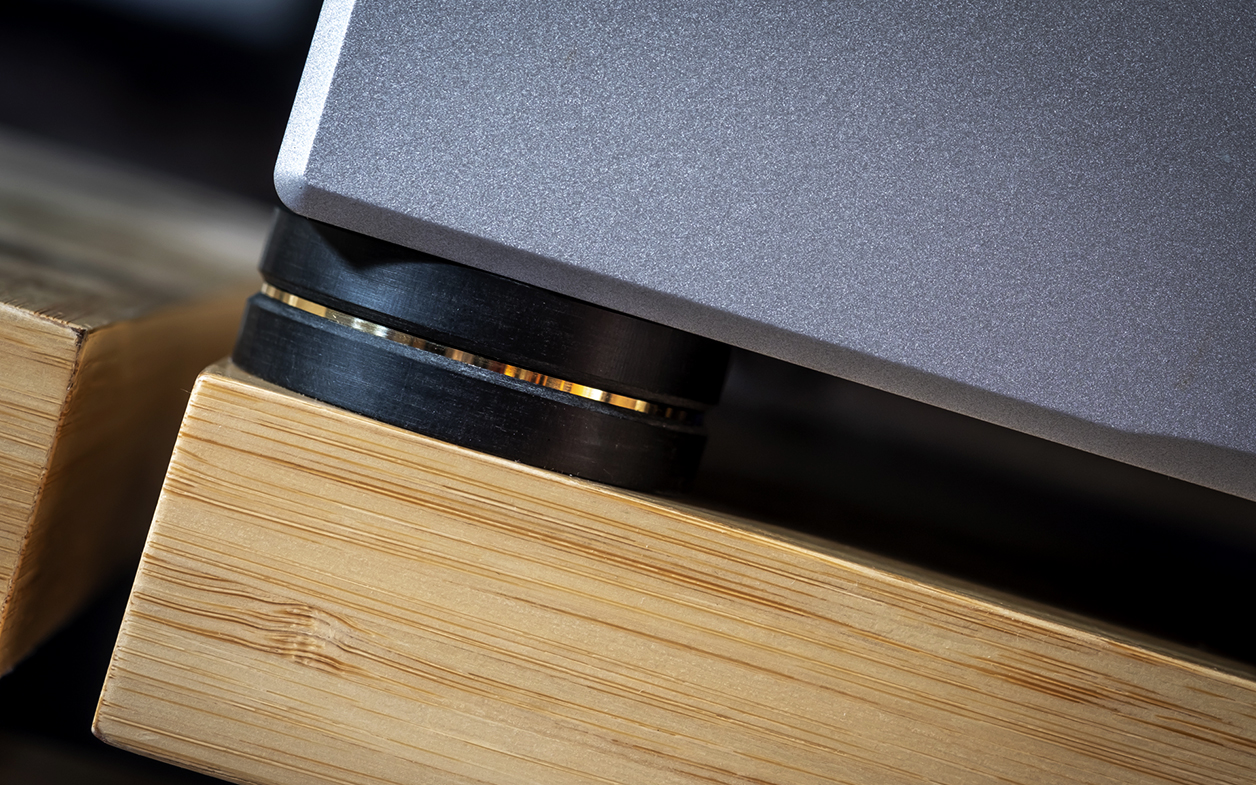
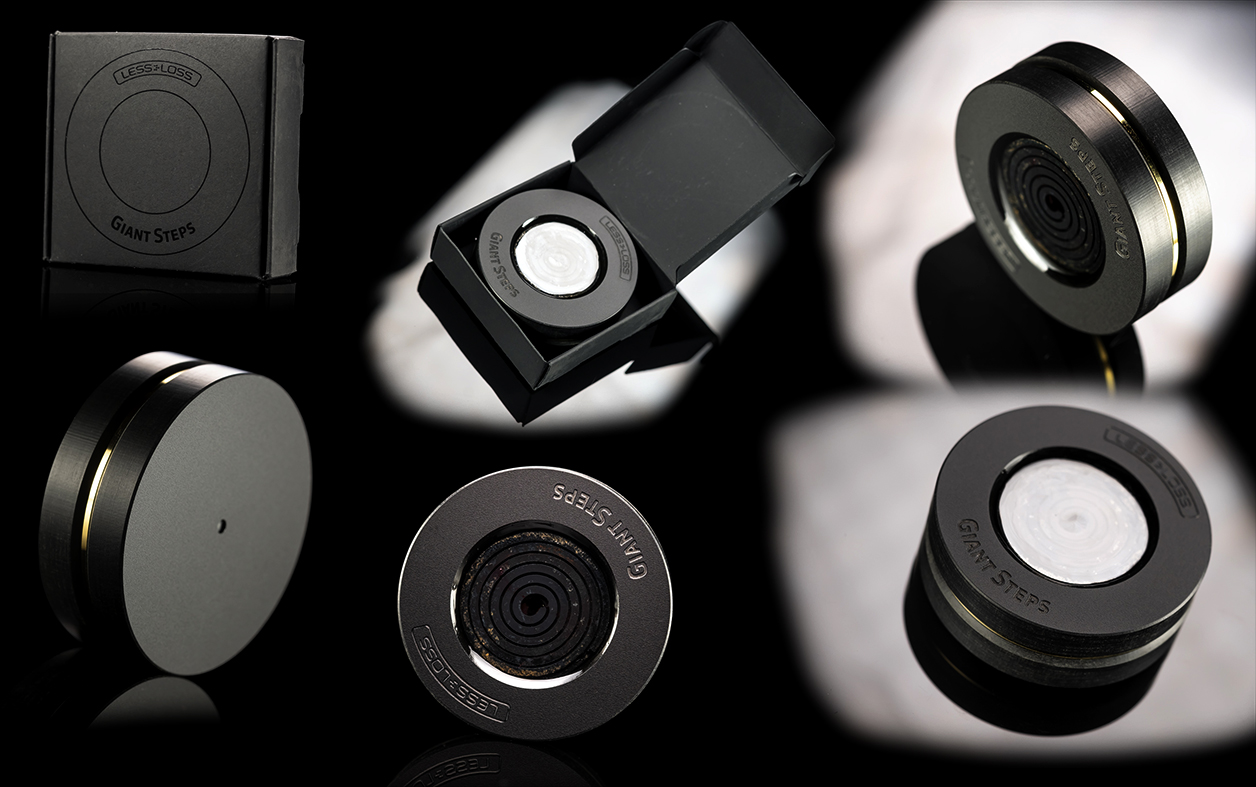
This device is a handsome round puck of 17 x 50mm HxW and 200g on the scale. It's a rigid object without any soft or hard moving parts as found elsewhere. The housing built up from multiple Kraft paper layers soaked under high pressure in ink resin scores even higher on damping properties than the already excellent Panzerholz LessLoss champion for component chassis. This extremely inert body with recessed polished brass ring qualifies Giant Steps as a hard anti-vibration product. Meanwhile an intriguingly spiralled object visible under the translucent resin core makes this footer into something that does most its work in the magnetic realm. This is the key. Ferromagnetic materials like iron or nickel become magnetized in the presence of a magnetic field. Paramagnetic materials like aluminium and tantalum are ever so slightly drawn to it, diamagnetic materials like bismuth or copper repelled. The Giant Steps insert consists of thin laser-cut layers of strongly diamagnetic and ferromagnetic spirals alternated multiple times. When an external magnetic field triggers the diamagnetic layers, they instantaneously oppose its force. Since they're trapped between ferromagnetic counterparts, the entire stack's layers effectively want to move apart yet their hard resin prison prevents all physical motion. Ergo, the applied magnetic forces exhaust into heat.