 Ortophase driver assembly
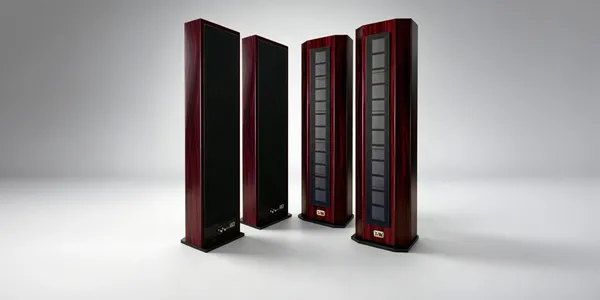 If dynamic cones 'n' domes represent speakerdom's normality by dint of vast majority, today looks at a few outliers promoting different tech. Let's kick off with the 1960's Ortophase from French inventors Georges Gogny and Georges Poutut. It was a flat polystyrene planar cell employed in mass-paralleled guise in curved open baffles which came and went. But many decades later Frenchman Thierry Cirot rediscovered it, acquired 20 raw drive units and between 2013-2017 managed to reverse-engineer and resurrect the technology. In Hong Kong meanwhile, Wango Lee had heard an original Ortophase system in his youth and never forgotten the experience. In 2021 he learnt of Thierry's work online. Today the Thierry & Wango Audio brand is dedicated to a modern interpretation of this technology assisted by owning an original 32-cell Ortophase cabinet. Their modern open-baffle hence dipole line-source V12.1 [right] stacks twelve 1.5g/ea. planar membranes in a crossover-less vertical array which claims 5Hz-40kHz response at ±3dB. It reads like the ultimate widebander but adds cylindrical wave propagation for reduced room interaction and distance loss. Brands promoting other forms of planarmagnetics include stalwarts Magnepan and newer brands Clarisys and Diptyque.
Also in France, AudioNec have revived Paul Paddock's original Linæum driver which Radioshack had subsequently licensed as a bipole tweeter. Whilst Linæum had scaled up their floppy twin-cylinder bending-wave driver to a midrange, the brand dissolved in the late 90s. Likewise short-lived was Impact Technology with their derivative Airfoil models. AudioNec developed the concept into a larger version good down to ~200Hz which remains perfectly current. Serge Schmidlin of Switzerland's Audio Consulting too has a take on it. So does the original inventor with his newer company MC Audiotech. German Physiks meanwhile are the quasi inheritors of the original Lincoln Walsh omni driver, an inverted and elongated dynamic cone of pliable diaphragm working in bending-wave mode. Josef Manger invented a flat-cone version which continues to this day with his daughter Daniella Manger. Göbel for a while championed a bending-wave or distributed-mode driver based on an ultra-thin vibrating wood panel, apparent variations of which continue with Amina Sound's architectural panels designed to integrate into walls or ceilings; and the various NXT and Tectonic variants.
MBL invented the Radialstrahler omni-directional drivers which remain exclusive to their brand. Whilst brands like Duevel promote their own omni speakers, the actual drive units there are classic dynamics firing into reflectors to disperse 360°. Full-range electrostats represent another very narrow speaker alley off the dynamic highway. With brands like Soundlab long established, let's here mention Polish newcomer Lirogon Instruments with their zero-crossover Origin, a Quad-shaped dipole with multiple electrostatic panels where mechanical adjustments afford some tuning variability. For ribbon speakers meanwhile, Alsyvox are the modern go-to brand in lieu of Jason Bloom's long-gone Apogee. In the dynamic sector too, unusual variations exist. Take the flat-cone driver of the Audio Physic MedeΩs which falls between a classic dynamic and planarmagnetic. Then there are spiderless versions which Audio Physic have made by Monacor, MarkAudio's Alpair range and even more radical, the Illumnia dynamic with neither a spider nor surround. Without altering the classic dynamic shape or operating principle, companies like Børresen and Dali have revisited their magnet structures to minimize inductance and improve a driver type that's remained essentially unchanged since Rice & Kellogg invented it for General Electric in 1924.
Given this far from conclusive variety on tap, we can obviously point to numerous examples of speakers which combine classic dynamic drivers with some of the types mentioned here. Ribbon tweeters are reasonably common. Elac even had multiple generations of their 1984 4pi omni ribbon as an add-on super tweeter. Then there are derivatives of the original Oskar Heil air-motion transformer or AMT for short which Mark & Daniel have scaled up to cross at a low 600Hz. Plasma tweeters can be found with Acapella and Lansche. Since their invention by Motorola, piezo tweeters continue to be made by Monacor for example and a Japanese version from TaKET factors in AudioNostrum's Saturn Pandora. At the opposite end of the frequency spectrum lives Bruce Thigpen's 2016 patent for a rotary transducer, essentially a fast-spinning blade fan first demonstrated in a powerful subwoofer. Whilst many outlier driver types aren't sufficiently full-range to work solo in speakers, headphones present different opportunities where even a single AMT or thrice-paralleled narrow ribbon needs no down-low help. Hence we have true ribbon headphones, AMT headphones, e-stat headphones and very many planarmagnetics. In speakers however, pure not mixed outlier technologies are more rare though they do exist. This page makes no claims of completeness. If readers submit other noteworthy examples, I shall add them…