
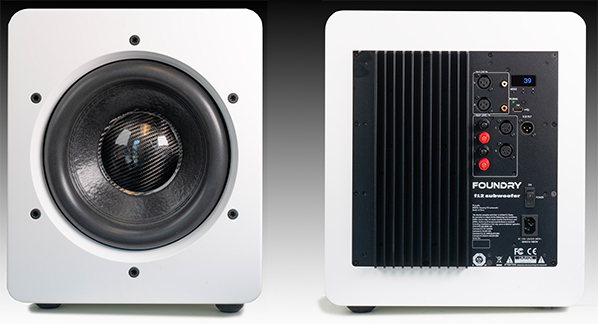
 PS Audio announced their first-ever sub, a fat-stroke 12-incher fronting 1kW power with an 1'800W power supply called Foundry 12. App-driven DSP exploits a smartphone's mic to perform auto room correction, manual override allows power users to create their own compensation curves.
Zu's newer 15" Method sub runs Hypex Fusion electronics, pre-codes its 3 presets for ideal interleaving with their own models but doesn't lock the filters so power users can change them at will. Paint options span their Custom Shoppe gamut, even veneers apply.
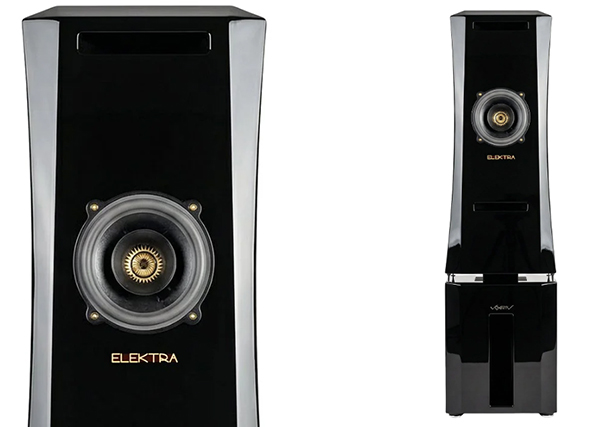
Voxativ's new Elektra model docks a rear-horn loaded field-coil widebander good to ~60Hz atop a 99dB dual 12" RiPol bass system with 500 watts of in-house developed class D power for 20-20 response with 110dB sensitivity facing our own amplifier. Rev up your flea-watt engines to bring down the house.
spl's new Crossover MkII not only gives us separate control over 2nd/4th-order slopes, filter points, hi/lo-pass and phase all in the pure analogue domain but runs its circuitry on 120V rails four times higher than normal. Where standard operational amplifiers even of the discrete sort à la Weiss, Burson, Sparkos & Bros operate on ±15V, spl's discrete modules do ±60V. In my system this works like a dynamic expander so bolts onto a basic traffic-cop job—mid/high freqs right, low freqs left, stay in your lanes!—an accelerator function which improves the entire system because it impacts the total bandwidth so polishes up the main speakers. Unexpected but true and now enshrined in my main system.
 From Magico to Wilson, Focal to sonus Faber, many of the big speaker houses offer sophisticated subwoofers. Yet despite that happy fact, the audiophile press at large doesn't promote their use for music not movie systems. I think that a shame and serious oversight which really ought to be rectified. It's why at regular intervals, I post an editorial on the subject just to keep the matter afloat. If you've never worked with a properly integrated sub or two, you cannot know what you're missing.
Three of my speaker systems are stereo 2.1. The desktop isn't for obvious reasons; and the smaller upstairs one isn't because in the nearfield, its monitors with six passive radiators per side already do 25Hz. Everything else incorporates big active woofers. For those setups, I'd never return to fixed passive bass. If you asked me 'why' for the short answer, I'd say that the presence of a correctly set-up sub makes a bigger difference than digital and line-level choices. Hence once those are sorted, I see little appeal to keep shining them up without first attending the bottom octave (or two).
The plethora of subwoofer news announcements clearly suggests that I'm far from alone thinking so. I'm simply wondering why the plentitude of such releases doesn't reflect in more reviews, discourse and dialogue on their use. Surely manufacturers wouldn't keep introducing new subwoofers if they weren't selling. If so, why so little talk about them?
In my own annoying way of basic repetition, I'm unhappy with this because when presented properly, more education on the matter would save audio enthusiasts time and money to achieve the results they want but presently pursue by rather less effective means called ever bigger passive loudspeakers.
Annoying, innit (unless you're a purveyor of big passive speakers)?
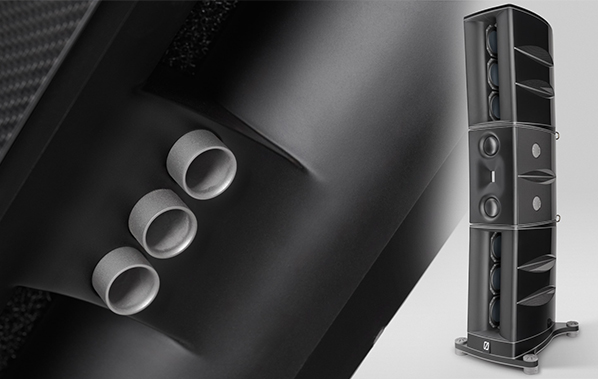
A day after I published the above, a press release for Børresen's new flagship M8 Gold speaker dropped. Around a central d'Appolito-style 5-inch two-way bracketing the firm's signature thin-film planar tweeter dock two passive RiPol bass arrays with three pairs of 8" woofers each. Yes, that's a doozy dozen woofers per channel adding to the cone surface of three 15" woofers whilst applying far more motor force to their combined moving mass. Bi-amping is recommended for which sister brand Aavik has launched their 400-watt class A monos whilst their top preamplifier includes an analogue hi/lo-pass module and bass attenuator to bolt on in-room bass adjustability and active filtering.
With the prior M6 model in the Danish speaker range commanding a cool half mill, word remains out on what the sticker for the M8 will be though I saw one post referencing €1'000'000/pr. Regardless, even as a mere concept it shows where forward-thinking design is headed. Like sound|kaos and Voxativ, Børresen have put their corporate resources behind folded dipole bass for its superior self damping and controlled directivity with far less room involvement than generic omnidirectional bass.
Subcutaneous?
You cut me deep, my friend.
Happy days!
