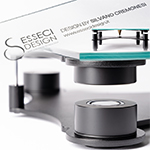

Controlled ringing x mass damping? In audio, dispatching mechanical noise follows three main routes: absorption; dissipation; isolation. In the above photo we see tempered glass and steel separated by the visual nothing of magnetic repulsion. The only thing keeping the top plate in place are two restraining bolts, one of which we can make out faded on the left. This is virtually perfect isolation. Whatever vibrations a component atop the glass plate generates have no means of escape so remain in the component. Likewise anything arriving through the floor into the floatation device's bottom plate. It has no means to jump the shark into the upper plate.

Italian brand Esseci Design which also make wine storage solutions have a second version of their magnetic levitation platform. As shown it adds a massive central brass spike seated hard in a suspended steel plate. Hello evacuation path of component-generated vibrations into the lower half of the stand whose steel plate will resonate inaudibly thus dissipate input energies. This isn't the high-mass sink concept nor is it pure isolation aka decoupling. This is highly focused coupling into a reactive structure whose low-mass design can release the incoming mechanical energies. It's the same principle discussed in this feature, albeit for speaker stands. It's certainly not the only way to peel this onion. Weight-rated viscoelastics are another, wire suspension, ball bearings, particle chambers and sundry combinations thereof yet more. It's how opposing concepts vie for followers and rattle the dualistic thinking of "if this is right, that must be wrong". Which solution is right for you? We must experiment. Theory only goes so far. Practical applications must follow. If two opposing principles work equally well, cost the same and look equally attractive, the deciding factor could be conformity with the theory our mind finds more reasonable. Or is that an entirely unreasonable and unscientific proposition? What does science have to do with wine tasting and buying the case that tastes best to us? How is sonic flavour different? We simply buy the hardware which produces the sound we enjoy the most. In that decision, science factors naught. It does in the creation of said hardware. But unless we DIY, that's out of our hands entirely. Then why not leave the science of it all to the producers? Having two ears and a selective mind with clear preferences between them is all we need to curate our own sound. True, good information, access and money factor as well. But that's beyond the scope of this little article.
Is controlled ringing audible? Does resonating steel in a speaker stand's column or component platform make audible noise? Is that just an old wife's tale? If you use speaker stands with hollow uprights, that's easy enough to test. Use them empty, fill them with sand, steel shot or cat litter. Compare until you have an informed opinion. If you use isolators, put them between speaker and stand or stand and floor. Listen. Change. Listen. Change. With today's Italian product coming in two executions, we can compare pure levitation; and levitation plus coupling to a resonant drain. Pick what sounds best to you. With audiophilia as an enthusiast's hobby not appliance concern, minting experiences from experiments is half the fun. The end. Or might it be the beginning?
Esseci Design's website
