This review page is supported in part by the sponsors whose ad banners are displayed below |
 |
Invicta as headphone amp: Here it got very interesting. If I had to make assumptions about team Invicta, I'd guess that many of its contributors are from the pro arena. Think cosmetics and VU meters. I'd further guess that many of them are serious canaries - headphone listeners. That refers back to pro with location monitoring. For one, there's the SD card slot. Not only does it eliminate physical exposure to computer radiation which in headphone mode tends to mean close proximity. It also reduces foot print. One machine compact enough to slip into a laptop-style bag is it. Add headphones and a few cards. This puts your entire core library at your beck and call. No further boxes are required. Two, there's the actual headphone performance. If you remember, the Invicta actually dedicates an entire analog board with its own Sabre chip to the headphone sockets. Talk about optimization.
Seating a 6.3mm plug in one of the Invicta's ports turns her into Evicta. You're evicted from this reality and 'invicted' into colossal refined detail. It's a popular image to think of headphone listening as essentially hard-wiring music to the brain. While the headphone feed here can't be much different from what exits via the other outputs, it does couple rather more directly to the ear. This eliminates dilution effects from additional electronics (preamp and/or power amp), less resolved loudspeakers and acoustic losses from room interactions and listener distance. It's a bit like a headphone trip to Pandora in 3D. In this application the additional resolving power over the Burson noted previously dominated to widen the gap on that score. And with sufficient drive to power HifiMan's inefficient HE-6 and HE-500 orthodynamics simultaneously, unplugging one had zero effect on the other. It demonstrated proper isolation between the ports. One did not load down the other. That's proper 'parallel power processing'.
|
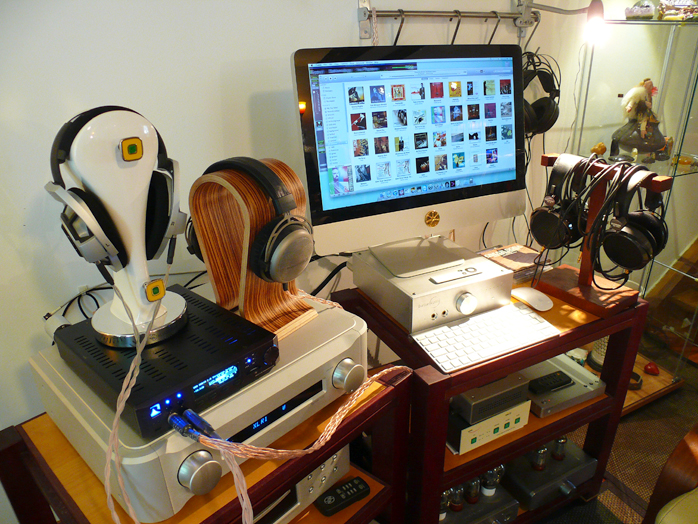 |
Sennheiser HD800 on Klutz Design CanCans, beyerdynamic T1 on Sieveking Omega
HifiMan HE-500 and HE-6 on ALO Audio T woodie
|
My wife who listens at lower levels than I would have found even the HE-6 well too loud at zero attenuation. With these particular gold-voice-coil planars however I could at times have wished for more headroom. With the more efficient HE-500 model meanwhile full throttle was intense and standard levels were anywhere from minus 6 to minus 15dB. Headbangers could run out of steam regardless but the majority of more civilized users should find the Invicta potent enough even for the HifiMan orthos (meaning that anything else is a go without qualifications). The unique feature is twin drive with discrete output levels. Nothing in audio is quite as asocial as headphone listening. One disappears into a private world not only deaf to talk and door bells but oblivious to whatever sonic excess might be leaking out. Being able to share the joy with a significant other is a minor paradigm shift. Envision the bumper sticker. Audiophiles do it together. I leave it to you to wonder what that makes those who don't.
|
 |
Audez'e LCD-2 on Klutz, AKG K702 on Omega, audiotechnica W5000 on T
|
Combining very low self noise (here headphones are far greater microscopes than loudspeakers no matter the latter's sensitivity)
with very high resolving power and stout drive ends up with the Na'vi because the color temperature scale of timbres hasn't been set too low. While not the outright lush life of Yamamoto-style SET, the kind of honesty one would expect with my assumed pro roots does emphatically not equate to tonal bleaching. That's true even with an intrinsically lit-up leaner headphone like Sennheiser's HD800 or one so neutral as the AKG K-702 which easily devolves into boring. The Invicta not only practices benign detail saturation but tonefulness. Even relentless hard and bright stuff like a frenetic Ivo Papasov ruchenitza or Balkan Messengers equivalent doesn't get unpleasant. As a very modern headphone/DAC combo which supports two listeners and can feed on memory cards (who'd want a computer in a bedroom or on a porch/balcony for example?), the Invicta would seem to approach 'ultimate' in a compact one-box solution.*
_________________________
* One feature I'd still request is display verification of input trim. It would be nice to know by what amount each headphone socket has been pre-attenuated or not. This would make specific settings perfectly repeatable for any given listener/headphone and avoid frustration when your favorite hard-of-hearing can doesn't seem to go loud enough just because its socket was seriously choked back by the previous user.
|
|
|
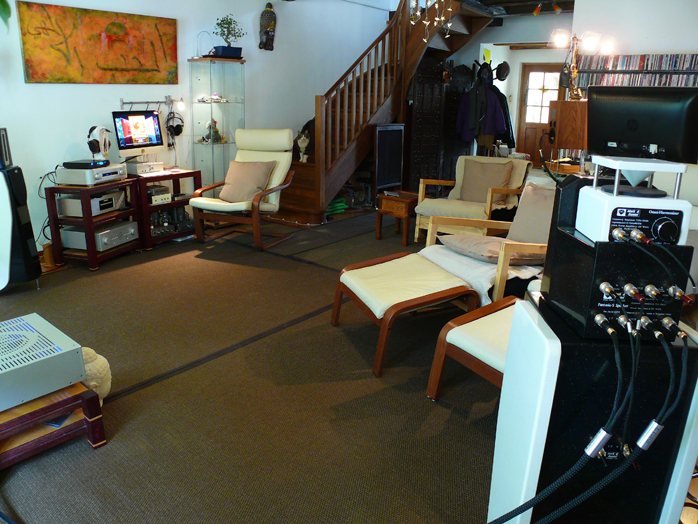
Invicta as converter/preamp: 87dB Mark+Daniel Fantasia S speakers; ModWright's conservatively rated 100/180wpc direct-coupled 2-stage Mosfet amp; 3.8-meter listener distance from speakers; 5.5 x 12m space with openly adjoining second floor. My listening levels now were mostly above -30dB, i.e. still within the range claimed at full resolution compared to an analog volume control. Now add that "production units will come with the
following upgrades:
1/ The Invicta will ship with an IR remote for volume control.
2/ The user will have the option to install one of two types of user
display interface similar to the one you used which
we expect the professional market may prefer. A second one will have the left and right flashing channel displays removed and replaced
by an easy-to-read volume readout similar to the one you
requested. This user interface will be more iPod like
in appearance.
3/ Mac users will be able to play AIFF files on the SD card and not be restricted
to WAV." I don't know about you but that makes me functionally complete.
How about sonics? I've of course put the burden of image/tone density—cajones/huevos—on converters with variable outputs before. As a rule it's always netted greater immediacy/directness on the plus side, compromises on body, bass mass, saturation and dynamics on minus. With the Invicta and FirstWatt F5 amp, my €10.000 Esoteric C-03 preamp even with zero voltage gain but those charged ±38V rails added some profundity, mass and drive as though it conditioned the signal. Into this low-power amp and these particular speakers my tastes would find the Invicta solo just a bit too lean and whitish and especially so at the lower levels I often happily listen to.
|
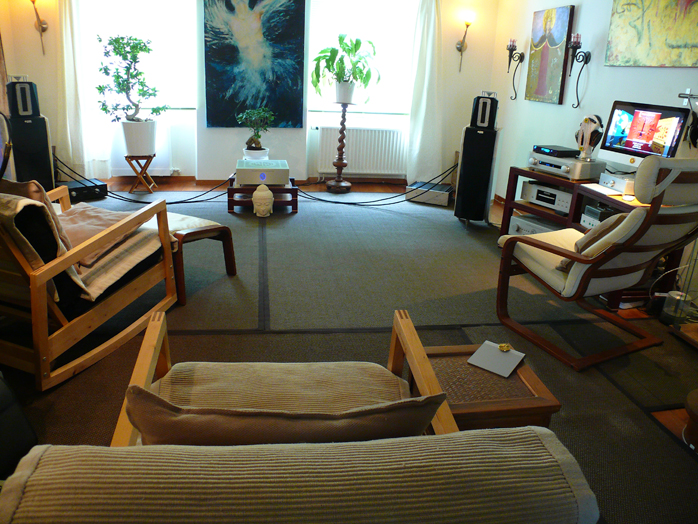 |
Enter the dual-differential ModWright fed balanced. By design and raw power this amp is warmer and burlier than the F5. Now eliminating the Esoteric preamp caused no tears. Energetically—what I think of as musical mojo, transmission or orator's power which connects the music with you in the seat rather than requiring you to seek it out there behind the speakers—I found the direct route superior and preferable. That forward-leaning attitude which projects across the empty space between seat and speaker was active to require no preamp conditioning. Former contributor Chip Stern used to call that the lap dance perspective. I also had long legs in tonal richness or massiveness. Aspects associated with these qualities were dynamic rather than electrostatic in nature. To improve upon this direct-drive combo without the customary Potomac 2-step (stealing from Peter to pay Paul) would, I imagine, involve a very expensive preamp.
|
 |
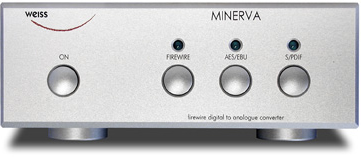
Doing the math: I didn't find the converter performance itself superior to but perfectly on par with the Weiss Minerva. Two years ago the Minerva sold for $5.000 and was fêted king of the hill. In principle then my search for the 'next level up' goes on. Practically however motivation is soft given the excellence at this (upper mid-priced) level. But this still misses more than half the picture. From the Minerva one has to subtract $1.000, then add very real multi-tasking talents. First there is brilliant headphone performance and in tandem no less. Then there is only slightly qualified suitability as a very serious digital preamp with remote volume. Next is the rare memory-play feature which only requires functional but already promised 'screen mode' enhancements to assist with navigation. Then there is a surfeit of hidden—and thus reverse-engineering proof—FPGA programmability whereby the company can for example recode the BNCs and update various firmware. Last but not least there's top-notch build quality including internal execution and that unconventional and costly one-piece milled aluminum fascia/bottom cradle.
|
 |
Contemplating the whole picture finds that this new company's maiden product not only aimed high but delivers. With production purportedly addressing certain functional items my loaner hadn't installed yet, the only useful but still missing feature I can think of might be a Weiss-style multi-step analog gain trim provision, say at 1/2/5V. This would pre-match front-end gain with the amp/speaker interface to minimize the amount of digital attenuation required. Particularly for folks with highly efficient speakers and/or those who like to listen quietly this could be a welcome asset.
|
|
Given lack of precedents, I'm simply unsure over reactions—acceptance, desirability—to the SD card at large. Detractors will point at external SSD drives with up to 960GB capacity to question the concept. Supporters will point at the extra stuff of outboard drives, additional cables and such. They appreciate the convenience of postage-stamp media enough unto themselves. Dragging a playlist into a high-speed Class 10 card takes very little time. If you don't care about browsing and shuffle play but prefer to listen to a pre-sequenced program, the memory card route strikes me as ideal especially in headphone mode. Here the Invicta as complete source/headphone system ought to press the hot buttons of serious headfiers. With the monitor-via-HDMI interface, the card can become an integral iPod without moving parts and a digital-direct connection. For others less concerned with simplicity and health ramifications the card slot could be a non feature. Those who'd say the same about the variable outputs because they would always run any converter through a preamp shouldn't forget that some preamps don't have remote control. There the Invicta's 0.5dB increments by wand become the perfect fine-tuning convenience.
|
|
|
Final words: It'll be up to Stereophile's John Atkinson to put the Invicta through its paces on the bench and create measurement context against his data log of competitors. Given the extensive documentation by the design team one wouldn't expect meaningful discrepancies. What we have here is a newly minted company with a very well-built maiden product. It enters the market at a performance level which as little as two years ago was considered absolute SOTA but then demanded more money for rather less functional returns. Today it seems mirrored by another newcomer, Antelope Audio's Zodiac Gold with Voltikus. While I didn't A/B these machines, the Gold had left the building just a week prior to the Invicta's arrival. I'm certain both compete 'on the level' and head on. The Gold throws in relay-switched discrete resistor analog volume with remote, the Invicta the card and what I think is higher build quality**. The Invicta takes the lead in amp-direct mode and to a greater extent in headphone drive whilst forthcoming and apparently quite advanced programming features should go where no consumer converters have gone before. In my estimation that's a real coup. It's a tour-de-force showing for any newcomer and even more so for one that enters a sector that's as hotly contested as D/A conversion with USB is today.
_______________________________
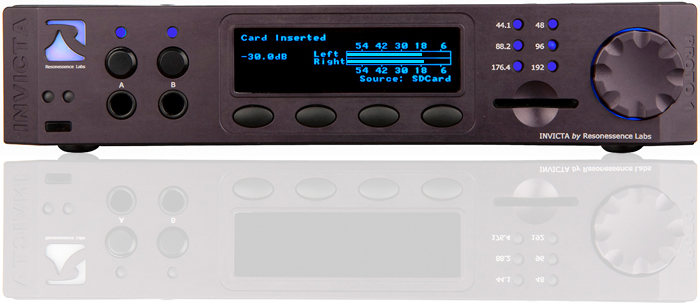
** Canadian subcontractor IMWorks did the chassis design. Mark Mallinson explains this choice: The Invicta chassis is designed and manufactured completely within Canada.
We have taken great pride and care in the design, testing and manufacturing of this unique
chassis. Hundreds of hours were applied to the design optimization within the 3D modeling
environment. The proximity of the components to one another is extremely close fitting. Many design
configurations were required until a layout that would fit in the 'half a 1U space' allocated would be
achieved.
|
 |
Here is a
quote from the manufacturer: “It is very rare that we are approached by an organization that wants to
truly place quality in front of cost. There are many who say quality is foremost but in practice this is very
rarely the case. Resonessence Labs has not restricted our design/build process in any manner. We have
managed to complete what we consider to be the perfect chassis for this product.”
|
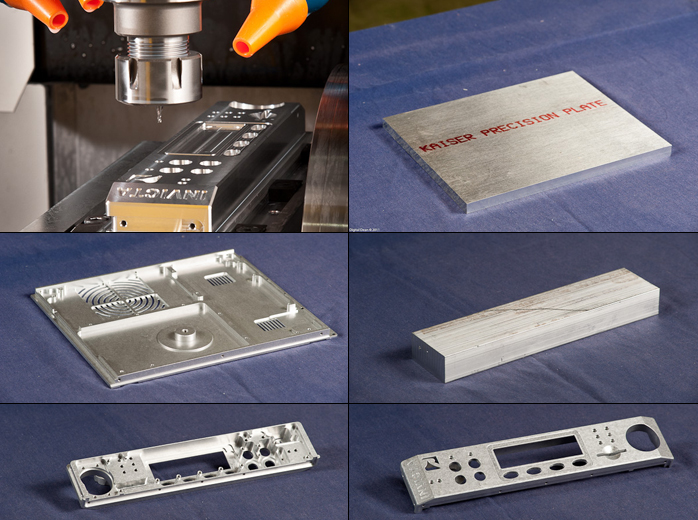 |
The materials, finishes and construction technique are all done to precise specifications. The practices
chosen for assembly of the chassis are not typical to the conventional electronic enclosure industry. The
front panel is a structurally integrated part of the assembly, not a cover to hide an ugly
stamped steel sub-chassis. Many of the tolerances on the manufacturing drawings are held within .001 inch.
The main front panel and chassis base are machined from solid 6061 T6 aluminum. The internal sheet
metal components and fasteners are all manufactured from stainless steel. The latest high speed CNC
machining and CAM technology is employed
to help complete this process. The precision and repeatability of this equipment results in parts that are
exactly the same size ensuring a precise fitment during assembly. Laser etching is employed
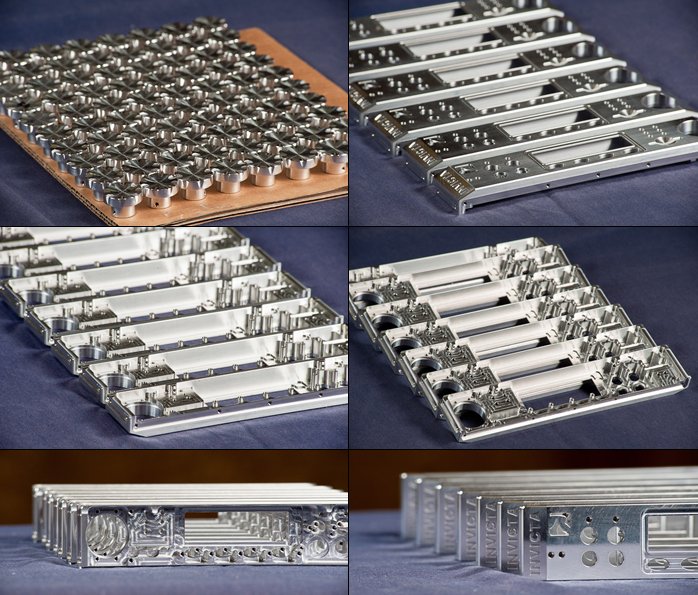
for the permanent marking of the front and rear panels. The front panel sub-assembly is extremely
complicated, containing no less than 27 fasteners. The result of this design is a front panel UI that feels as though carved from a block of granite. The solidness of the switching assures tactile feedback. The overall robustness can be felt every time a button or knob is operated.
The chassis manufacturers are extremely proud of what they have been able to contribute to this
project and hope that you will enjoy this product for many years to come.
|
 |
Postscript May 4, 2011: Given the unexpected dispatch of a pre-production loaner in April made it highly likely that some of my preceding comments would be rendered redundant and mute two short months later when formal production was expected to have addressed many of them prior to shipping. That was simply part of this particular setup. Given the 'on the fly' nature of online publishing, I would however be able to report on subsequent software/feature implementations. Such an addendum will be appended to this review in due time to report on items such as AIFF file compatibility, the 24/96 Mac fix, the 24/192 firmware code, the multi-function remote control, the expanded SD card display UI and such.
June 26, 2011: "We are on track with our software upgrades. The remote, AIFF compatibility and volume readout
display option will all be included in the first production units. We may
even squeeze in USB 2.0 as we now have this showing signs of life.
The SD card display via external monitor is targeted to be released in
time for our first trade show which will the Rocky Mountain Audio Fest
in Denver." |
|
Quality of packing: Very good and professional.
Reusability of packing: Many times.
Ease of unpacking/repacking: A cinch.
Condition of component received: Flawless.
Human interactions: Good.
Pricing: Upper mid-level in this component class but unusually full-featured. Good value.
Final comments & suggestions: Specific requests for programmable features are embedded throughout the review. Minimalist headphone listeners with top-class earspeakers will want to investigate the Invicta closely particularly where listening between two people is desired. Class A bias means warm but most assuredly not hot operation. |
  |
 |