This review page is supported in part by the sponsors whose ad banners are displayed below |
 |
September 1, 2011. That's when a full production unit with remote showed up. Whilst obviously feature tweaked, I asked Mark to itemize all changes. "Improved build quality - the rear panel was redesigned to feature a crafted anodized aluminum plate and the power entry module was relocated
for greater long-term rigidity. There's now a better color match between anodized aluminum base plate, face plate, rear panel and cover. User interface -
we made changes to the LED display to show larger volume. User settings now include default volume level, default source, headphone trim levels, LED and OLED brightness levels and standby mode.
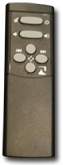
Features - we added a full-featured remote with access system features as well as source select, volume control, pause, rewind, FF.
We implemented USB 2.0 and
file playback via the card reader now accepts AIFF.
|
"Electronics - we improved the headphone outputs with more power and increased the timing-error tolerance for drift of host clock relative to the Invicta's precision clock.
We made improvements to grounding and tolerance of EMF noise.
We also tweaked the XLR output filter to exhibit more HF rejection."
While the plastic wand can't match the Invicta's frontal appearance of being hewn from a slab o' metal, it not only works well but for iTunes users unexpectedly so. As long as the Invicta remains actively connected to the computer, its play/pause and next/last commands hijack the control of iTunes. This cleverly replaces Apple's own wand whose reach is decidely shorter. I thus could skip through albums or playlists from 5 meters away and happily retire the Blutooth Magic Pad I'd gotten used to for that purpose.
|
|
|
|
|
|
AIFF playback via the card reader now worked swell except for one peculiarity*. I routinely download AAC files of obscure new stuff from the iTunes store until such time that I can replace it with a proper Redbook or better version. Good music simply can't wait for full resolution. I've converted some of those files to AIFF to see their file density magically balloon by four or five times. That's sleight of hand. Such files sound no different than the compressed originals. Dragging 'n' dropping those into the iMac's desk-top SD card icon to play them back resulted in invalid file silence. At first I didn't comprehend why out of 15 trial tracks 5 wouldn't play. Then the truth dawned. I promptly deleted the whole bunch and made sure that my second data dump onto the SD card contained only bona fide AIFF files. Now each single track played fine even though the title read-out beneath the big volume numbers didn't always migrate properly. Some tracks showed it complete, some only managed a first letter if that was followed by European characters like ä, ö, ü, é, ç and such for which the current coding apparently doesn't provide.
_______________
*
I wrote peculiarity because in streaming USB mode the Invicta plays compressed files fine. You can even presample lossy music in the iTunes store without issue. Just don't try to play that back via the card reader. That slot has attitude. It only accepts lossless.
|
 |
Also nice was the new headphone offset verification. Simply hold down one of the two 6.3mm port controls.
At a glance this tells you how much extra attenuation you or someone else already programmed in. With your finger still on that button, a twirl on the master control quickly adjusts that value. Display dim occurs over 15 discrete steps and is independent for the main display, the indicator LEDs and the power-blue/standby-red logo. Still MIA was a software control that converts one or both of the current BNC inputs into outputs (engineer Dustin Forman confirmed that this can be done in firmware which will be available upon demand); and the promised SD card GUI for external monitor navigation which was scheduled for its formal public launch at the upcoming RMAF show in Denver.
|
|
|
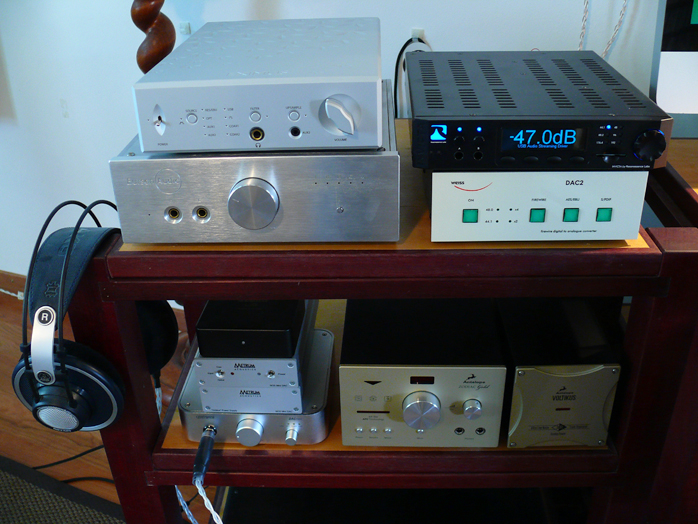
Battle of the DACs: With four other converters of preamp/headphone functionality in the crib—Burson HA-160D, Antelope Audio Zodiac Gold/Voltikus, Centrance DACmini, April Music Eximus DP1—plus a plentitude of headphones, I had the makings of a quantity showdown. The Metrum Acoustics NOS Mini DAC Octave with April Music Stello U3, Burson DA-160 and my original Weiss DAC2 would round out that lineup. Stay tuned while your lone gunslinger gets busy eliminating the competition one by one... |
|
 |
|
 |
|