This review page is supported in part by the sponsors whose ad banners are displayed below |
 |
 |
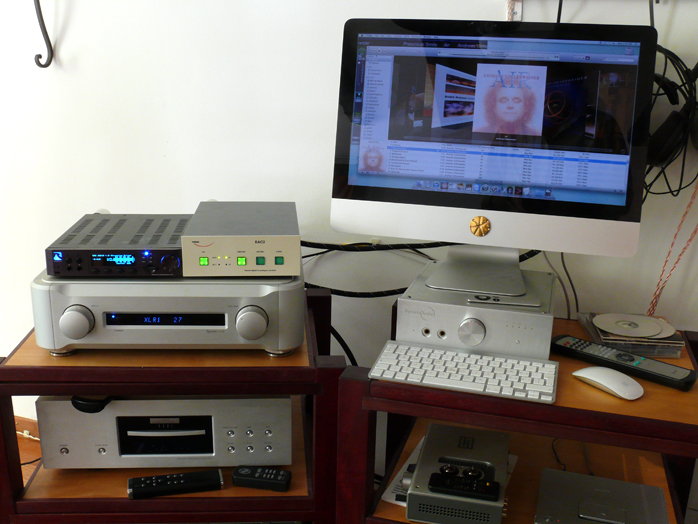
Weiss Minerva/DAC2 vs. Invicta: Obviously my DAC2 no longer represents Daniel Weiss' latest thinking on the subject. Those who've compared it to the more recent DAC202 predictably pronounced the latter mo betta. That's how it can go in this sector.
Legacy digital of course got away with off-the-shelf converter chips. The advanced crop of multi-platform DACs today involves field-programmable gate arrays with application code to customize behavior. This core skill exceeds what traditional analog engineers were comfortable with. It ushered in a new breed of digital audio 'hackers' who must be fluent in code writing. That's a new game.
In this comparison I ran equivalent Entreq Konstantin USB and Firewire links and the same Zu Event balanced cables into the preamp to keep things squared up. Incidentally the Invicta team and Weiss both champion opamps as output devices. So does my Esoteric C-03 preamp. Burson and Yamamoto demonize them. They advocate going fully discrete. Different ways to Rome.
|
|
|
 |
Weiss Minerva/DAC2
|
After many hours of mounting comparative frustration, the upshot was that those who've always wanted a Minerva/DAC2 with USB instead of Firewire input plus a far bigger feature set including headphone drive, remote control, finely calibrated volume and SD card slot now have one. Sonics weren't just from the same school. They were from the same class and virtual doppelgängers. The one aspect I could consistently tell apart (recording permitting!) was that the Weiss with its more centralized soundstage focus lightens in density or substance towards the sides where the Invicta maintained more consistency. Its stage spread was equally solid on the sides as it was in the center. There also were very small textural/timbral differences. Those I could make out at the very beginning of each track whilst focusing down hard on individual instrumental tones. Describing it however proved elusive. What's more, this very minor change of scenery lighting receded from my attention fix so quickly that even though it was a consistent occurrence from track start to track start, it just as consistently was too subtle and slippery to remain identifiable for more than a few seconds. With properly matched levels I doubt anyone could tell these machines reliably apart. Those who hoped that 'best in the world' claims for the ESS Sabre chip meant a real rung or two higher up on that ladder in the sky would eye the Burr Brown BB1792 in the Weiss with real consternation.
|
 |
Given the 'measure close to perfect' focus of Resonessence's documentation, another comment is warranted. In a quiet urban dwelling, daytime background noise amounts to ca. 40dB. If it drops to 30dB at night you're lucky. Under real life conditions rather than the abstractions of a laboratory scope, this means that the Invicta's proud S/N ratio just sacrificed 1/3rd of its 120dB+ advertised dynamic range. The first 40dB are lost in listening room noise floor. Documenting this differently, I ran the Invicta over its RCAs as a 2.5V-max machine directly into my 25/50wpc F5. This meant that anything below -70dB was mute, period. A whopping 55.5dB down to the fully attenuated -125.5dB limit were immaterial. Now add recorded dynamic range or rather compression. You're lucky to see the VU meters overshoot 10dB (with most popular music PureMusic confirms the max difference to be about 17dB). So much of what's measurable in an advanced lab isn't as relevant as it reads. But the war for consumer attention is fought on paper with outrageous specifications.
|
|
|
Burson HA160D vs. Invicta: Once again Zu Event links connected to the Esoteric, balanced for the Invicta to tap its full gain, single-ended for the Burson whose stepped attenuator was additionally lowered to limit at 5V and match the Resonessence. Here frustration over barely telling things apart relaxed. For one the Invicta had the stronger backlighting. Space from behind the performers was more illuminated against the listener. Individual sounds were more embedded in recorded ambiance. This was the case even with productions that don't stand out in that regard.
This distinction translated not so much as additional top-down illumination or aeration as it had with the Zodiac Gold + Voltikus vs. Burson. There textures for the Antelope machine had come across as somewhat fluffier, airier and lighter. Whilst the Burson's retrieval or recreation of recorded space was once again less keen to make it sound meatier or more robust, this wasn't 'per se'. Clearly top to bottom the Invicta did not trail it on image density. This difference seemed to simply be a psychoacoustic function. Equal material substance acquires different weighting when one is considered more on its own—just the steak, no sizzle—and the other in the context of surrounding space (with sizzle).
|
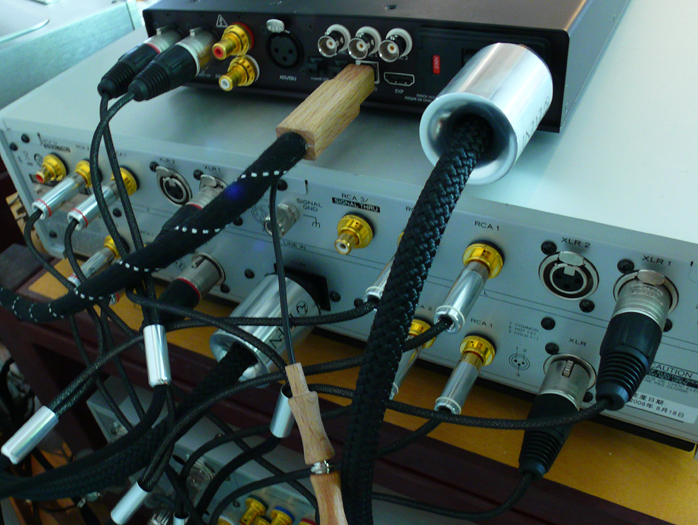 |
What complicated matters was my Esoteric C-03 preamp. Its inbuilt flexibility features in many of my reviews. The Burson's 'analogue' meatiness is best served when the Esoteric's voltage gain is set to either zero or 12dB. Because the Aussie needs no help in the bass with its concomitant effects on color saturation and overall weightiness (that's what higher preamp gain builds out), it responds best to the more energetic incisive transients and greater leanness of lower or no gain (that choice depends on the amp/speaker interface). The Invicta meanwhile clearly sounded best at 24dB of gain.
Running the comparison at 24dB favored the Canadian machine with higher transparency, more audible space and greater speed/incision. At 0dB where the Esoteric operates like a passive, albeit and very signifcantly with ±38V supply rails, the Burson acquires higher spatial resolution/separation but unlike the Invicta didn't wash out on tone and texture. While the HA160D still came in a dimensional second—by a smaller margin however—it now was ahead on what I call incarnation factor. It's this precisely which has me listen more to the Burson than Weiss these days. The latter is simply such a well-covered quantity that it makes for an excellent reference even if it is by now outdated.
I must confess that whatever expectations of an unconditional next plateau or higher octave I might have had based on the firm's unusually comprehensive technical documentation were somewhat disappointed.
As I was with the top Antelope machine I'm convinced that the Resonessence is digitally the more advanced. I also remain convinced that team Burson's insistence on going full-on discrete in the analog domain is responsible for their fleshier sound*. With the flexibility of my preamp standing in for mix 'n' match shifts from ancillaries and cabling which every audiophile system builder exploits, this digital/analog teeter-totter could be made to meet in the middle and balance out for status equality. Or it could be deliberately set to favor one or the other machine by maximizing 'compatibility'.
_______________________________
* It appears Daniel Weiss would concur. His latest Medea+ top converter runs all discrete output opamps like Burson, albeit of Weiss' own design.
|
|
|
That said, I'd absolutely accord the Invicta the lead on raw micro resolution which primarily showed up in ambient retrieval of fine low-level data. Talking in generalities to magnify differences for easier commentary, the Resonessence had the more quicksilvery sophisticated lither finer more feathered-out sound. The Burson was richer heavier darker and more physical and grounded. My secret suspicion based on this comparison and many which preceded it is that we might be very close to—or have already reached—the limits of what's actually audible vs. measurable on digital specology. Adding dual-mono power supplies the size of the Burson alone might still make a nice difference. But that's back to good ol' analog engineering, not FPGA code writing. It's what significantly costlier gear ought to accomplish; the kind I've stayed away from because €10.000 converters these days seem excessive given how good the sub €4.000 sector has gotten and how quickly things still (seem to) change. |
  |
 |
|