This review page is supported in part by the sponsors whose ad banners are displayed below |
 |
 |
Context: I pacified PCfi by April 2010. Prior my digital front end had included models by Audio Aero, Accustic Arts, Ancient Audio, Esoteric/APL, Yamamoto and the big four-box Zanden. Based on my budget and reviews—including one from our own Frederic Beudot—I acquired a Weiss Minerva in its pro iteration of DAC2. This got me started on a still affordable but globally recognized high note. (The Ancient Audio Lektor Prime, Esoteric/APL UX1/NWO3.0 and Raysonic CD-228 legacy spinners remain in-house as reference and backup). The Firewire Weiss has proven a very solid performer. With various USB DACs through since (highlights included the Wyred4Sound DAC2 and Antelope Audio Zodiac Gold with Voltikus and RWA Black Lightning power supplies), what finally displaced the Weiss as my constant work and pleasure machine was the far more modest $1.150 Burson Audio HA160D. With a twin-toroid linear power supply, discrete custom voltage regulators, discrete op amps, a stepped resistor volume control, 10V max output, BB1793 DAC, 24/96 async USB and rich class A bias, this underdog with no street cred proved so strong on 'analog' values that none of the digitally perhaps more advanced challengers could reset my lust button. Displacing the Aussie any thrice or more priced competitor would have to offer fundamentally significant improvements. It would have to operate on a higher octave altogether. Moving laterally, only partially forward or backward on anything won't do. Thus far nothing has dealt that hand.
|
 |
Burson HA160D
|
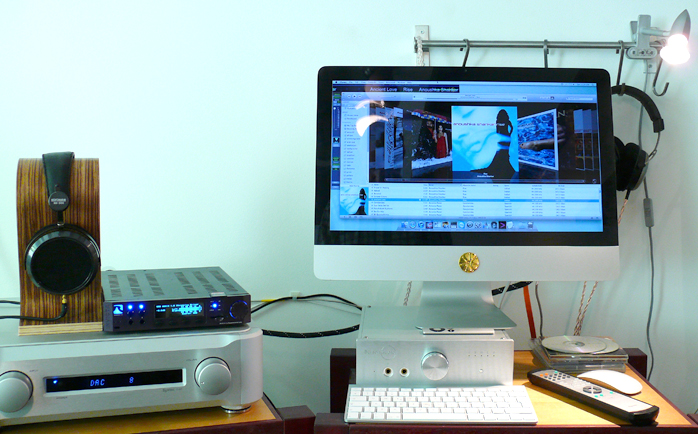
I expect it to happen of course. Eventually. But I've not yet cracked into the $10K leagues due to compunction and serious lack of motivation. When analog extremist Kevin Scott of Living Voice dropped by to set up his Avatar OBX-RW speakers he brought some discs which I duly imported, then played back for him over my iMac/Burson source. So impressed was the British Kondo importer—and he's thus far resolutely resisted streaming digital—that he vowed to duplicate that very front end upon his return to Blighty. Whether or not he actually did is immaterial. The spontaneous desire wasn't. I'm thus not rattled by digital specology. I view it as mostly misdirection. Digital converters that pricked up my ears like the Burson or Yamamoto arrived without any digital razzmatazz. For them I had to dig deep to get any relevant specs at all. On analog meanwhile—I/V conversion, output stage, power supply—their designers were very chatty about no opamps, no feedback and other such old-timey values. Because the Invicta's documentation epitomizes lab rat, I was doubly suspicious. Still, hope sprung eternal that my ongoing immersion in this sector would identify the next unconditional level up from what I knew. This background sets the stage.
|
|
|
|
 |
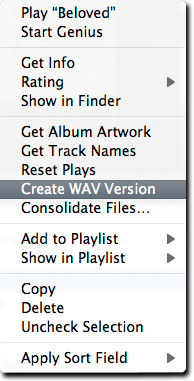
To experiment with the nouveau card slot I filched an ancient 4GB Class 2 freebie from my small wide-angle Lumix. Unhappy with slow transfers I next hit my local electronics emporium. They had a 32GB Class 10 Ultra 15MB/s card and a 16GB Extreme 30MB/s. I paid the 100 Swiss franks for the latter. At 200 x speed even long tracks now took less than 5 seconds to drag 'n' drop directly from the main iTunes track list to the No Name card icon on the desk top. A standard CD took about one minute. Since I didn't want WAV and AIFF tracks doubled up on my hard drive, I reset the import format to WAV in Preferences, right-clicked a desired track and selected create WAV version. This would rapidly insert the copy below the original. I'd drag the copy into the card icon, move the transfer status window to the top of the screen, delete the WAV file the moment it had exported and look for the next track to convert. Once AIFF becomes legit one drags an entire playlist of course, not individual tracks. Doing it now simply meant that I'd have to apply the convert command to the whole list to embed all dupes scatter-shot across the main library and make them harder to find and erase. |
|
|
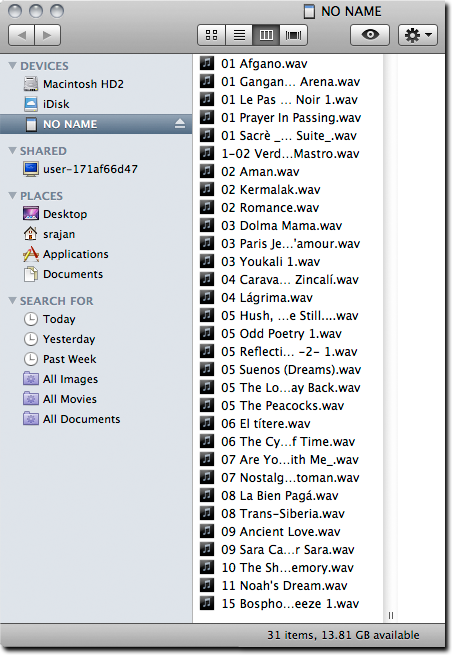
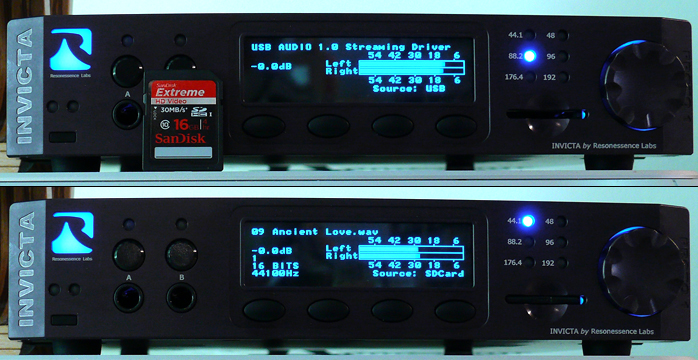
The card catalogued the imported files by original track number, then alphabetically by name. The Invicta for example would display the final track of Anoushka Shankar's Rise album as 09 Ancient Love.wav without artist or album data. Mysteriously playback still followed my original sequencing. Even so Mark's software team clearly had work to do. Nobody with any big library recognizes track names alone. I suggested to him that they also write a second but primary display mode to just show volume as large as possible. |
|
|
The small display's six lines make the readout font about 10 points. That's useless from across the room. Most users also won't care about those dancing digital VU bars or be confused about their source to need it displayed. They would want the volume legible from the seat. The present display could alight for a few seconds whenever one of the front panel controls was prompted, then revert to just volume for the planned remote wand. Being shipped not formal production but golden sample #3 with a proto1 emblazoned on the fascia's right bevel meant that I dealt with earlier software. Whilst sonically final to accommodate an early review, it left me with still crippled functionality. Suspecting that the company's peculiar USB 2.0 is coming comment was spin for working from a Windows rather than joint OSX platform, Mallinson had admitted as much. Class 2.0 USB audio is far from new to Apple users. How a DAC claiming ultra-performance ambitions could even be developed on exclusively Windows eluded me*. But it sure explained the AIFF gaffe.
____________________________
* We understand
there are a lot of Mac users in the audiophile and
professional markets. Early versions of our software such as what you are running now have come out of our engineering
environment where the PC presently happens to be the platform of choice. Most of the engineering tools we use only run on a PC. A
good example for this is the Xilinx development tool kit for the $80 Spartan
6 FPGA. This is not available on the Mac. It's one of the main
reasons why our product development work occurred on PC up to this point.
|
 |
|
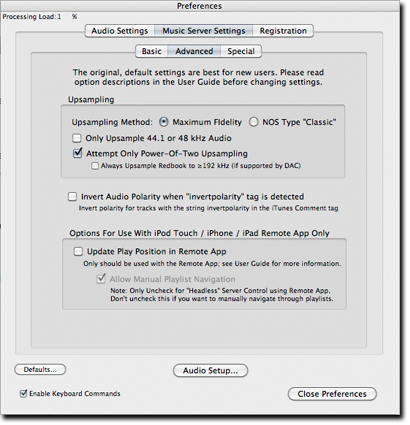 |
PureMusic 1.74 confirmed that the Cypress Semiconductor USB transceiver firmware was only 96kHz capable until the announced USB Audio Class 2.0 upgrade becomes available. This meant that with attempt only power-of-two upsampling I could trigger the Invicta to 88.2 [next image below]. Marking the only upsample 44.1/48kHz audio box instead predictably forced the Invicta to 96kHz, albeit with intermittent micro glitches of drop-outs and other hiccups that seemed like very fast relock artifacts. Those glitches did not occur in 88.2 mode but reappeared with both 96kHz files played natively and 24/192 files which the program automatically made playable by downsampling them to 96.
It appeared that something about the 96K USB protocol was still buggy**. The same files played error-free over both Weiss
and Burson. The Invicta did reset itself to different sample rates without annoying relay clicks or any time delay however. Playback from the memory card was naturally fixed by the native rate encoded in each file [second image below].
|
|
___________________________
** Mark forwarded this finding to his software team who responded with "we downloaded the PureMusic software, tested at 96K and reproduced the problem. (The issue is there even without the software but Mac does not always set the sample rate to 96K.) We captured the traffic and found the feedback is somehow like open loop. We checked the old code and found it was good when both in and out-streaming interfaces were present. During our test the Mac was sending more data however so when music hiccups, it actually overflows and a whole packet gets dropped, then it underflows. We added some lines to our code to prevent overflow and now it works."
|
 |
My first task was comparing USB vs. card using identical files. The remainder of the system was Esoteric's C-03 preamp set to 12dB of voltage gain; FirstWatt's F5 amp; and Mark+Daniel's Fantasia-S speaker with a complete front-to-back Zu Audio Event harness including all Fantasia jumpers. Only my usual Konstantin Entreq USB cable with external Minimus ground station defied this one-brand command (the Weiss later would run the equivalent Entreq Firewire leash). Because of the Invicta's dual-differential double-gain output stage I connected it balanced. For later amp-direct drive I'd swap in my ModWright KWA-100SE for its XLR inputs, then run my 6-meter balanced instead of single-ended interconnect. For the first audition I wanted the Nelson Pass amp for its extreme resolution.
|
|
|
This exercise messed with at least my expectations. I ultimately preferred the USB feed. I felt it was texturally and tonally fuller and weightier. The track which first had me catch on in earnest was the Jimmy Rowles "The Peacocks" tune with its Debussian quote from Bill Evan's last studio production You Must Believe in Spring. That memorable album was posthumously published by Warner Bros. rather than the previous Evans label Fantasy. Rhino's 2003 reissue then added three bonus tracks. It remains a standout in the Evans canon. The card reader felt starker and by comparison very slightly stripped. Via USB Eddie Gomez' upright was more redolent, Eliot Zigmund's cymbals had more substance and most of all Bill's piano was richer as well as fierier in the upper right hand.
|
 |
Without any software upsampling applied, I couldn't understand what should cause this difference**. Playback in either case occurred from memory, one hot-plugged into the Invicta, one remotely accessed by USB. Audiophile religion would predict that the card reader's shorter simpler signal path should have had the advantage. Unless PureMusic's author was up to some tricks. Here I was utterly out of my depth. My ears didn't care though. They called the same winner with Dulce Ponte's Momentos, with an Angelo Debarre guitar/accordeon musette number, a Pat Metheny/Anna Marie Jopek duet and some superbly recorded Øystein Sevåg 'contemporary adult' fare.
Though the distinction was assuredly small, given the altogether greater navigational inconveniences and capacity limitations of the card route I'd hoped for at least unconditional equality.
_____________________
** Whilst re-reading this paragraph one week past publication I had one of those 'duh' moments. I bet the difference came by way of the USB cable being a mite slower, rounder and fuzzier than the card-direct connection to cause a perception of greater roundness and warmth. It's only a guess of course but one that seems sensible. |
  |
 |