"Our overall approach is supported by broad and deep in-house capabilities in computational modelling and data analysis. Whether a project needs huge finite element analysis of stress and vibration patterns or relies on terabytes of 3D measurement data to optimise a crossover, most audio-sector problems are well within the envelope of our past experience. In addition to leveraging the practically unlimited compute resources of Amazon's EC2 and Microsoft's Azure, we have our own GPU-based cluster in Cambridge with over two petaflops¹ of peak compute capability." In short, extreme modelling powers allow YG's speaker design to get ever more granular on not just observing "do this and that happens" but understanding the 'how' of the interaction to then exploit it more effectively. "CAS was founded by two PhD astrophysicists from Cambridge University. Both have strong tech-sector backgrounds and a track record of successful innovation in several industries. Mukund and Matthew love music and share a fascination with how humans perceive sound. Following ad-hoc projects over the past decade, they set up CAS to support growing demand for more ambitious partnerships." Whilst we're fond of calling audio not rocket science, team Webster do approach it from an astrophysics background. They might say that YG speakers endeavour to leave behind the gravitational pull of me-too earth to rocket our listening experience into higher orbit. But as Matthew would be keen to stress, it's not in pursuit of 'perfect' measurements per se. It's about quantifying how to replicate an inspired playback session in speaker hardware. What are the involved mechanisms and interactions? How does a loudspeaker trigger our ear/brain into a suspension of disbelief? Then, how to specifically design for that and remove ever more errors in translation?
_______________
¹ If you thought a petaflop was a hippy flip-flop with embroidered petals, "it's a unit of computing speed equal to one thousand million million (1015) floating-point operations per second." That's the equivalent of running 1'000TB of data per second.
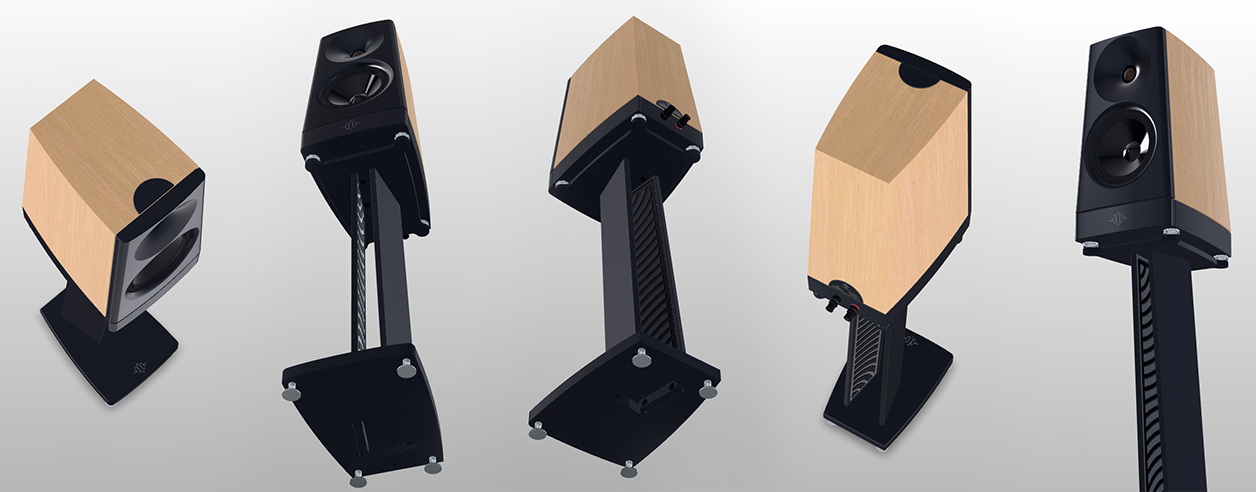
When asked, we'd expect virtually all speaker designers to insist that this is their precise intent, too. What seems to differentiate YG Acoustics from most competitors is their depth of data acquisition and analysis to shape R&D then great vertical integration to control material execution of this R&D in their own precision machine park in the Colorado facilities. As Greg Weaver's factory-tour video shows, YG now make many of their own capacitors after a lengthy apprenticeship with one of the world's foremost specialists in the field; use compressed gaskets wherever enclosure panels join to achieve what they call the tightest air seals of any closed-box speaker made; actually mount their crossovers on elastomeric suspensions outside the main box even though the final appearance suggest a mere sub chamber; and mount Tor's mid/woofer at a slight angle machined into the 1½" thick curved baffle to have both drivers cohere perfectly starting at 6ft to not be intended as a desktop nearfield monitor. After watching the linked factory tour, you'll have zero doubt why YG's rates are what they are. Only their accountant and the investors know just how much the heavy machinery they operate on site cost to acquire. When you outsource, those costs defer to specialists doing contract jobs for outside accounts. When you insist on in-house fabrication, you pay for the industrial equipment, its maintenance and operation. Hence it's not just YG's deep roots in scientific R&D but the sheer scale and sophistication of their fabrication side which dwarves that of most other brands, many of which still procure their HDF cabinets from China. That in-house precision heavy equipment battalion is the second very industrial ingredient of YG's secret sauce. Against that impressive backdrop, how would their 2nd-from-the-bottom model register in my hot seat first solo then gravitationally enhanced by the Descent sub?






… to be continued…