Cracking my Polish care package open showed how Greg has fun with 3D printers. Check out the red plastic retainers he ran off to secure the footers in place whilst hidden bores in the clamshell hold threaded shafts and a hex key to insert them into component or speaker bottoms. In the foreground we see a few of his super opamps.

Here comes another photo showing the three different sizes before loading up my lot with actual mass to put them to work. To the touch they not only look like impregnated so stiffened rope set into an impossibly precise pattern but feel like it. We can bend each individual turn a bit and squeeze the footer inward but my grip strength was insufficient to explore any top-down compression. If there is any, I'd see it under my big sub while pushing down to watch/feel for give.

This cutaway better shows the Vibron's geometry…











… of "40 mini beams quite elastic horizontally but rigid vertically whilst connecting in only a few strategic points for a complex structure that can only be realized with 3D printing".

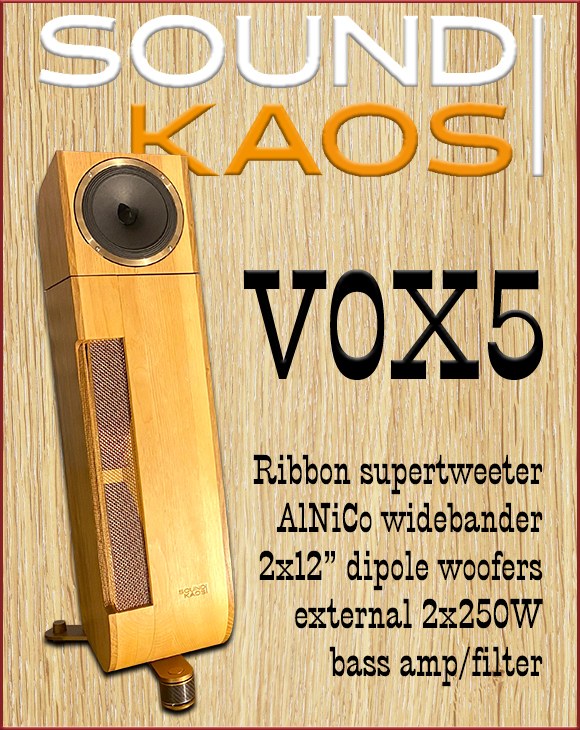
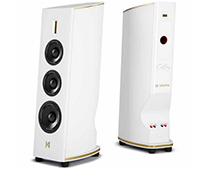 Next we see them under sound|kaos monitors fronted by Simon Lee's AIO from Seoul. Right at this narrative juncture dropped a news announcement: "Maria's high C? Strike the first two words, unpack the C to Callas [€88K/pr] et voilà, Kroma Atelier's newest speaker which does mean to hit a high note by belonging to the brand's top range. This 4-driver floorstander in the company's signature synthetic stone called Krion combines two Mundorf AMT, one front one aft, with dual 8" Purifi mids and one 10" matching Purifi woofer in a rear-ported alignment. At 123kg this Maria is a heavy but her physical stature quite modest at 133cm tall, 56cm deep and 42cm wide. 91.5dB sensitivity and reach to 20Hz round out the core specs. As we're beginning to see with other brands, IsoAcoustics Gaia isolators are part of the package."
The obvious connection is the last sentence. It also applies to Mårten Design who began their collab with IsoAcoustics years prior; Sonus faber who build them into a top model; and Greg's own Qualio IQ Ultra. Decoupling speakers is becoming more widespread. It includes Boenicke, Magico, sound|kaos and Wilson all with their own solutions. In such company the Polish Vibron is a super-affordable option indeed. Are you still hazy on the underlying rationale?

Avoidance of structural excitation. Particularly on suspended flooring of upper storeys, the coupling of mechanically active devices can trigger structural bass resonances which will always be delayed in time so behind the beat. Worse, they can feed back into all other floor-coupled hifi kit. Severing the bridge across which this interaction occurs reduces bass amplitude across the affected bandwidth and the temporal blur which results from overlaying the signal with structural 'echo' effects. Less fat, more clarity. Run-on effects into the midrange are quite common. Obvious variables which determine the severity of the problem are amplitude and bandwidth; and how 'talkative' our floor is to begin with. The lower and louder we play our music, the more we set up virtual jackhammers that pump mechanical energies into whatever they sit on. Making those supports vibration traps or a seriously compromised passage for vibrations has benefits. In the above context where I don't play loud or bombastic save for the occasional DVD with LF effects, the primary benefit was the height increase of the short stands. That changed when…