The differences between the large Carbide Base and Micro under my Trilogy 915R preamp and LampizatOr Pacific DAC mirrored those with the Statement. Hence my route to maximized potency was straightforward. The big hockey pucks armed with upward TwinDamp spikes remained under my Vox speakers, their smaller siblings augmented with rigid TwinDamp bullets and spikes assigned to low-level signal devices. That's the lay of my land which today's Swiss isolators parachuted into. First the Vibra 68 had to battle the large Bases under the monitors followed by Vibra 30 to check on any differences. Next I moved the large Vibra under the preamp and DAC where Micro awaited. I asked myself just one question: could a piece of wire hold its ground against a super-effective multi-stage isolator twice as dear? The short answer is yes and instantly so. Prior to explaining what this meant, first some light on what to expect from a pedigreed decoupler. At first their kind often manifests as though SPL lowered a bit because particularly bass distortion registers as louder. Lower that distortion and the sound feels lighter and possibly less loud. Then come bass improvements on extension, speed, substance, definition, power, elasticity and dynamics. Residual hollowness and boominess from presumed room talk reduce. Vocals strip excess edge and grain to develop more colour, density, smoothness, outline specificity and articulation. The backdrop becomes darker, cleaner and busy nuances are easier to follow. The soundstage expands and develops additional layers while images focus in higher contrast. While many top-tier anti-vibration devices provide these foundational qualities without major sacrifices, the key difference between them is efficacy. The higher that gets, the easier we hear and appreciate the changes they make.

Again, my Carbide Base Diamond footers under the monitor stands are extremely potent yet the Vibra 68 quickly pulled even to consider it as effective which made Martin Gateley's more affordable design quite the overachiever. I detected no disparities other than bass. The Vibra 68 had that leaner yet more guttural and defined, stronger and more raw while on the compliant Base it got fuller, rounder and more relaxed. This shift was easy to hear but not drastic and no reason to call one inferior. That alone spoke volumes about the Swiss isolator's calibre. Whilst the sonic results struck me as a nice compromise between the large Base and Micro on bass mass and speed, its easier use permanently attached under the Vox would be my main reason to replace the current stationary Carbide footers. After comparing Vibra 68 and 30 under the Vox, they proved virtually identical. The one barely registered difference was the 30's slightly fiercer bass attack. Other than this I heard nothing. That gave me a firm idea on who this review's real hero was. After sampling quite a few anti-vibration devices over the years, some extremely costly, I find it quite mental that a footer this tiny and cost-effective can fare so well. I wish I had more to say but really don't. While the skirmish between large Carbide Base and Vibra 68 was very much even so a bit boring, the next rounds against Micro beneath my tube DAC and preamp were spicier. Versus the 68's contribution, the mid-sized Carbide clearly leaned towards precision, articulation, quickness, definition, outline specificity, illumination, freshness and spatial envelopment. In my experience, these traits grow ever more pronounced as an isolator interface gets materially harder. The Carbide Micro with diamond Nano insert and TwinDamp steroids combines five individual isolation layers. The Vibra 68 has just one that's also hard. That elegant simplicity manifested more artistically if you will so with greater depth and saturation, softer outlines, a touch more darkness, wetter textures, higher relaxation and a tad less treble sheen.






To go automotive, the Mini packed higher horsepower on a stiffer suspension, the Swiss traded some torque in favour of comfort. I heard two equally valid awesome options which couldn't decide on what made for the subjectively nicer fit with my low-level electronics. That's how competent today's Vibra turned out to be. If I were to keep them, the 68 would slip under my speakers, the Micro would stay put and the large Carbide Bases migrate under the Statement currently on stock isolators. With two Vibra 30 quads left, I'd either use them under my mono amp or one under a linear PSU, the other on standby for upcoming electronic samples. Knowing how both Vibra types perform the same, they could also swap places; or the 30 could change places with the Bases under the Innuos. The list of feasible uses is long and exciting. No matter how I look at it, bold performance leaps are what I see courtesy of these extremely gifted Swiss footers. They're way up there on the performance map together with the bigger costlier Carbides. That's my core takeaway. Let's wrap.
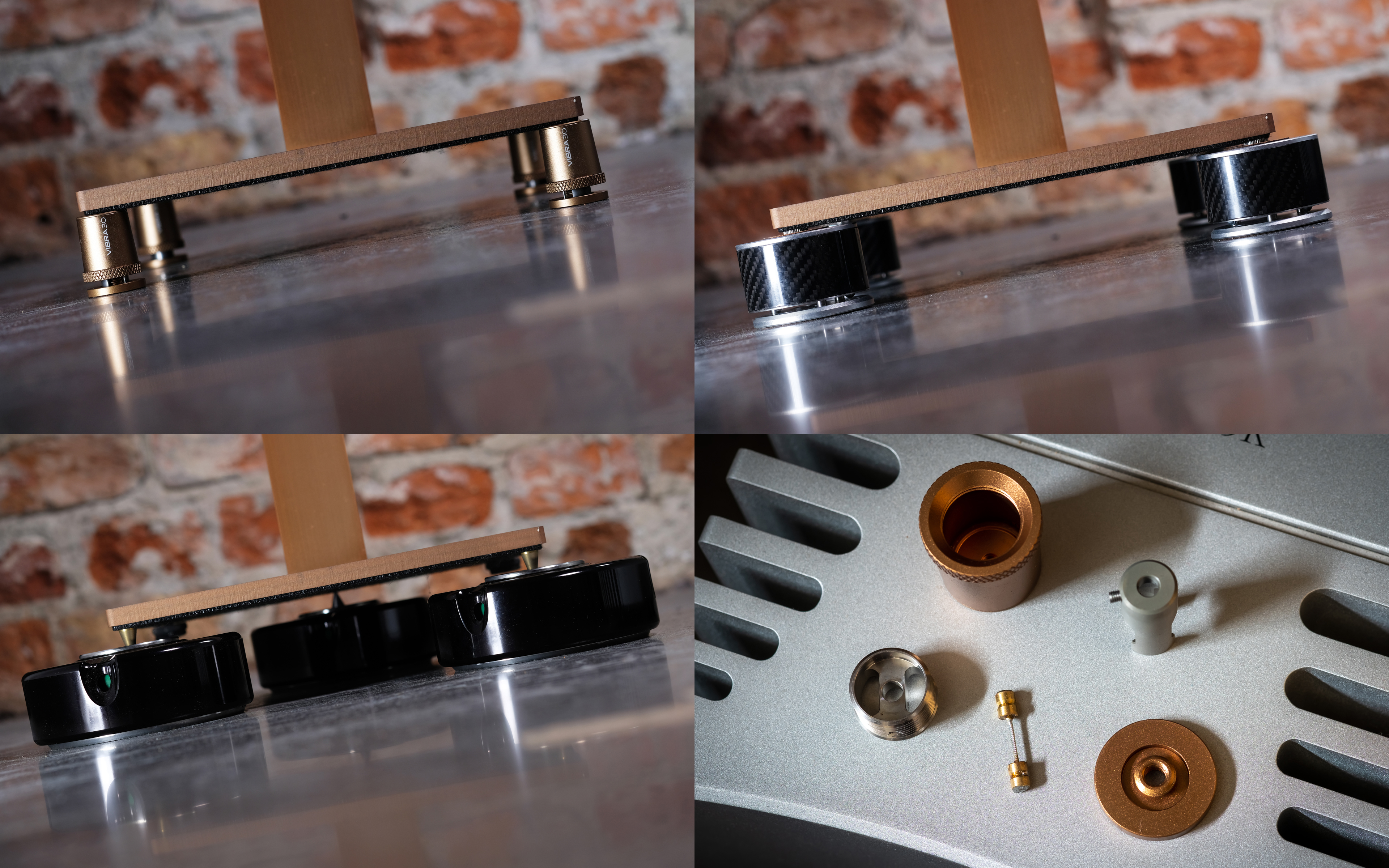
Martin Gateley designed his compact Vibra isolators with speakers in mind since that's what he builds. Although they support them in spectacular fashion, their effectiveness under tubed components is just as fiendish. So I'm chuffed with these Swiss-made beauties. Considering price, mechanical smarts, fit 'n' finish and wholly positive gains, it would be a crime to ask for more. That said, the Vibra 30 is this report's brightest star. Don't let its petite footprint fool you. On its financial turf and well above, nothing I know comes close. For context, a highly effective €2'500 LessLoss power cord does clearly less for my electronics than a trio of Vibra 30 does for about €530 with VAT, import duties and shipping. Hello! To improve a five-figure DAC or pre this significantly with such a small outlay is peanuts. If Martin charged twice for Vibra 30, I'd still consider it a major bargain worth every penny. If it doesn't meet your weight requirements, the competitively priced larger Vibra 68 will. What these footers do is identical, profound and truly wicked; so much so that after sorting out our room acoustics, I now consider them a tweaker's mandatory next target before ever spending any money on AC conditioners or power cords.

Publisher's comment: Resonance control isn't very popular. Many performance-engineered racks look more like laboratory or torture kit than fine furniture whilst pricing gets unwieldy. So many listeners skip the topic entirely. Given how much of my own experience and conclusions overlap Dawid's, I was thrilled to read his 2nd opinion with speakers and electronics. Where spending €3'500 on a single ball-bearing footer from Ansuz's top tier is oligarch extreme, today's CHF140 Vibra 30 makes experimenting with an effective decoupler a rather saner exercise. And since these are small, they won't add that laboratory geeky aspect to our hifi which in many households just won't fly. Still don't believe that effective resonance control is most audible? Now you've got two reviewers on this site who staunchly disagree. Resistance is futile? If that overstates, how about temptation is now within reach? If you don't experiment with effective resonance control, you'll never know what it does. With the barrier of entry now lower for something that flat-out works, you can have a go beyond just reading about it? If not, we'll just have to keep writing about it. – Ed.