Class D-etail. On raw detail, class D in the more affordable sector often up-legs the linear legacy. Its switch-mode power supplies are quieter and recover faster. They bypass the 50/60Hz power-line frequency and its harmonics and mustn't recharge big slow capacitors. It's why the 2nd generation of Vinnie Rossi Brama electronics which include direct-heated 300B moved from linear to switching supplies. Manley Labs and Nagra, Aavik and Chord, LinnenberG and many others have embraced audio-specific SMPS for the same reason on class A/AB outputs. In the linear supply camp, we routinely see S/NR ratios from 78dB in many valve amps to just around 100dB in good transistor amps. That equates from 13-16 bits of data density; just about CD quality, often less. Meanwhile such amps may be preceded by DACs that clock 140dB figures to achieve 23-bit rates. It's obvious that these signal pipes clog up. They filter out detail like a fishing trawler's fine-meshed net. Singxer's SA-90 approaches 24-bit resolution to mirror excellent current D/A converters. We really hear more and deeper into our recordings. On that score the Singxer circuits compete with superior class D amplifiers. That's far from a back-handed compliment. It's a fat forward-paying fact because our speakers then ears get more to work with. This assessment also applied versus my Kinki EX-B7 monos. The half-power SA-90 were quieter to paint low-level ambient and harmonic cues and hues with a broader pallet and finer brush. To phrase it economically, were Singxer to repackage this circuit in thicker heavier bigger metal and style it less pedestrian, they could easily charge double and remain perfectly competitive and high value. They'd only lose out on the power meter. There 200-250 watts remain a perception marker of Bryston-style muscle amp chops. Meanwhile Singxer's honesty even misses the magic 100-watt figure. Punters who shop by those numbers already wrote off the SA-90 on our first page. They misjudge the significance of power doubling's extra 3dB amplitude at 200 watts. It's punters who shop on signal-to-noise specs with a clear insight into what those signify who are still here. And their sort will be extra keen by now.
 Kinki monos: twice the power, twice the size, twice the price.
They're listeners whose ears watch. They delight in sensing the recording venue, how distances and angles to various images differ relative to the observer. They're audiophile trekkies whose final frontier is space. They demand that the invisibility of silence become visible space whilst micro decays light it up like a meteor shower does a black sky at night. They enjoy the mental inspection of musical architectures. That parsing relies on separating out intersecting lines and layers in the beat, harmonic and melodic domains. In this venture, separation is king and key. Reverb is the action which follows direct sound via recorded ricochet off boundaries. That rapidly loses energy as it travels. Unless it's a heavily reverberant venue like the proverbial cathedral, decays are exceptionally short-lived. Anything which clips them off prior to their recorded expiry minimizes even negates our ability to perceive recorded space. At worst we end up with cut-out images in a vacuum. Think shadow play in two dimensions. There's no connective tissue between images, no planktonic residue of ambiance. It's a desiccated starkness. To my ears a lot of budget class D is guilty thereof. My techno peasant brain calls it overdamping of the mid-to-high registers. It feels as though fades die prematurely. That dries out the atmosphere, sucks out its oxygen and eliminates 'half' and 'quarter' shadows. Music gets binary as either black or white. We're back at my shadow play. On this score, the SA-90 begged to loudly differ from the hyper-damped so dry archetype. It tracked even more gossamer games than my resident monos do. It made it still more obvious that individual images share common performance space without clumping up in the least. In broad terms we might say that its separation intensity mimicked hi-res class D, its ambient recovery top-shelf class AB. In non-tech terms, I'll call it a meet of the crystalline and organic, slight emphasis on the former. If you're a tweeds type who likes his woollen warmth and the weight of heavy-soled brogues, you could find the SA-90 too sporty and lean. That's their crystalline aspect. Use the correct speakers and you'll have proper fleshiness without amp-caused opacity, congeal or smear. My Qualio IQ's hybrid dipole dispersion created just that. That was a most commendable match, no additive colorations from an active preamp required or desired. Put differently, I could most happily live with the Singxer monos as my main system anchors. Only reviewing cred would take a hit. That's if one subscribes to the notion that as the monetary value locked into one's hardware escalates, so does one's standing in the audiophile community. Were I worried about that of course, I'd not dba 6moons; nor build my systems with heavy reliance on the Far East. Aside from China, that includes Taiwan and South Korea with brands like COS, Enleum, MonAcoustics and Simon Audio Lab. So cred be damned by praising the SA-90 as heavyweights at their budget. Their performance is right on the level with the rest of my kit.










The ideal buyer for the Singxer monos strikes me as someone who wants to build their hifi house on a foundation of class D's spooky cleanliness but then demands a treble that's harmonically far richer and more sophisticated plus a temporal gait that's more fluid so less mechanical or clipped. In short, she wants great clarity without those overdamping effects which choke off decays to dry out recorded atmospherics. Her emphasis is on 'truth' and headfi-type resolution. In this context 'beauty' isn't meant to be created by additive enhancements or soft focus. Beauty is to be a reveal of what the music data contain. To clean those proverbial plates down to their pristine porcelain and leave nothing to the dishwasher relies on high resolution. That's simply a combined function of two great lows: noise and distortion. To my ears, that's the design credo and sonic aesthetic behind Singxer's new monoblocks. That it's been realized with such cool-running and compact chassis, with a classic if minimalist class AB circuit of just two output transistors driven by a 300VA linear power supply, is really impressive. That we get power-doubled 180 watts into 4Ω with perfect channel separation for €1'500 the pair so NAD/Rotel coin spells impressive in all caps.
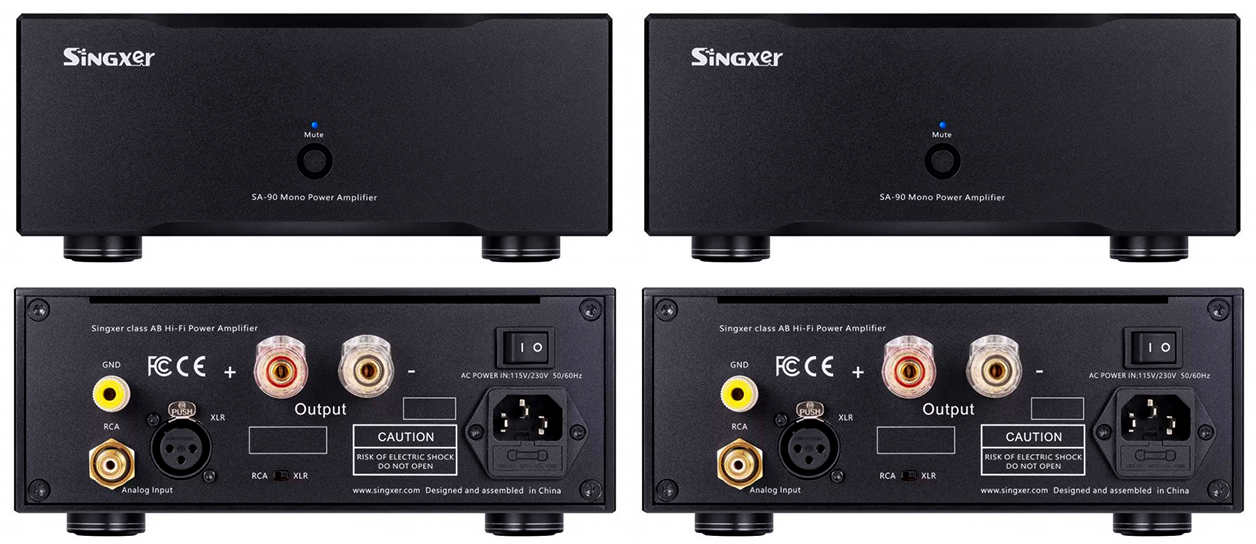
What makes this so unexpected is that until now, Singxer focused on digital. What's more, they're not one of the mainstream Sino brands like media darlings Denafrips, Holo or Prima Luna. Many shoppers whose needs and budgets overlay the SA-90 to perfection will have never heard of the brand. How many will believe that these amps really ace it? How many of those will give a relatively unknown brand a chance? These seem to be the only real questions. All the rest of it is done, dusted and delivered with a delightful dip; what the British call a curtsy. If you need a manlier message of proper thunder and lightning—more street cred, bigger size, higher weight, greater power and snazzier industrial design, escalated sticker be damned—these SA-90 shoeboxes aren't for you. They're far too unpretentious; and too hardcore minimalist. Yet they very much are a secret entrance into true high-end/resolution sound which should be rather more within reach than what's typically required to get into that space. So now the SingXer SA-90 mark that spot as the most affordable non-D monos I've heard which, given everything else I've auditioned or own, I could happily get older with. That I'd not expected when I signed up. But there it is. Anything less just wouldn't be true. Whilst you could argue my opinions until hell freezes over, you shouldn't argue that I always call it as I hear it. So don't ask what I really thought. I just told you so…