Across the range. How the M7 performs full range I described in my year 2020 review ending in an award. Because today focused on its bass mastery—an application very few readers will duplicate when most all subwoofers are active to leave just bi-amping—revisiting the M7 across the range seemed useful. Going upstairs now meant the inverse of downstairs. By replacing my usual Crayon CFA-1.2 speaker amp, the M7 would cover 60Hz and up driving high-passed MonAcoustic SuperMon, 4" isobaric minis only good to ~60Hz by virtue of diminutive size. So the 2 x 9½" sealed sub fills in down to 25Hz. How would the M7 strike me now as vast-majority driver being 4 x as powerful as the Austrian resident?
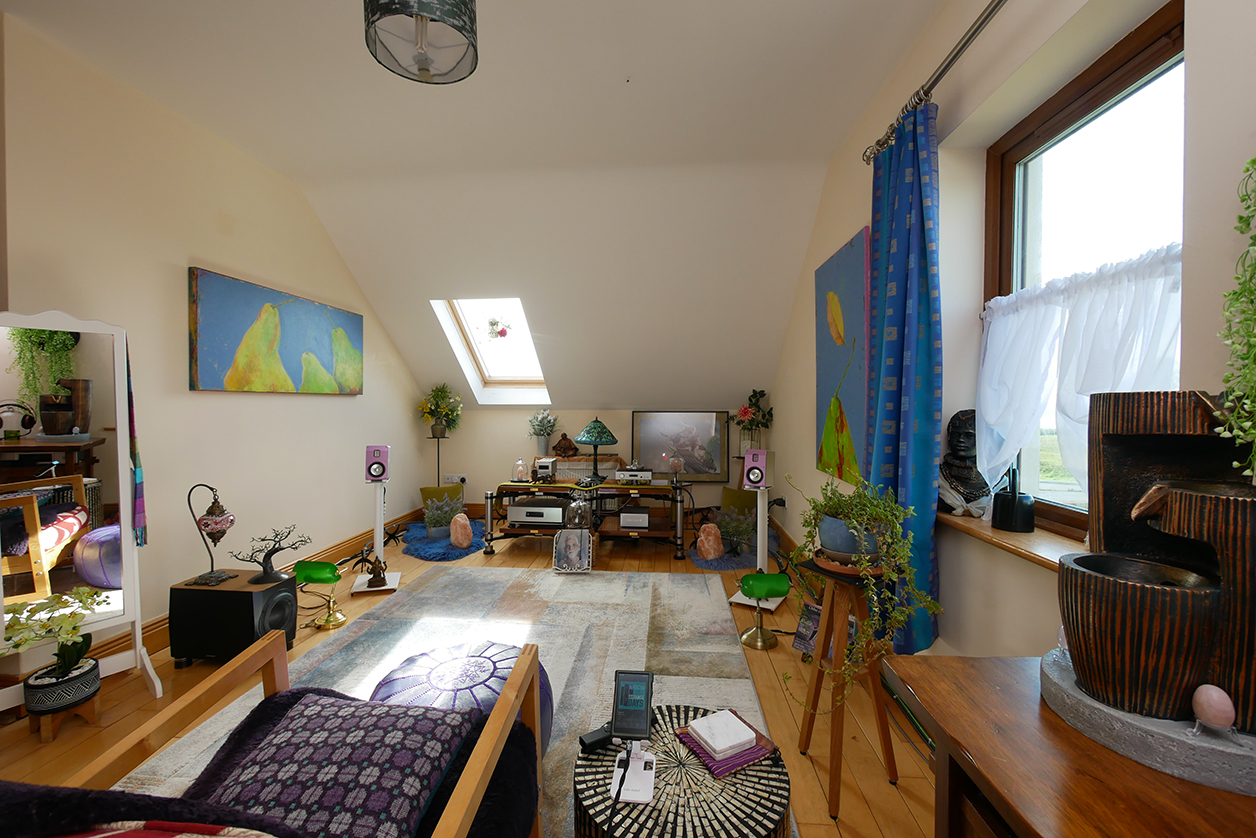 A Shanling M3 Ultra plays SD card server USB out into a Soundaware D300Ref USB bridge That then sends out AES/EBU over 6m floor-board runner cable to a Sonnet Pasithea DAC with analog volume control.
Cut from the same bolt of fabric. If I heard any meaningful difference, it was in the harmonic domain. The EX-M7 was perhaps slightly warmer; but if so only marginally. As such I'd call it an Über Crayon because it transfers the sonic signature to far higher power; and because it sacrifices no reflexes in trade. That unfortunately makes sense only to Crayon initiates. So it's better to add a few things. First off, think bona fide high-resolution sound that doesn't go soft at the extremes—in this system obviously specific to treble not low bass—to be uniformly quick. This sound is stripped of fat and its less certain timing to come across as broadband lit up and lucid. That it never goes lean beyond being simply fit and energetic is compliments of proper nearfield tone. Such tone still packs its full upper harmonics before those dim over distance. This isn't any cream from triode-type 2nd-harmonic enhancements whose octave-doubling gelatin tends to obscure the far higher more subtle overtones. It's why this sound feels faster, crisper and snappier. Unlike much class D, it's simply not overdamped or harmonically bereft. It's just fully awake and on.








Now we're back at my fascination with Raal's ribbon headphones driven off Schiit's Jotunheim R. Blazingly fast and fully in the light top to bottom, they remain my unrealistic yardstick for how I also want my speaker systems to sound. It's unrealistic when to go low, speaker drivers pack ever more moving mass to be a far cry from open-baffle barely-there ribbons whose entire surface is the de-facto voice coil. In this smaller room, it's eventually meant these tiny widebanders in alumininum cabs completed at the very top with small AMT, then hung properly so not out to dry with a sealed force-cancelling sub situated appropriately forward to compensate its 2.5ms digital latency.
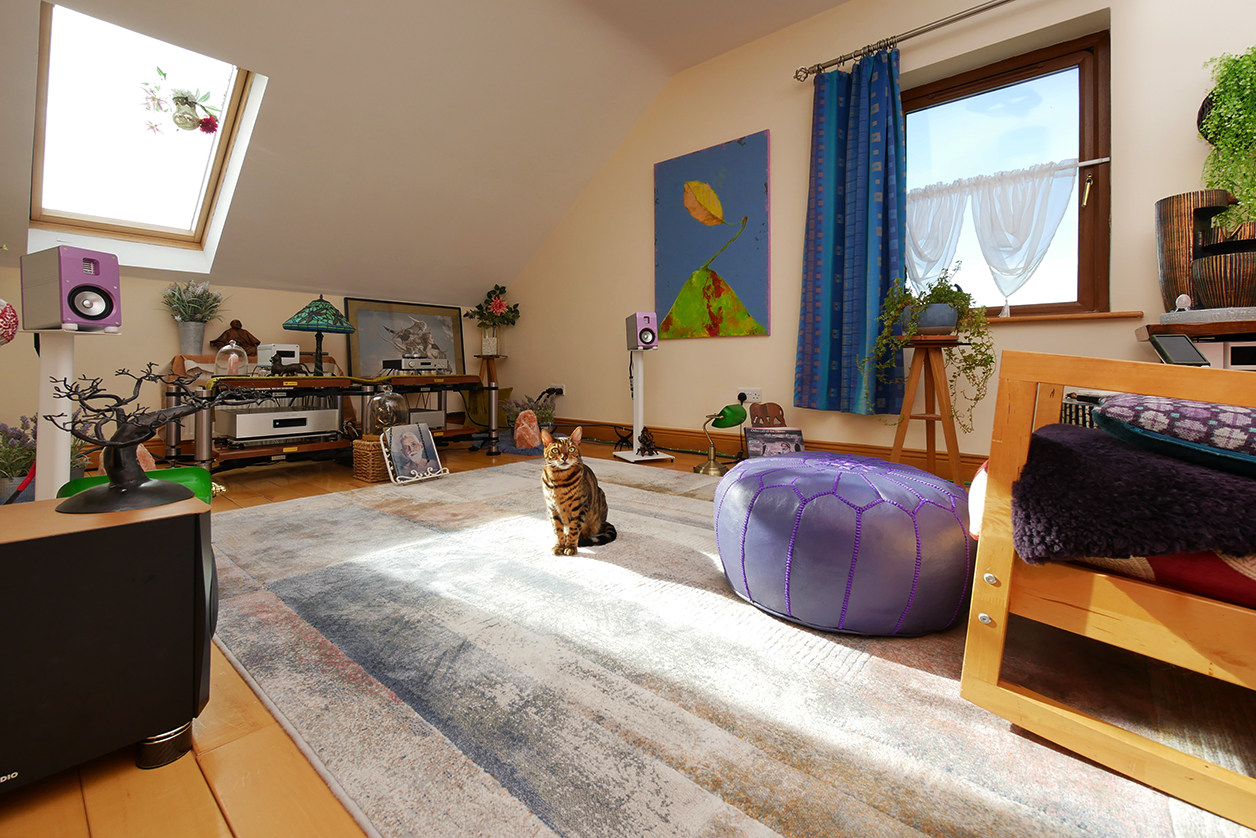 Chai Baba our lounge-leopard Bengal sniffs out anything new in minutes then brushes up against it to claim it as part of his kingdom. M7. Added.
Without benefiting in ways I noticed from quadruple power—being high-passed, these monitor voice coil don't ever see any low bass—this setup shall very contentedly return to the long discontinued Crayon CFA-1.2. The M7 was always meant for our big sound|kaos sub. You'd expect 15-inch woofers to engage in different power-mongering than petite 4" widebanders. But clearly the passage of time hasn't dimmed my enthusiasm for Mr. Liu's Rotel-priced stereo amplifier. It still flies the flag of my original Blue Moon award.
In a way then, that's been 20:20 foresight for a change. Albeit three years late, it even led to eventual ownership so not a sorry tale of one that got away. Mistake. Fixed.