 The next three cables all contributed to my final result in a major way, their noise/distortion-lowering effects being additive to lead to the heightened resolution, dynamics and rich tonal colours I view as Furutech's NCF hallmark. Starting with the Lineflux NCF RCA interconnects one level below the top-line Project V1, we forego Furutech's most advanced silver/gold nano metalurgy suspended in oil but otherwise benefit from the full complement of their best tech. Compared to my long-time Zu Varial and Absolute Fidelity links, the Lineflux NCF was more open, dynamic, vivid and drew a broader deeper soundstage. The Genesis cable was much closer to the Lineflux and in a blind session I'd probably have labelled it the next level down in the Furutech line. But the venerable Varial in my system for almost 20 years sounded constrained and grey when reintroduced, two adjectives I never thought I'd pin on it but the comparison was punishing.
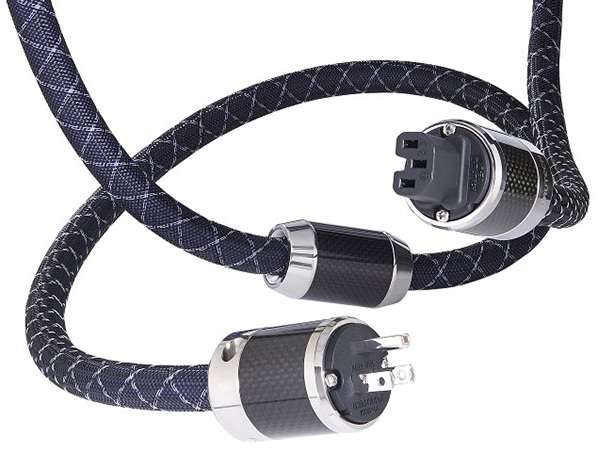
Until recently the NanoFlux power cord was Furutech's best but recently dethroned by the Project V1, another 50% more expensive. I first tried the NanoFlux plugged into the GTO-D2 power distributor assuming that feeding the cleanest power to the distributor should benefit all downstream components for the greatest effect. There was no doubt that alternating between my Zu Mother cord and the NanoFlux revealed the same overall effect I now associate with Furutech. It just wasn't as profound a shift as what I heard with the Lineflux interconnects.
But the folks at Furutech clearly know their stuff and had warned me that my connection may not be the best use of the NanoFlux and that I should test it also directly on the Tambaqui DAC and Enleum amplifier. They were right. The NanoFlux had a more profound effect on my Enleum but it's when I connected it between the Tambaqui DAC and GTO-D2 distributor that I met its fullest effect. An old audio adage says to invest the most on the source because anything lost there will only further degrade downstream so always start off cleanest. That certainly proved true for me. The Tambaqui's resolution responded well to being treated to such a superlative cable although I suspect that most other components would be equally happy with one of Furutech's 'lesser' cables. But if you own one of the mighty DACs or amplifiers of this world, the NanoFlux proved to be a powerful enabler to fully experience what such components can ultimately do.








The NanoFlux speaker cables gave me the most heartache though they did contribute to the overall effect without a doubt. When reverting to my Zu Event or Genesis cables I favoured until now, I could absolutely hear my system taking a step back for a little less air, sparkle, space and imaging precision. The NanoFlux speaker cables are better built than anything I ever had. If you can afford them, they won't disappoint. In the context of my system however, I had a tuff time allocating half the budget so over $8'500 to cables which contributed perhaps 10% of the total result. Maybe with more demanding speakers driven by far more muscular amplifiers, the effect would be greater? I don't know. I'll miss the Furutech speaker cables because they are better than my current crop but when I try to objectively assess how to allocate a budget across my wonderful Furutech samples, those would be my last pick.
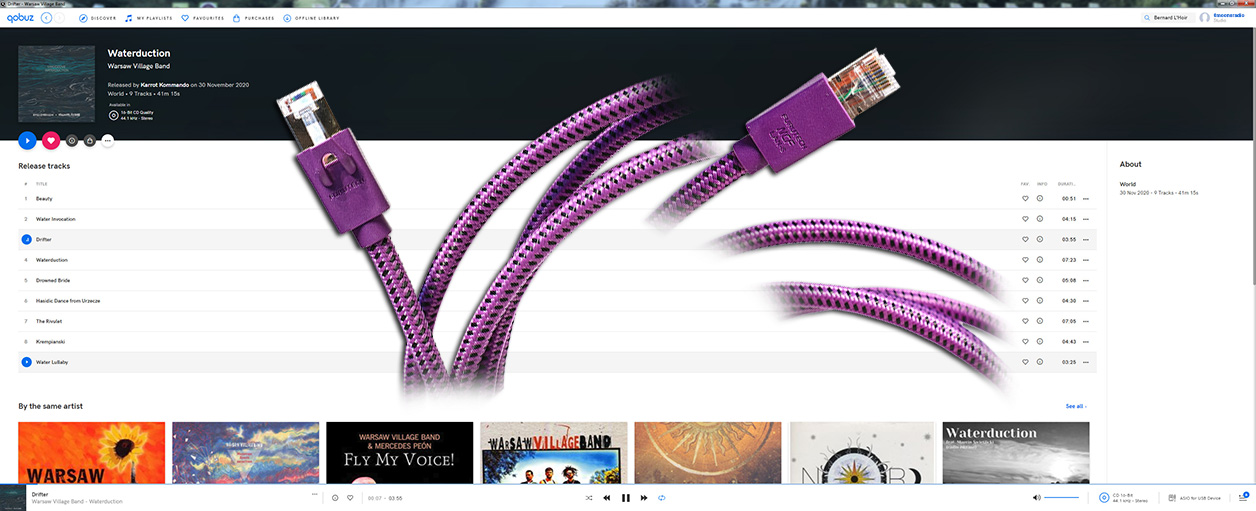
Time to wrap. I didn't think I'd have fun doing another cable review but I did. The Furutech sound was about all that I love: extremely resolved but never showy or aggressive, helping throw a huge soundstage with precise placement, airy and elegant with superb tone colours, at once fluid and dynamic, never constrained. Best of all, you can get a good helping of it without spending insanely. The full effect gets progressively clearer. If your system is up for it, a full-hog investment will pay off. Before splurging on cables costing tens of thousands, simply identify where the bottlenecks are in your system. It's only due to the Tambaqui DAC, Lumin streamer and Enleum amp that I could fully appreciate what a full Furutech loom brings to the table. My previous system suffered too many bottlenecks in resolution and dynamics. I wouldn't have appreciated how far Furutech's top tech can really go. I'll leave you with one final thought. Find a cable brand with a house sound you like and play the cumulative game over time. Mixing and matching cable brands is more likely to create counter synergies than benefits. I don't know how much of the improvements in my system came from simply layering up cables and noise killers that shared one gestalt rather than my usual bag of misfits accumulated over decades. All I know is that the resulting synergy with the rest of my system was ear-opening. Although each singular effect was subtle, the cumulative result was unmistakably intoxicating. Thanks to Graeme at Furutech for letting me have this experience!
Publisher's comment: My own experience with Furutech's NCF tech mirrors Frederic's to an 'f' for fabulous. By that I mean that for me too, their passive NCF-augmented power distributors work better than far costlier active filters; and that the 'dirty treble' which can be digital's shadow is very cost-effectively cleaned up with Furutech's slinky HDMI, USB and LAN cables. Like him, I'd look first at those digital cables and the four- or six-outlet GTO passive power bars to maximize my return on investment in Furutech NCF coin. And to pour oil on Frederic's one-brand loom suspicion, I too have long concluded that sticking with a front-to-back loom from one provider even if not of their best outperforms an arbitrary hodge-podge of 'superlative' samples from different inherently mismatched suppliers. To sing with one voice, it's best to stay loyal to one cable brand.