

 June 15th, 2021. Grey matter. We all have it. It's how we use it where we differ.
There's even really dark matter, still hypothetical likely composed of as yet unknown sub-atomic particles. Its presence is implied by a variety of astrophysical observations. Those include gravitational effects that can't be explained by accepted theories unless there was more matter than can be seen. This dark matter doesn't appear to interact with observable electromagnetic radiation like light. It's invisible to the entire electromagnetic spectrum. That makes it extremely difficult to detect, hence dark matter.
If your grey matter were lodged in the busy skull of one Ivo Sparidæns of Dutch speaker house Æquo Audio, you'd not worry about hypothetical dark matter. You'd engineer your own very much concrete though still strange matter to design better speaker enclosures and drivers. Hello Diluvite™, an umbrella term for a new portfolio of nano-enhanced composite materials spun off Æquo Audio.
It all starts with that age-old battle between stiffness and damping. The more of one we chase, the less of the other we get in a slow dance of mutual exclusivity.
"Stiffness and damping are the two desired properties when fighting off unwanted vibrations that cause side effects like distorted audio signal and panel vibrations. Stiffness helps to take on force without bending or deforming (Young's modulus, storage modulus) whilst damping sheds energy via dissipation (loss factor tan). Metals like certain aluminium alloys, steels, titanium and beryllium (lightweight and stiff but expensive and toxic) excel at stiffness but self-damp poorly. Certain pure metals like magnesium have good damping but lose those properties when alloyed to become strong  enough for manufacturing.
"Extremely stiff carbon-ply epoxy laminates and ceramics can offer double or triple the stiffness of metals but fail the loss of energy when made to resonate. The actual procedure of laminating carbon ply also limits design freedom and increases labour costs.
"Diamond may lead in hardness but suffers poor damping combined with high cost. Both synthetic diamond and beryllium are starting to disappoint as the promised solution in high-end loudspeaker driver membranes because they do raise odd-order harmonics whilst lowering even-order harmonic distortion at the lower end of the usable bandwidth. Furthermore, most of the resin-based and ceramic super-stiff solutions offer poor thermal properties.
"Since the arrival of nanotech in the 1980s, large leaps in composites performance have become possible by applying technologies on the scale of nanometres and micrometres in surface science, chemistry, biology, energy and medicine. In micro fabrication and molecular engineering, many breakthroughs report on what’s possible with organic (carbon) and ceramic-based composites. The more famous ones are carbon nano-tubes (CNT) and graphene where the building sheet used for CNT is a single layer of hexagonally bonded carbon molecules.
"But promising specs on paper don't always make good performance. Many carbon nano-tube apps disappoint on cost vs performance. Most issues link to lacking production processes and dispersion problems. Also, commercially available CNT in a matrix composite—regardless of single walled, double walled or multi walled even when properly dispersed—will always trade gained stiffness against poorer damping."
If you're Ivo, you're deep into these hi-tech materials sciences. You start there and eventually end up with different nanotech composites which feature very unusual property combinations.
The first is a metal matrix composite or MMC of extreme stiffness and high damping. "It provides better damping than any commercially available alloy, surpassing even lead while being far stiffer than alloys of aluminium. Its unique crystal structure makes for excellent damping loss of virtually the same high value at any frequency from 0.01Hz to >100khz, something normally never seen in alloys or polymers that suffer resonance problems at certain frequencies.
"The composite is stable up to temperatures beyond 300° C and comparable to aluminium alloys for its excellent thermal conductivity where it can be used as heat sink in advanced audio cabinets and chassis as well as specific aerospace apps. Energy dissipation is maximized while density remains significantly lower than steel. It is free of toxins like lead, mercury or beryllium. Although the material as cast is naturally corrosion resistant already, all properties can be further enhanced with our specific Vantacoat™ surface treatments."
Developed for lightweight uses and smaller parts including speaker driver membranes, Ivo's new polymer matrix composite (PMC) "sets a new standard for its combination of low mass, high stiffness and high damping. This composite can be pressure-cast or forged by hot-compacting and is seven times lighter than our Nanocast MMC and up to two times lighter than carbon-fibre applications. The resulting damping properties are far better than any recent CNT polymer/resin solutions whilst providing stiffness higher than that of high-modulus epoxy resins. Additionally and as with Nanocast MMC, this polymer version is a standalone solution without laminating, making possible complex forged or moulded designs even at much thinner wall requirements than those applicable for metal casting or thin-ply laminations."

Not content to leave good enough alone, Ivo's Diluvite Nano-Gold™ material aims at "ultimate high damping in structures/designs made with our Diluvite nanotech composite portfolio. This advanced compound is specially structured to be applied as an ultra-high energy dissipating sheet solution added to Nanocast MMC or any flat surface of materials chosen for their extreme stiffness but lacking in damping loss. The most effective version of the compound sheet is a 4mm thick matrix holding titanium nitrite-coated tungsten carbide solids. Chosen for their ultimate stiffness which is over three times higher than advanced steels combined with a density that's more than five times heavier than granite rock, these carefully designed particles have a special 3D-sloped prism shape to dissipate any vibrational force vector regardless of its direction. This results in utmost efficiency at preventing and eliminating any resonance in designs like anti-vibration platforms and high-end speaker cabinets. The clear viscoelastic polymer matrix gives an interesting view into a micro-level tri-directional and macro-level non-directional matrix as formed by the chaos of triangles/prisms. The clear resin is specifically capable to allow a straight passage of infrared radiation to be reflected by the triangles. Gold is the colour proven to be most effective for heat shielding." There's even a new coating material to further enhance the properties of the above substances.
For the ultimate deadlock between stiffness and damping, one would use Nanocast MMC™ finished in Vantacoat™ sandwiched with the Nano-Gold™ ultra-damping compound. "Glued together with a special viscoelastic high-strength epoxy adhesive, the two sandwiched materials plus coating deliver a very design-flexible solution of great stiffness and ultra-high damping plus great thermal properties. Those applications in need of ultimate anti-vibrational performance can be created by sandwiching the Gold compound sheet between two layers of Nanocast MMC whose outer surfaces are enhanced with ultra-high stiffness versions of Vantacoat sprayed in extra thick coatings of up to several millimetres." By April 2020, the Diluvite portfolio of nanotech composites counted nine different materials.
Just to cover basics for Æquo's next-gen speakers took many words already. Yet we only managed to touch upon what its enclosure is made from. We haven't covered drivers, filters and performance specs. You'd expect proprietary materials from big names like Magico, Rockport and Wilson. You see firms like Crystal and Kroma rely on Hi Macs, Krion and related synthetic kitchen-counter stone from big petrochemical corporations. Mark & Daniel pour their own. Kaiser prefer tank wood. That newly engineered better alternatives would come from a small Dutch company could surprise unless you've read our reviews of their Ensis and Stilla. Those included plenty of advanced engineering. With Ivo's Diluvite development, that part exploded. If Æquo Audio's first iPad presentations at HighEnd Munich 2019 were any indication, there'll be a number of licensees wanting to secure the rights to design with these novel building blocks. As to Ivo's own speakers, not just their enclosures could benefit. Definitely for the pending Diluvium super speaker, we should expect driver diaphragms beyond graphene never seen before.

"Unfortunately, some issues also apply to graphene. On paper it may have the single highest stiffness value but as a coating, it doesn't much help gained stiffness because the thin 0.334nm layer related to the spec is usually insignificant to performance. The boosted high paper spec only applies to the in-plane direction of the platelet, hence the actual improvement when structuring it as a nano tube. Multiple layers fail to help because they don't bond and freely slide over each other. By definition, only fewer than 10 layers are considered transparent graphene. Higher layer stacks turn grey in color to become exfoliated graphite."
 Five months after I'd penned the above, Ivo's partner Paul Rassin dispatched an update.
"I’ve been meaning to catch up for quite a while but things are so very hectic at the moment. Time has become a most precious commodity.
"We are currently installing a new precision CNC machine. That will be able to make the detailed moulds for the new passive model and other Diluvite applications. Since the new model has been completely redesigned after its birth as the wooden Gladium, we changed the name. New design, new material, new name. It is now Adamantis. When the first casting trial is complete, I will get back in touch. I will then have more information and a realistic timeline.
"To show the difference, here we have the original wooden Gladium on the right, the Diluvite Adamantis on the left. Adamantis is smaller yet maintains the same optimized cubic volume. It gets more curves, gains in elegance and of course wins that resonance-free enclosure.
"We had been talking about this model for quite some time but after the presentations of the new design in Munich, communications with our distributors became a bit confusing. That ignited the name change because it is indeed a very different loudspeaker.
"Regarding Diluvite, we decided to split it off from Æquo Audio. Diluvite will aim much broader since we also want to supply other audio firms. But for speakers, we will keep the cast material exclusive to us, then offer it to manufacturers of all other audio equipment such as amplifier heat sinks, DAC enclosures, tone-arm tubes, hifi rack shelves, struts, footers and more. This way Æquo speakers will remain the only ones which are completely built from our proprietary material.
"We have not decided yet what to do with the driver membranes we already designed. Keep them exclusive to Æquo, sell them to other brands, something in-between? Ivo has now made a sheet so thin and light, it is perfect for tweeter membranes. It has the same stiffness as beryllium but 15 times better damping. Very cool stuff. Who the hell needs diamond?"

If you want to be a girl's best friend is who. Can you see the tagline? "Adamantis – a speaker even Wolverine can't scratch."
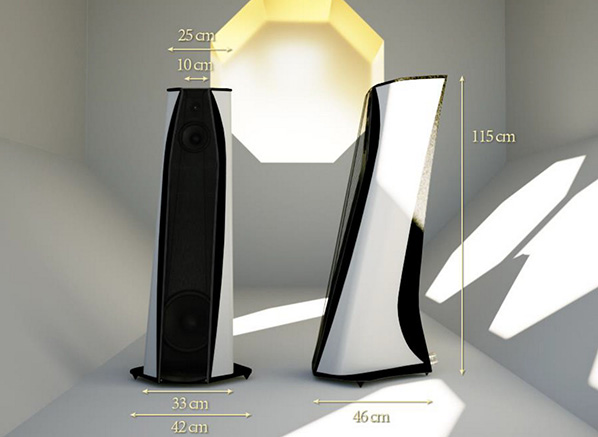 From Gladium to Adamantis. What became possible with Æquo's novel nano composites that wasn't before? "It allowed walls at a fractional thickness of those required by more traditional wood/aluminium panels whilst providing vastly improved anti-resonant qualities. It allowed greater design freedom without increased production labour. Adamantis has similar cubic volume as Gladium's prototype but is a much more graceful speaker. Gladium also needed a smaller tweeter to reach sufficient vertical dispersion by mounting on a baffle tilted enough for satisfactory time alignment. Ideally a baffle curves at different tilts between midrange/woofer vs midrange/tweeter. The new design achieves that. Now a bigger tweeter like Ensis and Stilla doesn't hurt vertical dispersion. This provides for increased resolution from a lower crossover point. Other than membrane size, the Gladium tweeter had its parameters based on the Stilla tweeter. When evaluating the potential of Adamantis, we felt it would best fit the super high-resolution Ensis motor. This positions it far beyond any passive loudspeakers at this price.
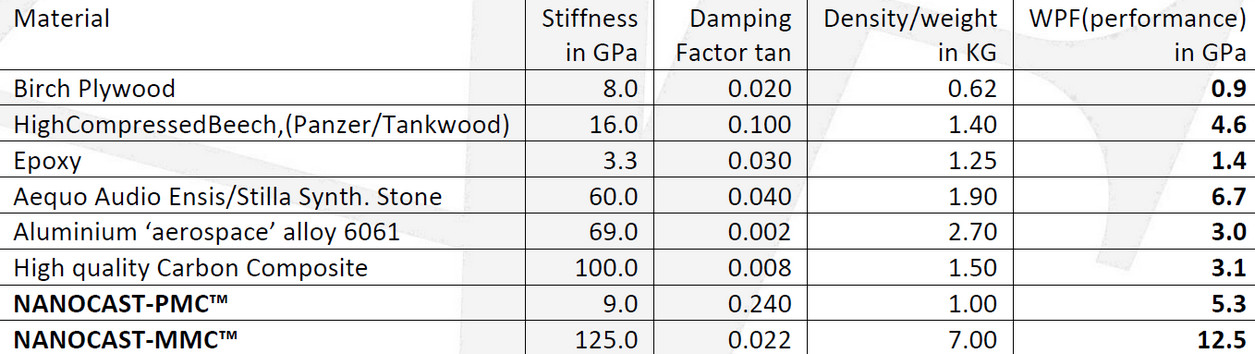
"Bending and pre-tensioning walls/panels increases anti-torsional stiffness. Pre-stressed structures also provide vastly better damping. Still, some material-specific resonances might occur. Anti-resonant properties effectively multiply when bonding two different materials. One damps the other. It’s best to choose one for high stiffness, the other for max damping. Nicely curved walls made from sandwiched materials might perform but are harder to predict and make for higher production costs. Ensis used a ceramic/polymer composite on front and top, billet aluminium opposite the woofer and Finnish birch ply braces in a forged multi-wood sandwich hull. Measurement evaluation then added a very expensive tungsten-filled resin composite to specific areas. Stilla used similar features in a more cost-effective full ceramic composite shell without tungsten. Applying these measures, the compact extensively braced Ensis and Stilla only needed 1cm thick walls with some extra material for problematic areas."
 "Most larger and/or less curvy speakers need far thicker walls, even those made from more advanced materials. We've seen highly damped not so stiff Panzerholz (Kaiser); fairly damped/stiff ceramic composites (Wilson); Panzerholz/ceramic (Kronos); quite stiff poorly damped aluminium (YG, Magico). Some brands use aluminium or wood with intermediate damping layers (Gauder); carbon, epoxy and MDF (Rockport); glass fibre with balsawood (Vivid). We've see pre-tensioning with bolts (Magico) or mechanical features (Sonus faber). Looking at performance versus price, increasing value seems not so easy.
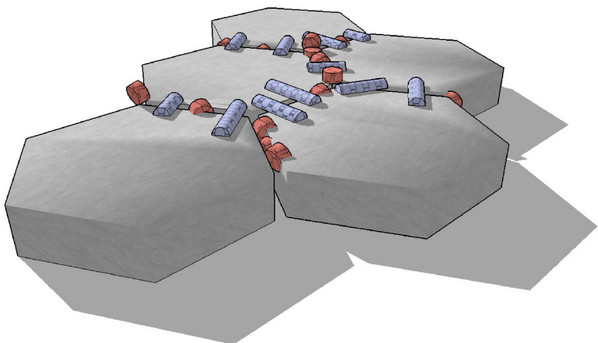
"Nanocast™ helps form an ideal crystalloid configuration of metal molecules [silver hexagons at left]. This ensures damping regardless of frequency, consistency and permanently without need of tension which wears down over time. Enhanced stiffness comes from connective nano elements [violet tubes] which tightly hold the grid together. This prohibits bending and allows more energy storage capacity. It then optimizes damping by increasing friction between crystals with nano boundary modifiers [red] as well as improving thermal conductivity by bridging the molecular grid for increased energy transfer. This greatly improves the composite's thermal conductivity.
"The Adamantis cabinet is cast in two complicated shells of non-resonant metal matrix composite joined by 11xM10 bolts. These custom fasteners seal the enclosure with damping-enhancing tension three times higher than standard bolts. Derived from computer modelling and simulating the dynamic forces at play, the cabinet then adds two side reinforcements in front of the woofer with a strong connection to the plinth. Additionally, several slanted inserts filled with thermoplastic Nanotech damping polymer composite [violet areas below] decouple the enclosures of the tweeter and filter from the enclosure of the woofer and its port as well as provide an acoustic barrier between the higher/lower cabinet halves."

"The Adamantis drivers are custom tailored with our Danish specialists and production partners at Audio Technology and ScanSpeak for absolute performance and best-in-class consistency. Low compression rubber surrounds and spiders, symmetrical motors and low self-induction on both in/out strokes show very high linear excursion reserves. Our unique 40mm fixed-silk-dome-plus-ring tweeter redistributes vertical/horizontal energy in the most optimal ways. Inherited directly from Ensis, this tweeter is far less resonant than beryllium counterparts or fast ceramic and diamond specimens from Accuton/Thiel and surrounded by a fully compressed wool mat. The 10" aluminium woofer too is very similar to that of Ensis but here almost doubles its maximum dynamic output with a port tuned to 20Hz which operates in the pressure domain and optimizes air flow efficiency by horn loading the front opening."
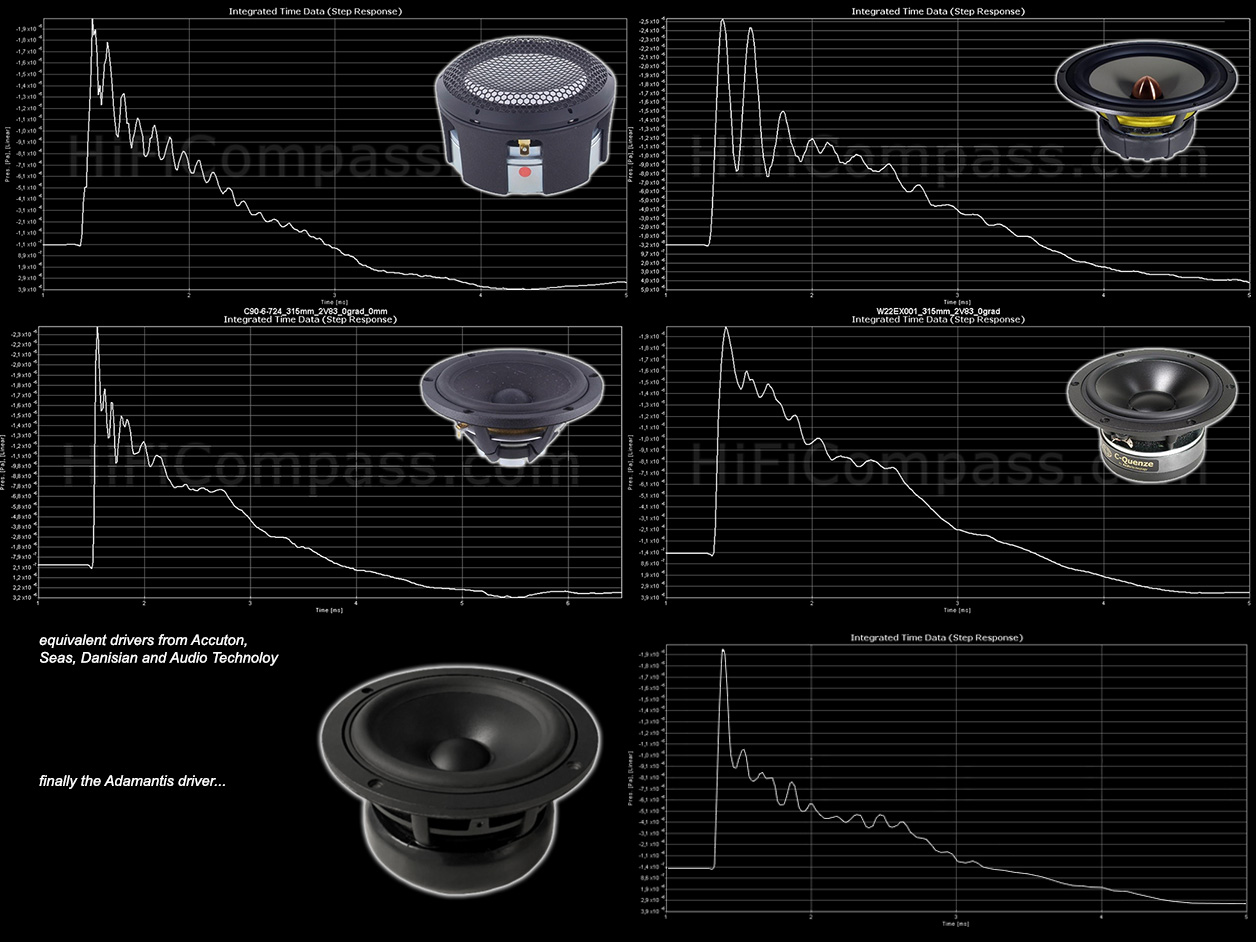
"Entirely new is the Adamantis 5" midrange. One of the distinct requirements was matching its now passive woofer's efficiency. To arrive at higher overall sensitivity, we would have had to raise woofer efficiency first by using a thinner lighter membrane or adding magnetic force to its motor. The first would increase cone-induced distortion and trade first-octave output for upper-bass efficiency. Adding magnetic force would have over-damped the motor system to again limit output. Our new purpose-matched midrange with ±3mm linear stroke thus has a paper-pulp not mineral-filled polypropylene membrane."
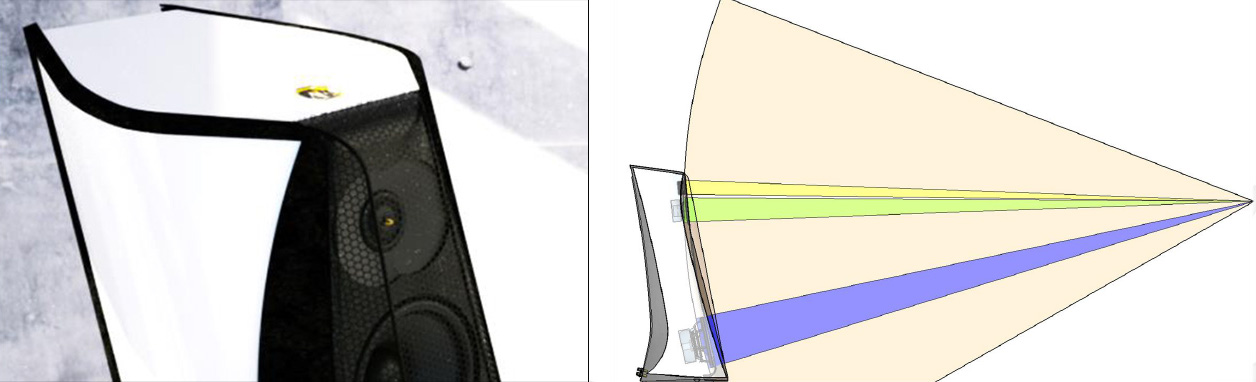 Curved baffle time alignment
"The three Adamantis drivers sit behind a fixed extremely open hexagonal mesh—16% more transparent than the Accuton versions—which adds magnetic screening to all the drivers behind it. To ensure vibration-free operation, this shield is reinforced with solid 3mm rods along both sides of the front grill panel. The enclosure's top and side inlays are made from multiple layers of different high-damping polymers based on epoxy resin, ABS and acrylic/PMMA to constraint each material’s specific resonant behaviour. These inlays come finished in various high-gloss lacquers such as white, black and red. Optional are metallic versions in white, ice blue, dark silver grey and beige gold. We will also offer some exclusive brushed metal and/or patina finishes as well as a large variety of beautiful real-wood veneers similar to the selection currently available for Ensis and Stilla."
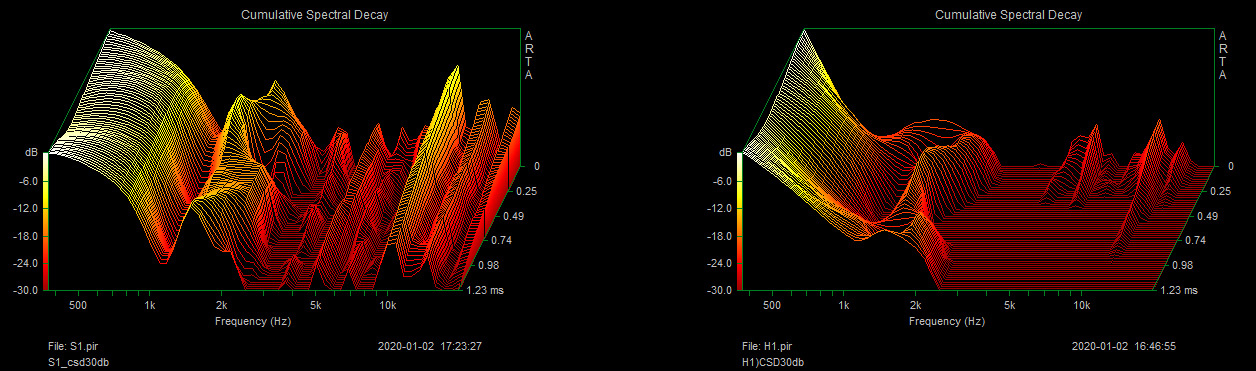 Enclosure behaviour of 6061 aluminium versus Nanocast-MMC™
The electrical filter in its sealed compartment uses "low-order slopes with super-wide bandwidth phase alignment made from high-quality Danish and German parts. Precision-value air coils made to order feature in a symmetrical layout with audiophile polypropylene caps and low-tolerance super resistors". The biwire terminals are WBT. Sensitivity is 88dB/4Ω, claimed -3dB in-room response a whopping 19Hz – 40kHz. Despite compact dimensions and thin walls, each speaker weighs 80kg or 176lbs [not! – see anon – Ed. ] and sits on three M8 spikes."
In short—or rather, quite lengthy—Æquo Audio's Adamantis already years ago promised to be a true hi-tech speaker, from a company still far smaller and newer than one might expect for such a dive into the very deep end of innovation.
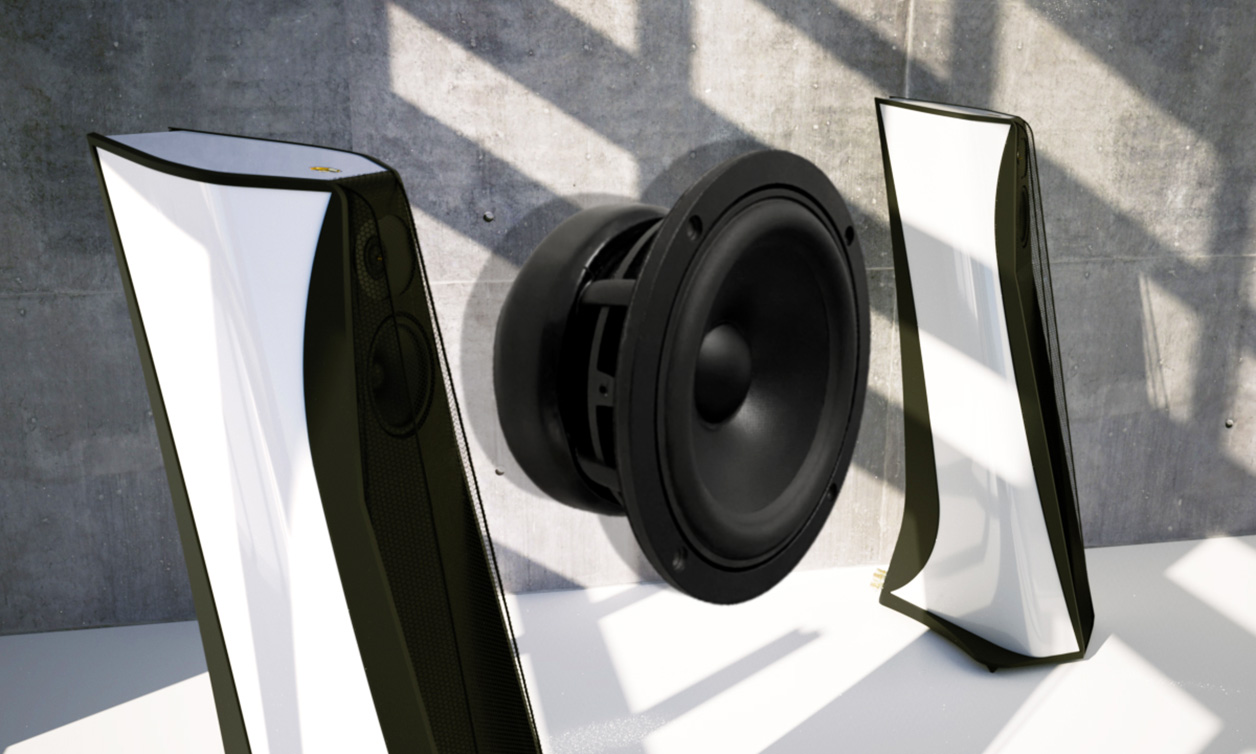
At the prior Munich show, I'd asked Ivo about rib patterns since cast panels afford design freedom to treat their inner surfaces. Aerospace likes isogrids for their ratio of stiffness to strength to weight. For hifi apps mindful of minimizing resonances, grids of repeating equilateral triangles are most prone to resonance because their ribs make continuous straight lines. "Pentagons and heptagons are better against resonance but won't combine into standardized grids." What Ivo's resonance-optimized ribs look like remains a secret. Suffice to say, they combine multiple geometric forms which break up straight lines. If you were wondering what the insides of Adamantis look like to render the panels even stronger, to avoid smooth flat surfaces and to be acoustically least reactive, it's the æquogrid pattern.
June 16th, 2020. Checking ito the project's progress, I learnt that Corona-related layoffs had delayed the Adamantis launch by placing the two principals in hands-on mode to fill burgeoning Stilla orders on the production line. The obvious core challenge for Adamantis was the creation of the master mould from which to cast the two enclosure halves in Diluvite nano metal. That mould can be CNC'd from a €6'000 block of solid; or 3D-printed from scratch. After discarding a few milled blocks for imperfections caused during CNC, Æquo discarded that process for being too inefficient and costly. Rather than outsource the second option to compete with other clients, jobs and schedules, Paul & Ivo meant to own their process. Coffin-sized to create monolithic moulds also for bigger future cabs, their new 3D printer wasn't just physically large but also a larger investment. Casting from these moulds was to take place in a nearby foundry specialized in casting aluminium. When Paul and I telephoned, Ivo had just finished installing their new printer. It works off the very same 3D files he uses during the design process. It requires no fussy conversion to a CNC-based computer language. Asking Paul whether they had ETA for first Adamantis samples just then—a growing list of pre-orders heated up the schedule—Paul though that if their mould printing netted early success, September 2020 was the target. If the learning curve there or in the foundry threw spanners in the works, it could be later. Nobody had ever cast in this material before. Learn as you go was the motto. To illustrate just one tolerance challenge, "the areas where the clam shells torque together with eleven bolts must be perfectly flat or there will be air gaps." Whilst assembly of the finished powder-coated parts will become child's play compared to Stilla and Ensis production, arriving at perfected parts could still become lengthy chapters of this origin story.
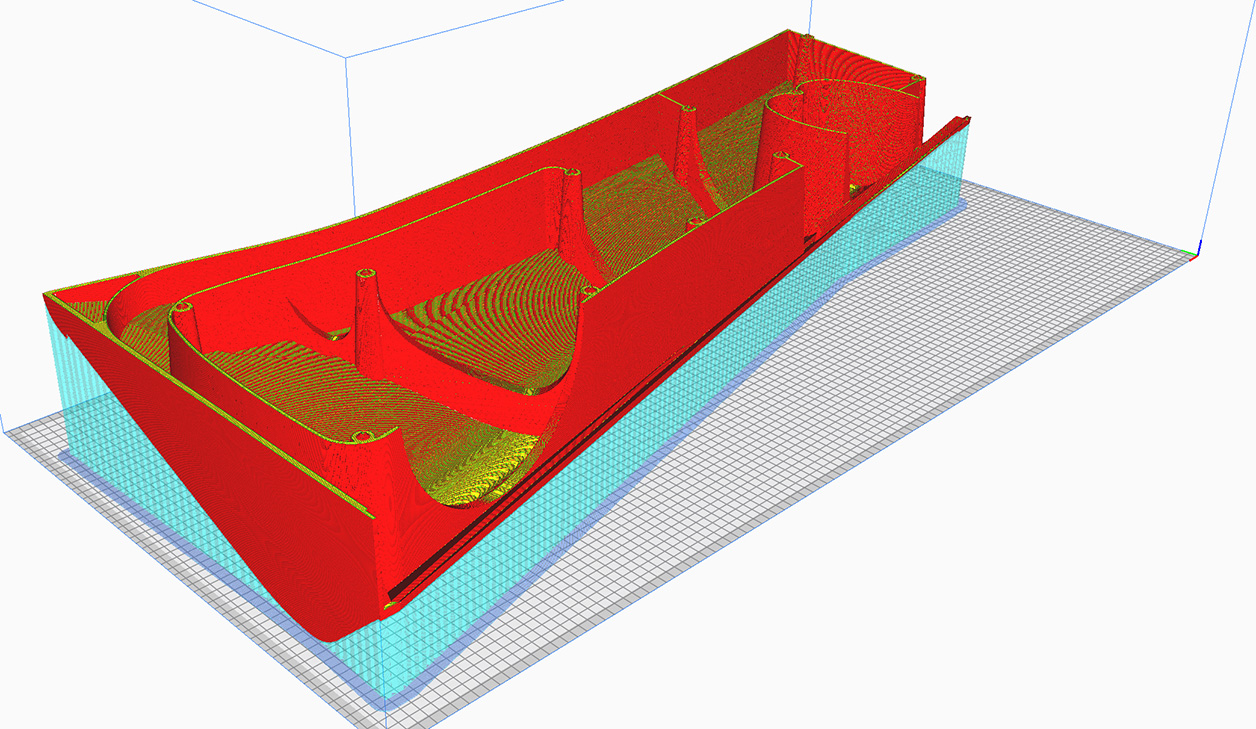 The light blue portion is the special support structure for the developing red 3D structure on the printer bed.
November 2nd, 2020. "Perfecting our mould and casting processes takes longer than anticipated so the Adamantis launch has postponed to the first half of 2021. When pioneering at the forefront of technology and creating procedures never before attempted, all estimates are a challenge. There are a lot of factors at play. Each cycle from mould creation to actual cast takes several weeks and it takes many cycles to inch toward perfection. We expect to need several more. Time goes by fast and of course there's the influence the pandemic had/has on the time line. We have a pretty strong Elon Musk vibe going. The promise of a unique ground-breaking speaker makes everything worthwhile. The fact that we'll use these same production techniques for future models means a very solid investment into our own future. It takes a lot of time and effort to set up but once perfected, we can roll it out for new models to come. Scheduling too will be a lot easier then. For now it's asking the patience of our distributors and the large numbers of interested customers. A lot of people understand the amazingness of Adamantis and its incredible value proposition. Their payment now seems to be more in time and patience than it will be in actual coin. We hope that promise outshines the patience needed for it to arrive."
June 9th, 2021. Paul proposed a Zoom meet with him and Ivo. "What a marathon we've run. We're real cast'n'mould experts now. Even making casts of ourselves will soon be a realistic option." Gallows humour is often great grease to keep grinding gears going. I was curious about their progress. With this project they'd bitten off a chubby chunk. If stiff ambition is a young man's game, how much had they aged since starting on their composite journey? Would I have new comrades in the league of premature greys? Not quite. Both still looked young if a bit worn. Shedding light on their mould perfection path, I learnt that each cycle of revised mould and subsequent proof-of-concept cast took them about two months. Just six iterations already ate up a full year. To print his mould originals, Ivo had customized their printer nicknamed Goliath with his own print head, vat and more. The learning process also involved figuring out how to best premix their nano material in a rough tumbler, keep it active enroute to the casting plant and during the actual pouring process; how to compensate for material shrinkage during cool-down; how to perfect a mould release; and far more on the casting end. Now both Ivo and Paul thought that quite possibly they faced the final cycle of the perfect mould. That would turn into an aluminium-alloy master from which they expected to cast 50-100 pairs before needing a new metal master. Compared to the 400-step Stilla assembly protocol which takes four people 10 weeks for 12 pairs, Adamantis would just bolt together, no real specialized skills required. Ivo's cab design accounts for future partial/full activation with built-in amplification à la Ensis. A thick dual powder coat will give the exposed nanocast metal a matte black look whilst the inset dress panels can be different woods or lacquers.
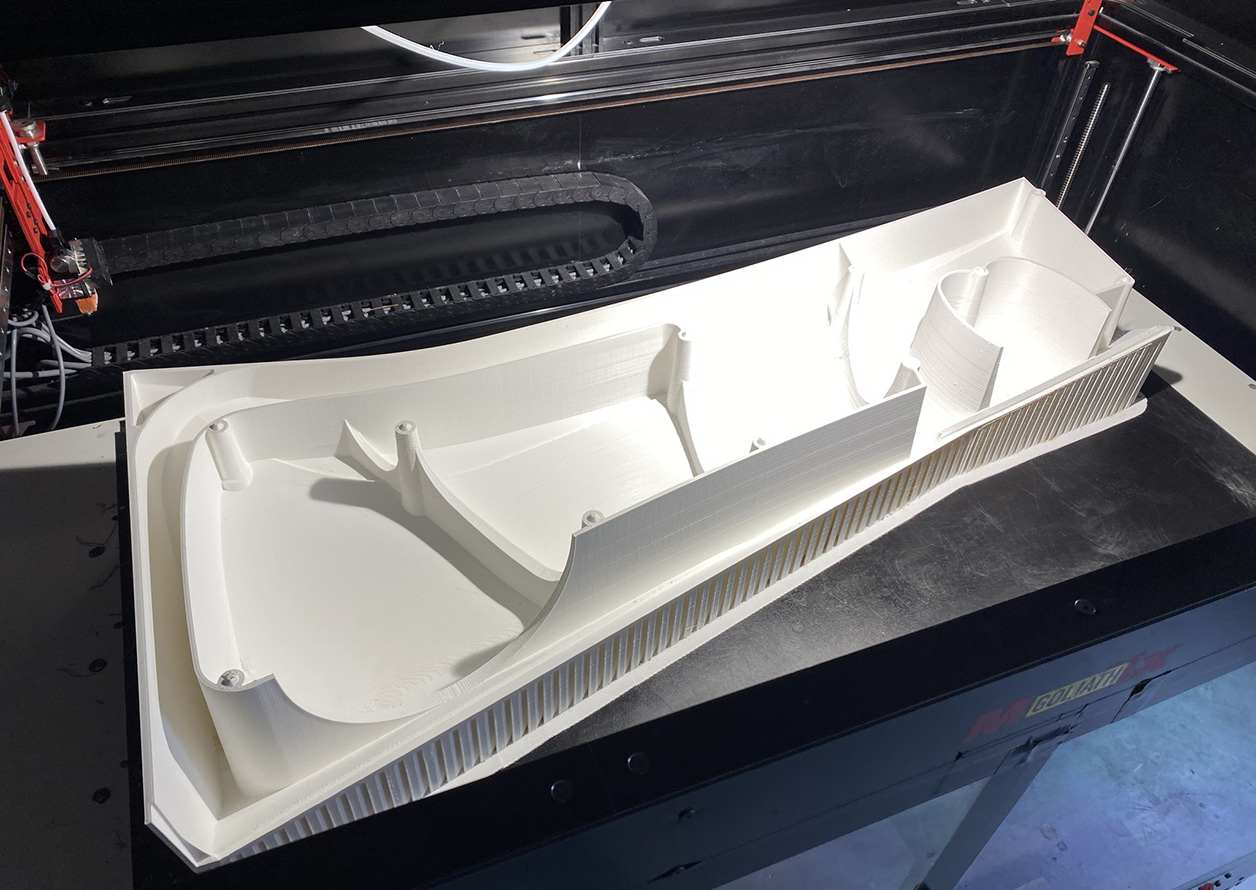 A finished print inside Goliath. We note the woofer's very long port which runs along the spine then curves to exit at the front's bottom.
Ivo mentioned his extensive data base of precision measurements he'd conducted in all of their Æquo installations. He'd become very good at predicting in-room speaker behaviour which now informs and quickens his design work. Once he had first finalized Adamantis cabs to work on, he didn't expect filter tuning to take very long. He was already very familiar with the drivers and had endless simulations on them. Paul brought up significant price increases they faced from their Nordic driver supplier. Like for other users, this would sooner than later have to impact their own retail pricing. Ivo talked of his first prototype nanocast 34mm tweeter membrane which is 50 x better damped than Beryllium. He still needed new measuring gear to see how it acts past 50kHz but could already see that it behaves more like a soft than hard dome. "There's some cone behaviour but far milder than the steep breakup of typical hard materials." A big driver house already had expressed exclusive interest but Ivo was hesitant to sell off the family jewels just yet. Paul brought up their invention of a new super-shield material. It won't need to connect to ground to work. "By measurably lowering the noise floor, we gain a significant free resolution increase." That invention was expected to launch a short line of ultra-performance cables called Arealis. Both men expressed hope to premiere Adamantis at that year's Dutch hifi show in October. Just then that was scheduled to run. The pandemic simply made all very unpredictable. That was a snap shot of the road map Adamantis had travelled by June 15th 2021. Then this story went dark. It didn't resume until September 26th 2024 when I checked their website to spot teasers for Adamantis and its semi-active sibling, Ensium.
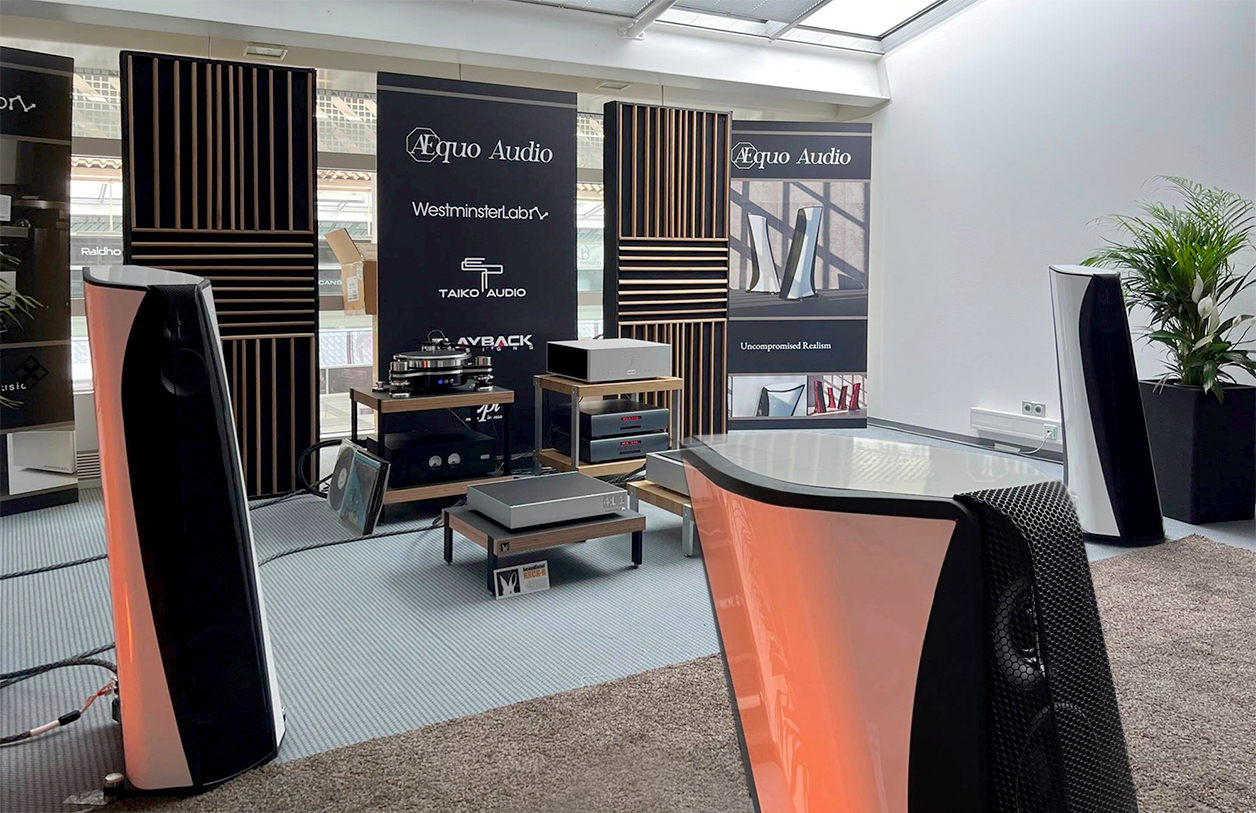
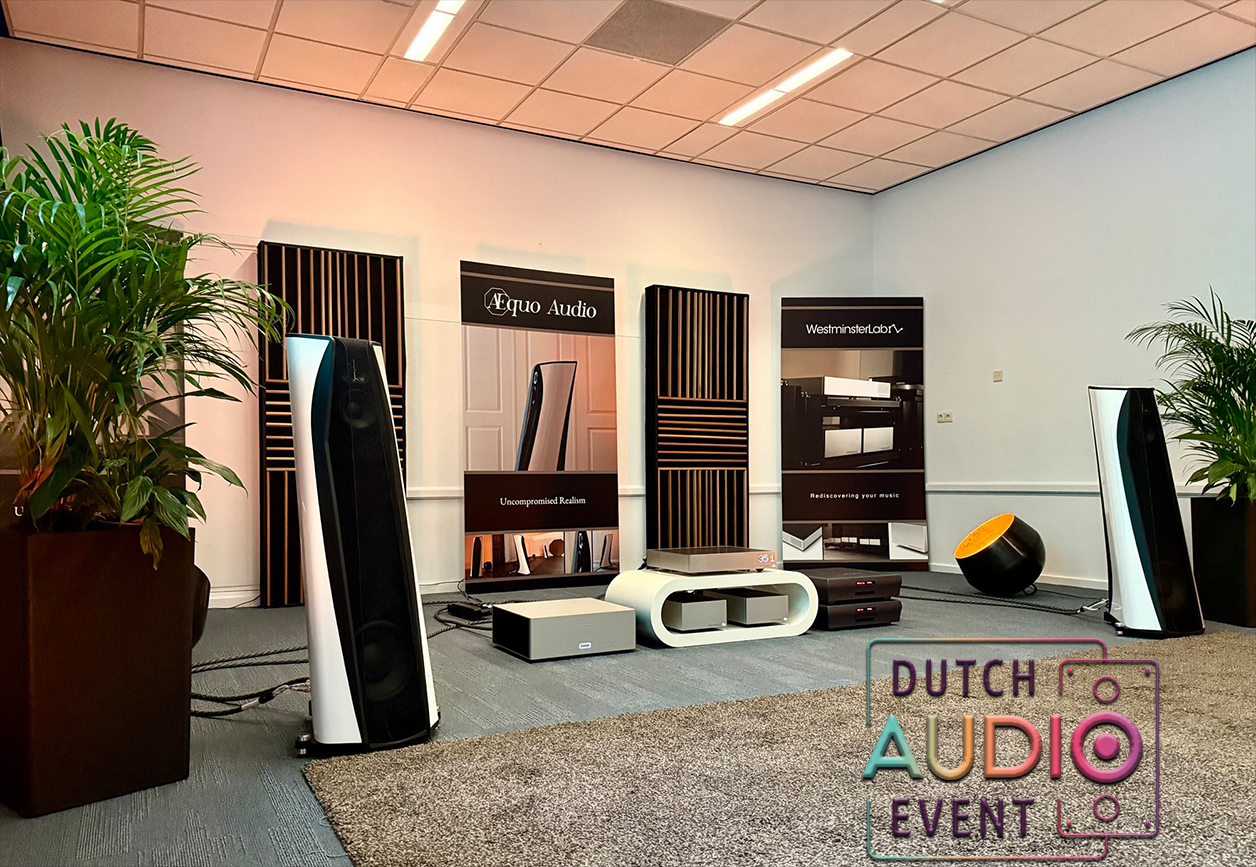
By late March 2025, Ivo and Paul were readying their Munich High-End demo. Above we saw their show system of Taiko server, Playback Design D/A conversion, VPI vinyl, WestminsterLab amplification and Audes isolation-transformer AC distributor. Post show, "Ensium sounded amazing like a big non-resonant Ensis on steroids. We had the whole delegation of The Absolute Sound and Stereophile in our exhibit. Every single one was incredibly impressed. Mr. Andrew Quint said our system was in his top two and for TAS listed us in his five most significant product introductions. The response from interested distributors, dealers and customers alike was tremendous. We were very pleased with our launch and have a lot of new orders to fill. We are now focussed on production to get the orders out to our distribution network. We expect to visit with you in about September."
By June 9th 2025, Stereophile's Jason Victor Serinus published his assessment of Æquo's show demo under 'one hell of a debut'. "Impressively full-range sound was the hallmark of a fine system dominated by Aequo Audio's new three-driver Ensium speakers with active, room-corrected bass ($44'900/pair, ~$40K/pr in the passive version). Connected by AudioQuest cabling (~$100K) with Aequo's own Ferroguard power cables ($4'100) for the woofers, the Dutch company's speakers absolutely sang. As I discovered from playing musical chairs, the sound was at its best in the front row; there, on Yello's "Till Tomorrow," colors were the most saturated and involving. Audio show demos too often focus on sonic allure and visceral wows rather than emotional connection (not that these are mutually exclusive). When I was handed the controls and cued up Sandrine Piau's gorgeous rendition of a Loewe song, I discovered how moving this system could be. The Ensium's cabinet is made from Diluvite, a nanotech material Aequo says is twice as stiff as aluminum with 10 times its damping properties. According to co-owner/designer Ivo Sparidaens and general manager Paul Rassin, Diluvite converts vibration into heat on a nano scale, allowing the just ¼" thick walls to be "totally inert," with no resonance from 1Hz to 100kHz. The Ensiums, which have no parallel walls, are cast in two halves for ease of assembly. The acoustic center of each driver is claimed to be equidistant from the listener. Described as a "bass-assisted, three-way, three-driver floorstanding loudspeaker with front reflex port," the system includes a 500W onboard amplifier with Bruno Putzeys's latest Hypex class-D technology. There is no DSP; correction is performed solely in the analog domain. The speakers, rated 90dB sensitive at 8Ω, weigh 220lb each. Claimed in-room response is 16Hz–45kHz (–3dB), with impedance never dropping below 6Ω."
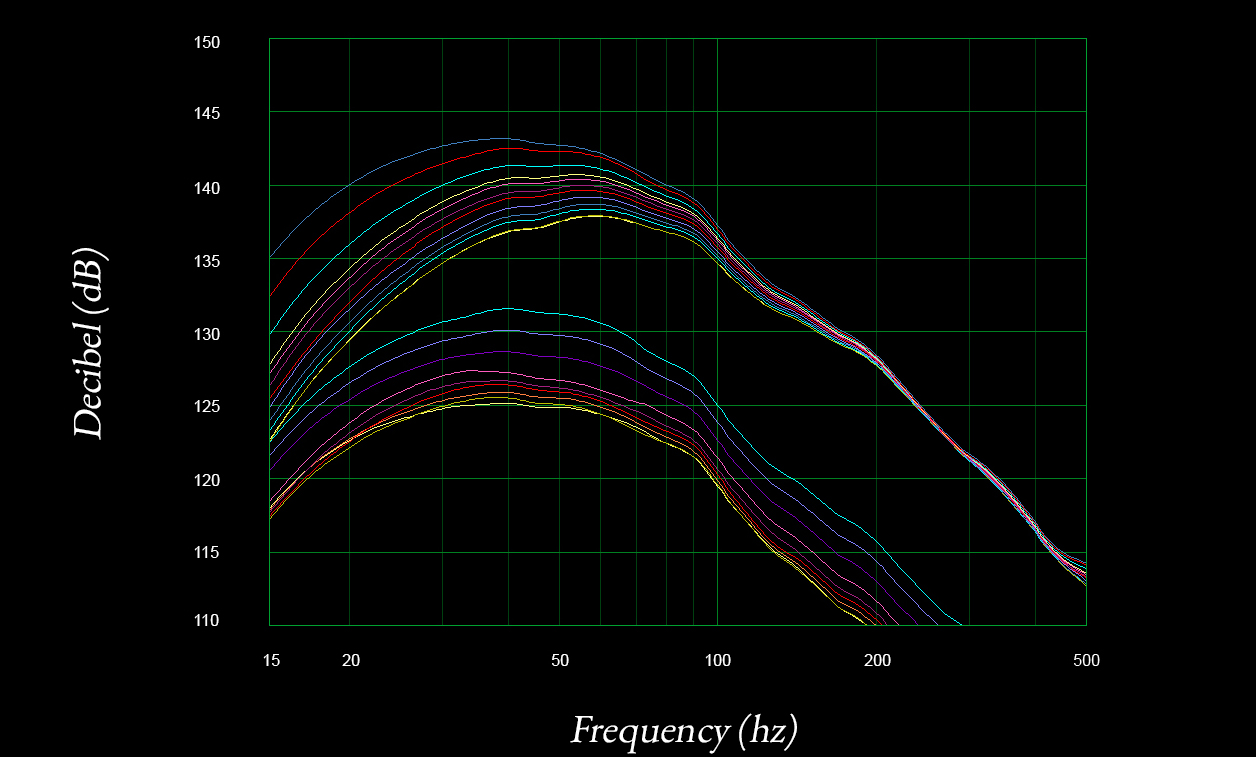 The Arpeq compensation effects for Stilla to preview the equivalent curves for Ensium.
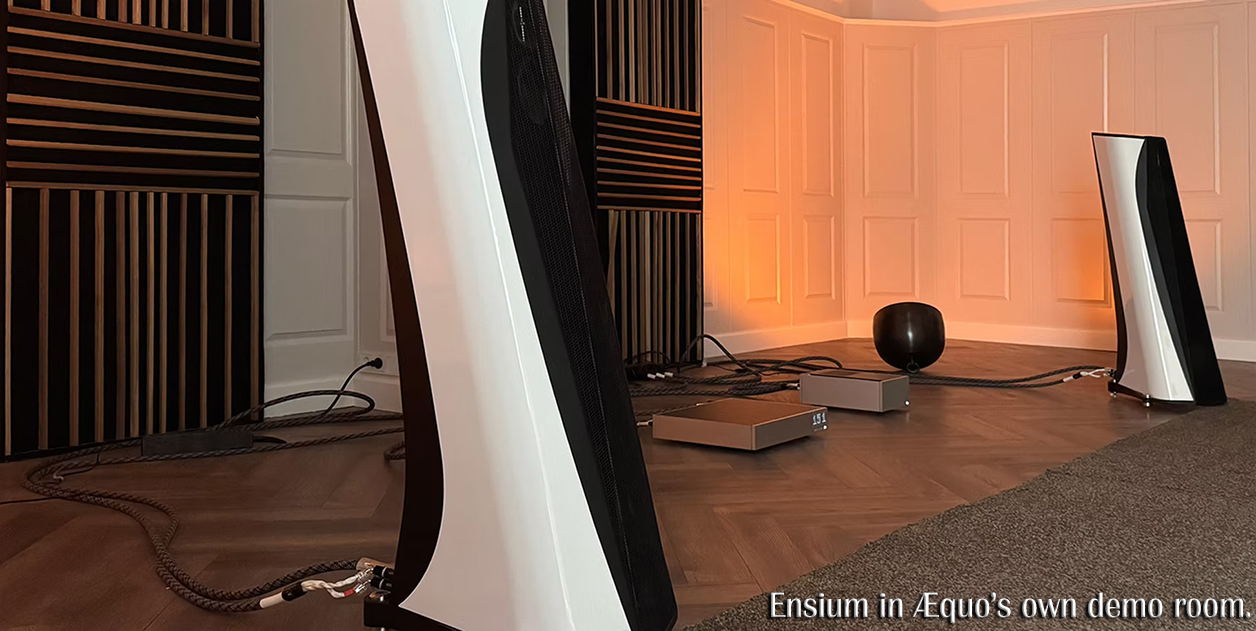
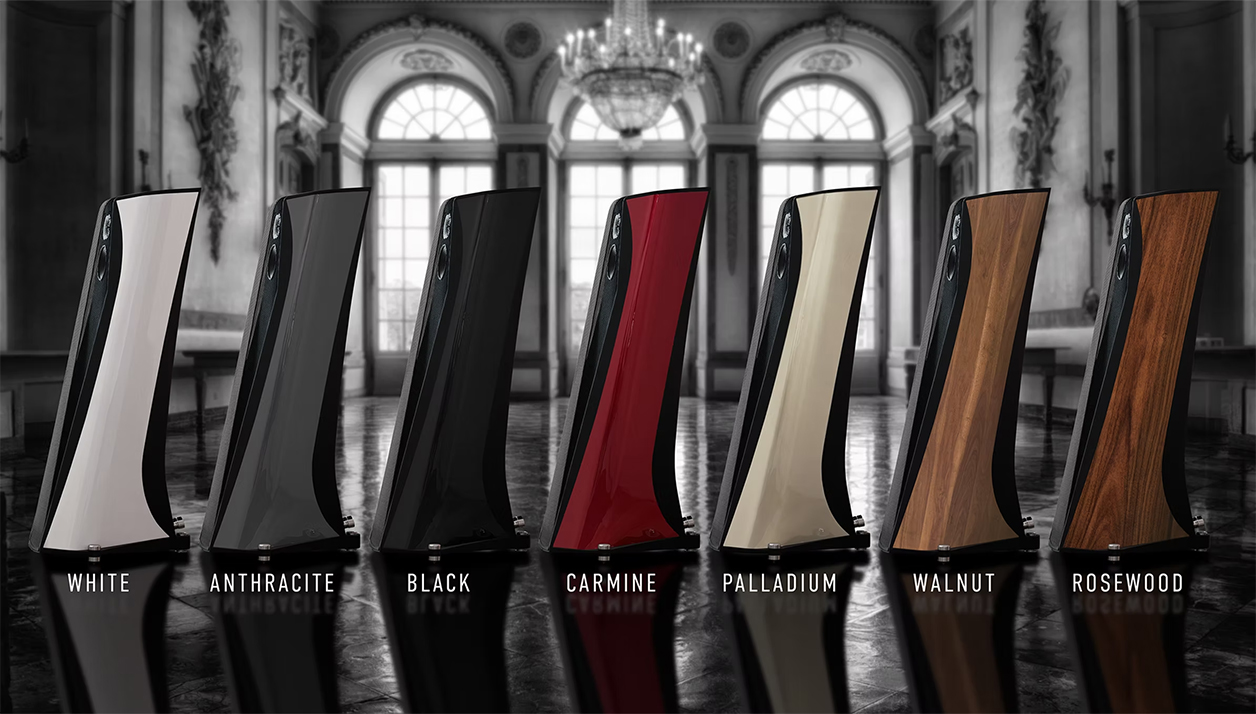
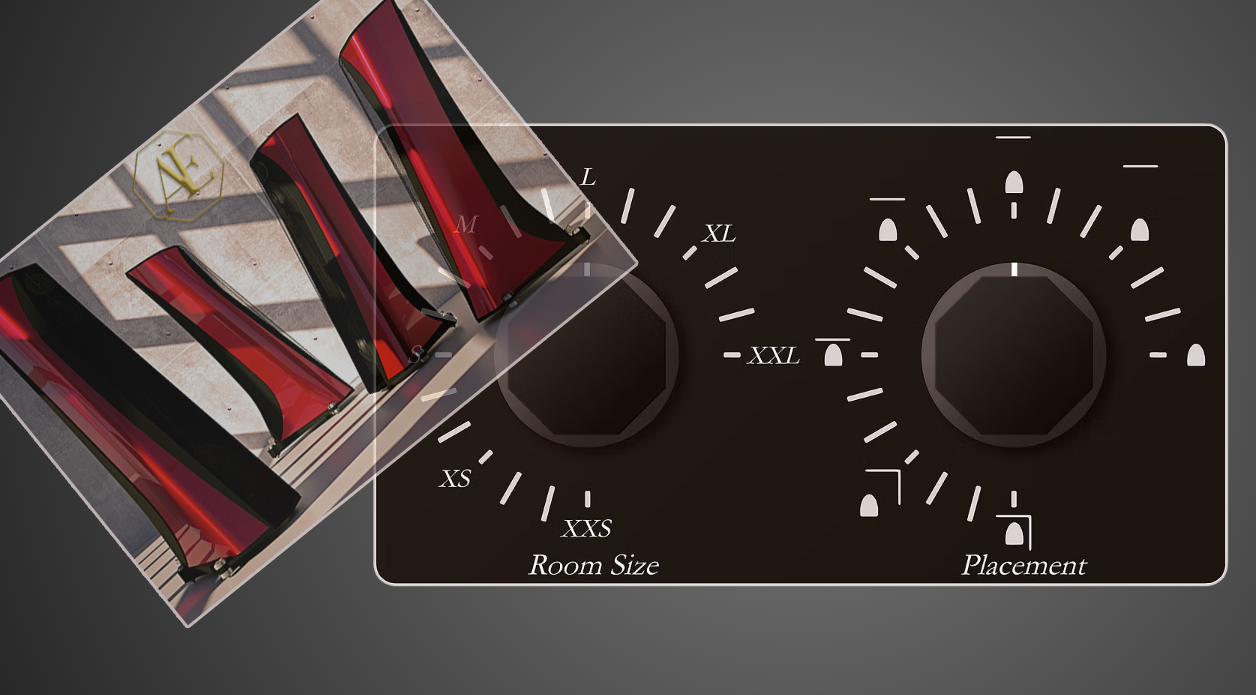
By December 8th 2025, Paul updated me by phone call. Formal production had commenced after a final 6-months delay having to deal with a 0.2% aluminium impurity of their Diluvite compound caused at the foundry which led to material imperfections in the casting. Ivo had not only identified cause but come up with a remedy which made his compound even more inert. Now it was time to fill long overdue orders whilst first review samples looked available for March/April of 2026. At ~140kg/ea. for the final incarnation—308 pounds not the 220lbs of the earlier Serinus quote—un/repacking would require physical assistance since such mass is far beyond what I could ever manhandle solo. Given my normal rather than capacious room, Paul suggested the Ensium model which like the Ensis it replaces includes active bass with extensive all-analogue compensation for room size (XXS – XXL aka extension) and boundary proximity (gain). With a 19Hz port tuning below room resonance in the absence of a 9.1m/29.8' dimension—speed of sound at ~343m/s divided by 19Hz = 9.1 metres for the fundamental axial mode whose wave fits exactly between two walls—Ensis and its adjustments promised successful integration with my room. In their new 1'300m² facility, team Aequo with its two principals, four full-timers, one outside electronics contractor and plenty of part-timers for sub assemblies use a monorail system from which these very heavy cabinets hang during assembly to decommission any lifting. To augment the always-black formal dress code of Ensium, its inset side panels can take lacquers or veneers. The stock high-gloss lacquer options are white then go metallic executions in black, deep carmine red, palladium white-gold or anthracite. Custom colours add €6.6K/pr. Palisander Santos aka Rosewood and American Walnut in oiled finish fetch €4.3K, custom veneers €6.1K, gloss lacquer over veneer €5.9K/pr. Exactly the same rates apply to the fully passive Adamantis with a base price of €35K/pr. Fully active Ensium goes to €48K/pr. Asked about its super-hard custom mould at the foundry, "they tell us to expect a 30-year working life for the mould whilst running off an indeterminate number of clones". Asked about Ivo & Paul's favourite amps for their speakers, they still use their beloved WestminsterLab Rei monos as shown below but also have a rare sample of a special-order Playback Designs SPA-8. Being aware that Christiaan Punter of Hifi Advice not only had visited Æquo HQ to hear Adamantis and Ensium but lives in Holland and owns Magico speakers for a perfect A/B op against an obvious competitor, it only made sense that his name should be first in the review hat. Paul confirmed as much.
Here are two thoughts. One, if high-mass speakers from Estelon, Magico, Rockport, Stenheim, Wilson and YG Acoustics have set the current ceiling of mechanically inert playback transducers, how will a Diluvite speaker claiming to measurably eclipse their resonance-attenuation properties differ acoustically? We don't know what we don't know until an experience resets boundaries and requalifies what we thought the practical limits were. This particular question will be for listeners like Mr. Punter to answer who actually own one of these ultra-dense speakers already. That's not me. My contribution on this dark matter is this extensive genesis story assembled over five long years. Two, true innovation means doing something not done before. In hifi, Raal's ribbon headphones are one such example. Casting in Diluvite is another. With no prior art to stand on the shoulders of, everything is learnt by trial and error with no shortcuts of previous experience. The obvious translation is time, more time and with it, money and more money. Ivor Sparidæns first dreamt up Diluvite in 2019. It took until Munich 2025 to demonstrate a working pair using this material. Within this time window sat two factory expansions to accommodate the required infrastructure and the global Covid-19 pandemic. To time and money we thus add incredible stubbornness to bugger on and keep the faith: heads as hard as Diluvite. That makes the gestation of Ensium a story worth telling! Or as occasional French contributor Joël Chevassus put it post Munich in his own Audiophile Magazine N°18, "the Ensium introduced a new high-end effort from Dutch company Æquo Audio collaborating with WestminsterLab and a Playback Designs digital source. This exhibit ended up on my list of surprises as it was unexpected to hear such compact floorstanders sound so convincing with such neutral amplification from Hong Kong. The qualitative leap over their small Stilla was so obvious that to me Ensium seemed to compete with very high-level speakers whose prices have a furious tendency to escalate far beyond reach. To my ears this was a near perfect showing with WestminsterLab and I was really blown away by such sound quality from a speaker priced at €45K, a relative bargain considering the competition which I would love to review in my own room one day."
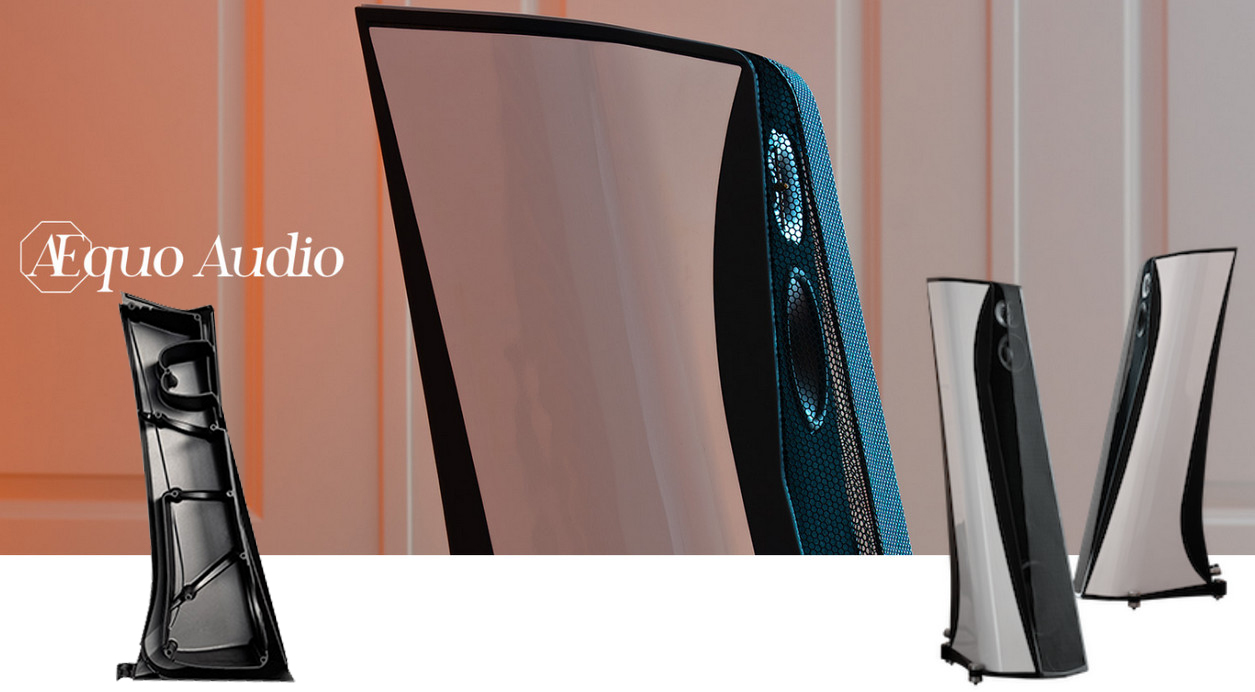 The open half clearly shows the 11 bolt holes whereby this clam-shell affair combines.
To return to basics, these first two Diluvite models occupy the same rakishly swooping 116 x 52 x 42cm HxDxW enclosure. With atypically thin ¼" walls, the interior air volume is larger than that of like-sized enclosures pursuing equivalent inertia with more conventional materials. Both are 3-ways with a 1" textile tweeter, 5" meta-aramid coated paper-pulp midrange in a sealed sub enclosure and a 10½" mineral-coated alloy cone loaded into a long curved port with minor horn mouth exiting close the floor in the front. Passive Adamantis is 88dB/4Ω and rated -3dB/20Hz, semi-active Ensium is 90dB/8Ω and rated -3dB/16Hz. The other end stop is 45kHz for both. The biggest difference is obviously Ensium's active uniquely adaptable bass system. Our amplifier must only drive the 5" 2-way array on top which enters at 170Hz. With the power-critical woofer no longer seen by our own amp, we aren't concerned with ultimate oomph but refinement.
"These days we use the 'A' of our Arpec acronym for analog instead of adjustable to stress the complete absence of DSP with its computing latency. Now the alphabet soup disentangles as Analog Room and Placement Extension Controller. It compensates for room gain where size and/or lossy vs. dense walls are the main variables; and boundary gain. It does this whilst maintaining perfect acoustical phase alignment even with asymmetrical settings between left and right speaker. As you mentioned already, over the years we collected much data from our installs to improve this room/boundary gain matching. We also raised the bass handover from 100Hz in Ensis to 130Hz in Stilla to 170Hz in Ensium for even better control over the upper bass region affected by boundary gain with now superior adjustability. We get significantly faster bass from the 10½" Ensis woofer now than we had even with Stilla's dual 7-inchers; plus better time alignment. I was no longer constrained to implement this higher filter frequency where up to 80Hz, phase/time discernment isn't yet huge but gets ever more critical above. I actually started at 150Hz knowing how fast our new Ensium/Adamantis woofer is and how well aligned its position relative to midrange and listener but soon discovered that best performance in 90% of rooms came at ~170Hz including very good rooms with almost 'neutral' settings. We no longer push the woofer in a small enclosed volume to reach below what it would naturally do but designed an excellent fully passive speaker from ground zero then added the Arpec system to make it adjustable in the purely analog domain. The Ncore power module simply adds current to the input signal to maintain your power amp's signature intact. The 19Hz port tuning falls into the pressure domain and its group delay in the roll-off mimics a large sealed box.
"With Ensium's Arpec set to neutral, we still get better performance than passive Adamantis because the active filter eliminates the passive's large air-core inductors in the woofer low pass. With the current state of affairs, passive filtering still excels at perfect phase alignment between especially midrange and tweeter. You could argue that adding active filter electronics to them counteracts potential benefits from excluding coils and caps. So even in our fully active Ensium you find a passive crossover between midrange and tweeter executed with the best possible parts in a symmetric topology to reduce side effects to a minimum and at the same time get all the beyond wall-to-wall and walkabout imaging we love. In this aspect too the new speaker is another step up as is resolution. Plus, the new upper bass quality simply must be heard. Adjusting the speaker's tilt is now done with a simple Allen key from above and the overall size is very modest compared to what's on the market. So our new slogan is Uncompromised Realism. Here are more general observations about the high-performance loudspeaker space and its various solutions. In the high-mass sector we see highly damped polymer and rubber materials, high-stiffness metal/ceramics or ceramic-filled polymers. We see high pre-tensioning by bolts, baffles which are vertically curved, non flat, felted, adaptive or of minimal width. All of it has varying effectiveness. To evaluate it better, we should first break down the basic functions a speaker cab must provide us with. Weight. Stiffness. Damping. Smallest achievable size for less room interaction, smaller reflective surfaces and more placement freedom. The greatest internal volume to accommodate bigger better drivers and all necessary filter and/or electronics parts. Minimum baffle diffraction so rounded or 45° edges, flowing surfaces, compressed wool felt. Freedom to shape the internals with variable wall thickness to spread eigen frequencies and be left with no parallel walls to minimize internal standing waves. Optimize coincident driver alignment with easy adjustments for listening height/distance. The execution of the lot then gets judged on value for money.
"Let's look at each parameter. Higher mass needs more input energy to activate vibrationally and more strongly couples to the floor if inert or the weight acts as damping force if non-inert. If not sheer density, more weight traditionally means thicker walls to steal internal volume or increase external volume. The latter leads to more unwanted room interactions and possibly greater diffraction issues for indirect sound behaviour. Higher stiffness requires more input energy to be put into motion (storage/Youngs modulus) but increased stiffness often compromises damping which turns unwanted resonance to heat. Many promising materials exhibit high damping at certain frequencies but behave much inferior at others. If we can get away with needing less raw material so thinner walls, we optimize the internal/external volume equation and reduce room interference. Our nanotech Diluvite material is 2½ to 3 times heavier than concrete and aluminium, twice as stiff as the latter but has 10 times higher damping across a whopping 1Hz to 100kHz! Our university lab can't yet measure above it. No macro-tech material comes close to these qualities no matter how clever their mix. Where high-priced high-mass speakers may use bolts to pre-tension their cabs for increased stiffness and damping, our clamshells of already vibration-inert Diluvite bolt together under 14 tons of clamping force. That far exceeds classic pre-tensioning even with added cast-alloy tops. Mineral-loaded polymers are about half as stiff as aluminium alloys and a bit lower in weight but can achieve excellent damping. Diluvite's advantage is needing from less than 1/3rd to often 5 to 6 times less raw material hence wall thickness to get the same or better results.
"One very effective solution I've seen combines cast aluminium with an epoxy-resin liner and carbon-fibre hull. It simply involves about 3 times thicker walls than ours and at least twice the price. In the practical implementations of this approach, actual wall thickness is around 6 times higher and resultant price about thrice. Just so, those cabinets perform as well as ours, just not on value. If a material of equivalent density costs you double but you only need 1/4th as much, you get competitive performance for half the price with a significantly smaller footprint. If our material of choice can then be cast into a 3D shape, we can avoid parallel walls and the waste and limitations of cutting and milling. We can fully integrate a geometrically optimized midrange cavity and flow-computed ports. We can minimize variable baffle width for the lowest possible diffraction and still add felted wool. We can built in perfect time alignment and have the space to use suitable drivers working with low-order filters for better phase behaviour. Finally, we can attain a flat 20Hz at high SPL without hulking towers. As were we, you might be sceptical about Diluvite's possible performance gap over the PMMA + 70% ceramic mix of our Stilla cabs. Yet at less than half the wall thickness with still more than twice the weight, blind auditions rate it immediately and profoundly. Whilst the numbers predicted it, beyond a certain level—just think of the number's wars in digital—one might suspect them to get purely academic. Apparently not with speaker cabinets which together with the conversion of a singular electrical into multiple mechanical/acoustic signals makes for the N°1 distortion generator in the hifi chain. Incidentally, Diluvite is non-toxic, meets RoHS3 standards and is 100% recyclable."
By mid March 2026, Æquo's website had updated the final Adamantis/Ensium specs: 116x52x42cm; and 129kg/each! For a 16Hz-45kHz speaker (in-room -3dB) claimed capable of linear full-bandwidth SPL to 116dB, that's very compact hence exceptionally dense. From Magico to Stenheim, Rockport to YG, knowing eyes would be on these latest entrants into the dead-cab league of high-end loudspeakers. To the naked eye looking at this group of brands, Æquo seem alone about insisting on rigorously implemented physical time alignment of their drivers. Ditto offering a semi-activated version with pure analogue compensation settings. In a crowded market, unique talking points are essential. With Adamantis and Ensium, our Dutchies seem particularly loquacious. Given that I can't physically manhandle speakers which ended up at 129kg, I had to opt out of doing an actual review. Hence here ends my lengthy introduction on the world's first speakers made from Diluvite. For more, visit Hifi-Advice when their Ensium review hits. Over & out.