This review page is supported in part by the sponsors whose ad banners are displayed below |
 |
| Regarding the relative importance of our Audiopax sound between amps and preamp, the amps are more important if one has the right speaker. But if one doesn’t, the ticket is the preamp with the customer’s existing amp and speakers. This gets still quite a bit of our signature performance. With the right speakers and our amp, our Model 5 preamp won’t make as much of a difference over a really good preamp the customer already has. |
|
|
|
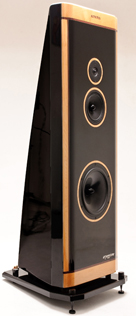 |
The Model 5 comes fully into its own when it replaces a very good preamp in an otherwise non-Audiopax system. A good/right speaker for the Model 88 would be 90dB or higher, with an impedance above 6 ohms (5.5 minimum) and phase angles not over 40°. If those factors are met, the combination should work very well.
The Mosfet version of the Model 88 which we currently don’t make behaves in exactly the same manner. It isn't intended for more challenging loads either. Sonically the minor tube microphonics give them slightly greater soundstaging capacity from their quasi dither. But my sound really isn’t about any particular output device, be it tube, transistor or hybrid. The moment such a device is coupled to a transformer, everything changes. Of course you couldn’t just use any transformer or tube. You must choose one that is copasetic with your concept so you can manipulate it to the desired point. It needs to be twisted in a kinky way to produce the real results.
Think of a transformer as a transmission or automatic gear which couples, changes, adjusts and transfers power. It’s the same thing with voltages and current. A transformer doesn’t merely change this to that. Some of its behavior is akin to a torque converter. There is some wiggle room which improves the sound if used correctly. People resist the notion that one mile of additional wire could improve the sound and not be heard. It must be worse they insist. It can be better if the hidden trafo effects are exploited. |
|
|
|
|
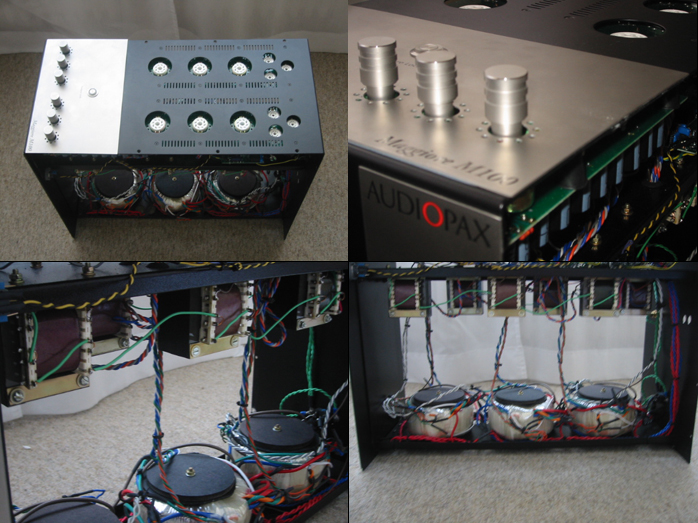
On standard specs, the output impedance of the Maggiore is about 2.8 ohms, slightly less than the 3.7 of the Model 88. The input impedance is a standard 100K. For all its power the Maggiore is actually quieter than the Model 88 by about 3 to 4dB. Highly efficient speakers are really no problem. And because each tube is protected by an externally accessible fuse, catastrophic tube failures are a simple plug ‘n’ play replacement. That is true also for the new Model 88.
|
 |
The XLR input on the Maggiore is for convenience. It is transformer-coupled to be matched to the single-ended circuit of the amplifier. People requested this feature to accommodate balanced variable sources and preamps. The driver tubes of this simple 2-stage circuit are 12AT7s, one per KT88 or KT120. The triangular layout of the small tubes is merely cosmetic and doesn't signify anything else. The drivers produce the majority of voltage gain (about x 35) while the power tubes are mostly just current buffer. The input sensitivity is 1.8V.
|
|
|
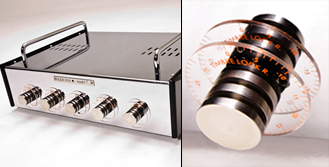
As a basic guide on how TimbreLock affects the sound, if I use my own speakers—and this differs with load—low (left-most) bias is softer/rounder, high (right-most) bias sharper and more distinct. These adjustments affect our perception of space, ambiance and speed but that is hard to put into words at least for me. It’s not about tonal balance. It's not about more or less bass, more or less treble.
The TimbreLock range of fine tuning really moves between the poles of transients/decays, sharp/soft and taut/relaxed. These are performance aspects we don’t really know how to measure. It’s not about frequency response, step/impulse response or general THD. Those we can and do measure.
|
 |
Brazilian preproduction unit without final bracing, machined bridges etc - refer to the review for production images
|
| Not only are our ears nonlinear devices, they are very intelligent adaptive devices. As with nearly all our senses we react to sudden variations, not steady-state or very gradually changing conditions. You hear a refrigerator turn off but you didn’t hear it run nonstop. This shows how we are sensitive to the variation of a constant condition.
This is true for all types of distortion. Steady-state content or behavior is less noticeable than changes. So the question becomes, what is the 'natural' variation of a distortion? That’s key. What is the variation your brain will not recognize as artificial? It's not about keeping distortion constant or low per se. That's the matter I’ve been working on for a long time now. |
  |
 |