This review page is supported in part by the sponsors whose ad banners are displayed below |
 |
In 2006 when our US operations stopped, I decided to remain in Brazil. Before then I’d leave Rio de Janeiro six or seven times a year for the US, the UK, Norway and Europe. Now I stopped all that to settle more firmly in Rio and concentrate on developing our domestic business. In 2007 I got remarried. This gave me further roots but also put a limit on travels. Now of course I have to spend considerable time in Switzerland. I’ve taken out a flat outfitted with a small laboratory so I can work as I would in Brazil. That’s actually more cost effective than a hotel. I’m naturally close to the manufacturing plant.
Managing international operations from Brazil with all our bureaucracy and customs would be impossible. The new Swiss operation is thus not only a move to uncompromised upscale manufacturing. It's also the beginning of our new global efforts. We now have the right personnel in place and a very ambitious new product to position us properly.
|
By the first or second week of August I should have the first two Swiss-built golden sample pairs to sign off on final production or adjust minor final items. We already changed a very small cosmetic detail where a certain panel will terminate in a rounded instead of square edge. Such things can kill you if you commit prematurely to a large first run. The final amp will have 12mm aluminium panels perfectly finished, with no fasteners showing. It will really be in line with what a customer should expect for €60.000. As I did with the original Model 88, the prototype assembly once again consists of two U braces one rotated 90° over the other though the final chassis will have sliding sides. At the bottom sit three big toroidal power transformers. Above those is a bridge with the six output transformers. Those are similar in size to the Model 88 transformers but different. Above those sit the two long valve PCBs (three tubes per board) which connect to the output transformers. The Swiss drawings account for all the necessary wire routing, weight supports, resonance isolation and mechanical integrity of this multi-layer structure.
|
|
|
|
|
|
|
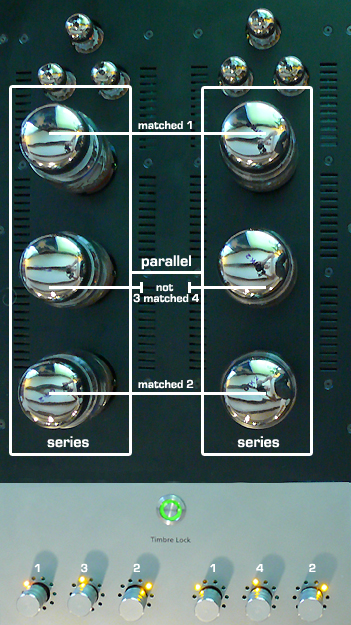 |
The six TimbreLocks are bias pots. Most mistake the scheme for basic bias adjustments. That's not it. It's rather more far reaching. Obviously these pots adjust the load line of the tubes and range from 78mA to 92mA. But this also affects the load in the associated output transformers and the operating points of the magnetics where we get 90% of pentode power efficiency and the curves of a triode. That’s quite the trick. We obtain 15—almost 17 watts—from a single-ended KT88 in class A1 but with a triode transfer function due to how the series-parallel connected six amplifiers operate.
The taps in our transformers are different, the way they connect to the tubes is different. There is a screen tap which used to be called ultralinear and another winding for the cathode for a type of local feedback. A Stockham paper from the 50s showed how a triode can be modeled as a pentode with feedback by removing the grids. When you take the grids out of a pentode you get inherent feedback between plate and cathode. It’s simply a matter of view.
Even though six single-ended amplifiers tied together only at the outputs running strategically dissimilar output transformers are more complex than the two series-connected amplifier halves of the Model 88, their behavior of a perfect high-power triode is actually more precise. The yellow or factory/start setting shown is 10:00, 11:00 and 2:00 o’clock for both banks. The left and right tube of each trio should remain fixed while the center ones are the wild cards or kinky valves whose output transformers are dissimilar unlike the other two matched pairs. The OPTs of tubes 1 + 2 are the same, the OPTs of tubes 5 + 6 are the same yet dissimilar from 1 + 2. Only tubes 3 + 4 have different transformers. That makes for a total of four different OPTs to require matched tube pairs. All six tubes don’t have to be matched but the individual pairs have to be.
|
|
I should add that the output power of 100 watts—130 watts from KT120— was a fringe benefit but not the primary design goal.
The primary design goal simply relied on six rather than two variables to more accurately approach my theoretically modeled ideal triode behavior. TimbreLock of course also accounts for tube aging. We can squeeze a lot of life from these KT88. I have run tubes for 2500 to 3000 hours without any decline I could detect. The way one detects small changes from tube aging is to swap in brand-new tubes. That’s what I did. I kept aging a complete set in the amplifier which I left playing 24/7. This set I compared at intervals to brand-new tubes. I tracked how many hours I could get from the original set before any changes became noticeable. It took more than 2000 hours before I thought I could detect any.
That was admittedly running them without interruption. If you turn the amps on and off for individual sessions, this number could change.
|
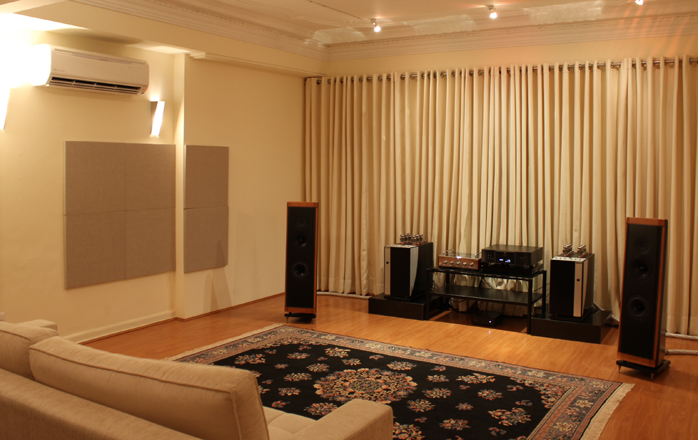 |
Audiopax Lab in Rio de Janeiro
|
Back to Brazil,
our production line really works well now but what would never work is state-of-the-art finishing and overall international customer support. I tried and spent huge amounts of money on it in the past to never attempt it again. If something broke I’d send out another amp while the original was never returned. Instead it would eventually show up in the used market to have another repair requested. I just couldn’t keep track. The logistics involved were a nightmare and you could perhaps also say that I didn’t have exactly the right head for it and at the time lacked the proper partner who did.
What technically could go wrong with the Model 88 at the time was the power transformer. This wasn't because it was badly designed or poorly made. It was due to an ergonomic design flaw. If you remember, all the TimbreLock LEDs then were red. The last (right-most) LED would light whenever current was 96mA. That said, you could keep turning the pot to reach 120 or even 130mA. The light would continue to show red. It never occurred to me that people might use the amps in this fashion, i.e. way well outside their intended operational parameters.
|
|
|
|
|
|
|
After the MkII version of the Model 88 in 2005/2006, international business pretty much came to an end. Now I made all the LEDs green and only the last one red. The instructions in the manual were to never use the red LED. Actually it was perfectly safe if you set it where it just lit up and didn’t keep raising bias current beyond it. So this was a design flaw of ergonomics that didn't foresee how a customer could interface with the device to eventually take out the power transformer. That was basically the only problem we ever had with the Model 88.
|
 |
With the MkIII or M88 A3 as we call it, I went to three colors. The TimbreLock LEDs are green, the last one is red and the preferred/initial setting is yellow. This proved to be altogether more intuitive and user-friendly. It simply works. You have the factory setting of the Model 88 at 10:00 and 2:00 for the left and right TimbreLock, you have the ‘don’t go here’ red one at the end and all the personal adjustments in-between. The MkIII version also got even beefier power transformers which now are toroidals. Those have advantages and disadvantages but I worked around the latter. Now the operational temperatures are lower and there is much more power headroom. In Europe the new Model 88 monos retail for €19.000/pr., the matching Model 5 preamplifier with remote volume goes for €9.000. A set shipping from Brazil is €28.000. We eventually plan on stock in Switzerland to expedite European shipments but currently we deliver all shippable models from Brazil within 30 days and accompanied by a 3-year standard warranty.
|
|
|
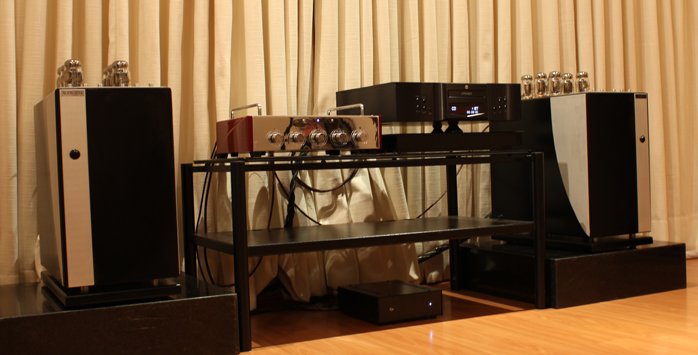 |
Audiopax Lab system in Rio
|
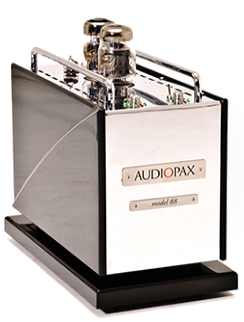
We no longer use wooden crates because to do so now from Brazil requires spraying the wood after the crates have been sealed and are readied for export to get an agricultural safety certificate. This adds five days once you send to ship where the product remains in Brazil for some silly formality to get bug-sprayed. We went to quality sturdy cardboard instead. The Model 88 is still finished in gloss black as you knew it 8 years ago but now it has a slightly more refined appearance with a minor profile sweep on the cheeks. Avantgarde red remains available too. People love that color.
|
  |
 |