This review page is supported in part by the sponsors whose ad banners are displayed below |
 |
As to how my understanding has changed since I first heard the Maggiore perform so much better than predicted, it is still valid that the similarity of distortion between single-ended triodes and simpler two-way speakers lends itself to strategic partial cancellation. But this is merely the first and most basic step. If you want to ‘control’ system distortion, you must take this into account and work with it. This sets the stage to understand what happens next - learning about real distortion in the form of artificial variations. That’s what has evolved in my concepts.
|
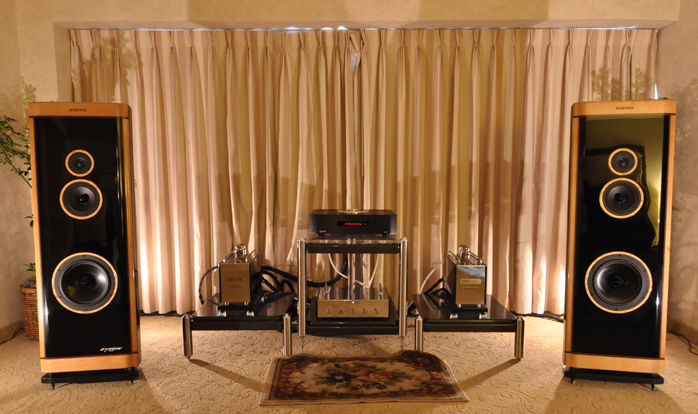 |
Audiopax at T.H.E. Show, CES 2011
|
This goes well beyond harmonic distortion. It includes spatial distortion, phase distortion, dynamic distortion etc. But let’s stick to harmonic distortion. Once you have a handle on how your system distorts and you manipulate that for some control over it, you notice how the most important factor isn’t the end or total distortion but the intermediate distortion which changes with amplitude and frequency. This affects the sense of musical flow or breath. You only have a fighting chance to apply some of that if you first understand and control how your system distorts on a permanent steady-state basis. Only this reveals how the various types of distortion interact.
|
| Now the next step becomes possible. That's where the Maggiore 100 project entered. In a concrete form which I could confront directly with my senses, it materialized some mathematical models I had tried to first apply theoretically. These aren’t higher-math models. They are just basic equations with no pretensions at ultimate accuracy. I simply needed certain formulae or containers to input specific values and attempt to correlate those with my subjective observations. After I heard these news amps for the first time, I had to go back and adjust for certain coefficients about how absolute distortions and their variations interact. I had to adjust some of these values and place them in a higher order. You might say that it now became about the variation of the variation but… (laughs)… it’s not math in any sense that would prove this from one point unbroken to the other. |
|
|
Such a perfectly linear mathematical proof would be extremely difficult I think. Mine is just a curve-fitting attempt. I’m trying to equate what I observe with mathematical behavior. I don’t have logical proof. But the beauty of it is that it works – or at least seems to based on the actual results from my amplifiers. Remember that I didn't have to adjust anything in my first Maggiore prototypes. They worked exactly as predicted, simply better. I don’t know what it would take to do it any other way. I don't know whether we will ever get there. It involves too many subjective behaviors that we should never successfully quantify.
|
|
|
So
I don’t have total faith in my own predictive equations. They are nothing but a work in progress and always will be. That’s what makes it so interesting. Theories can be pretty and orderly but reality is usually messier. What I needed was an actual collision with reality on a higher level than I'd been to before. I needed a new amplifier to challenge my assumptions and help me refine them further by observing what would happen with a more complex concept which offered me more control variables (six amplifiers with individual bias adjustments for deliberately flexible asymmetries, six output transformers, four of them different from one another). This showed me how my theories needed further fine-tuning while also confirming their basic merit. I was simply lucky that this revision was prompted by results which exceeded my predictions.
It’s important again to appreciate how this isn’t neat. It’s not like one unified fully synthesized master equation. It's simply a bunch of numbers and ideas, written notes, concepts and various suspicions of 'maybe it’s this, maybe it’s that' which I've worked over for many years. It would be fake to pretend this is a tight shiny theory without holes. It’s actually quite a patchwork but slowly evolving.
|
 |
As to your question what made the Maggiores so much better than expected, it was mostly the impression of authority not in the sense of bass but how you can focus on any part of the event you want. For me it even warped the sense of time. I had more time to look at anything I wanted without feeling rushed. It's almost like slow motion or a slightly altered state. It feels like my brain is running faster. (Laughs.) It’s quite a challenge to put this in the usual audiophile context. It feels like there's more resolving power not there (points at the system) but here (points at the brain). That was the really shocking thing.
|
|
In 2007 I was invited to do a presentation at the European Triode Festival. Attendees there were pretty well educated but perhaps a bit overly theoretical in their approach. They seemed to understand my talk even though it was not in line with what they are mostly up to. Even so they seemed to appreciate it at least as an alternate way of thinking about certain issues. Of course I don’t expect anyone to believe what I say. Only if you pursue this path as I have will you be able to view the matter in this particular fashion. Otherwise it’s merely interesting babble. Someone could respond that they have pursued audio design some different way all their life and have good results to show for it. That's solid and perfectly valid. It’s probably why nobody in the last 15 years has said exactly what I am saying. It’s been my path, not anyone else’s.
|
|
|
Right now also happens to be a very interesting time for digital. There are simply so many things I still have to finish that I probably won't touch that subject for quite some time. I have a few ideas I might begin to develop in three years but for the moment I’m focused on this project and developing loudspeaker drivers which apply my distortion modeling especially to woofers, with a totally different approach than the norm. Again, the variation of the distortion is more important than the steady state. To this end I have chosen, designed and modified specific drivers for all our loudspeaker models.
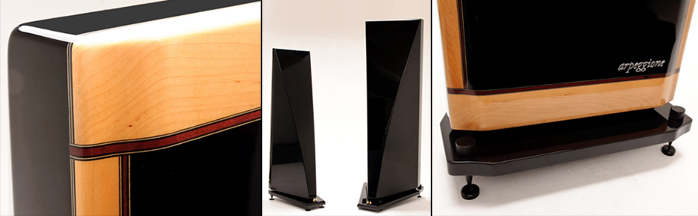
I designed and built my own drive units from scratch in the past but frankly that’s too time consuming now. More fruitful was finding suitable platforms to modify. These drivers aren’t from Brazil but Taiwan. There I had some control over the specifications before I would modify the drivers further. In the midrange for example I replace the original phase plug with brass, coat the cone, damp the basket and more which works very well. I also select between drive units and have to reject quite a number which fall outside my kinky parameters.
|
 |
What’s gratifying in all this is that I base all my work on the same core ideas of coupling distortion. Once the coupling distortion is under control, true system distortion reveals itself and you can begin to manipulate it according to your ideas of what it should be. While the theoretical ideal might be no distortion, the real question is what that would mean. For now we clearly have to live with distortion. This would ask how we can address it to be least perceived as distortion. It’s not about distortion elimination but intelligent distortion management.
To me all this seems perfectly logical, obvious and sensible. Yet here it is 2011 and we still see people go after 0.00001 THD or 140dB S/N ratios with real appetite as though it mattered. You do have to admit though that it makes for good marketing copy. Balancing or managing distortion just doesn’t have any punch by comparison. But that's us. What can I say?
|
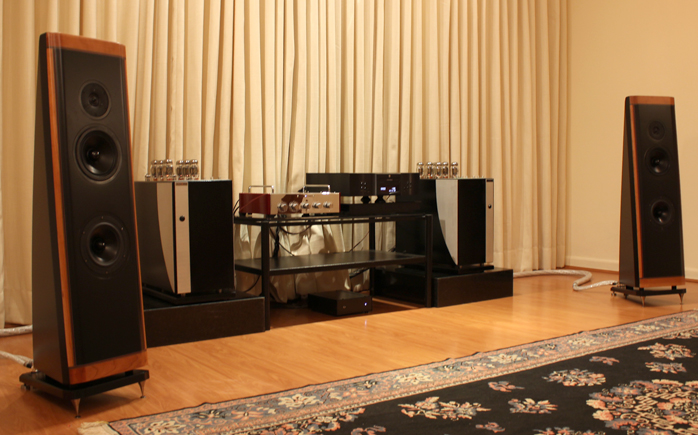 |
Audiopax Brazil |
|
 |
|
 |