This review page is supported in part by the sponsors whose ad banners are displayed below |
 |
 |
As analog integrated. A 6-meter USB cable is a no-go so my living room setup had to rely on an analog signal from the NWO (later my bedroom video system with NuForce Edition Oppo universal player and Mark+Daniel Fantasia S speakers would switch to a digital signal for the GI's BNC input to go the full monty). How would everyman ICEpower compare to the decidedly esoteric costly low-power static induction transistors from Nelson Pass which would connect to the GI's pre-outs? Quick background first.
|
 |
Over the years many pro and consumer audiophiles have commented on the merits of class D beyond its first subwoofer plate-amp use. These days traditional amp topologies progress very slowly and marginally. Class D for serious hifi is still young enough however to advance from year to year at a much more noticeable clip. That includes B&O. Their current modules—I have smaller also permanently bridged versions in my Wyred4Sound mINT—are clearly warmer and mellower than was earlier class D which was more whitish, spiky and texturally desiccated. Naturally very low output impedance remains to benefit woofers as controlled powerful low bass. Depending on what is replaced, this can seem to add the proverbial octave. Differentiation in the more vital upper bass often wasn't as pronounced however and this held true also for the treble which lacked the endless openness and finesse of better non-switching amps. While 1000+ damping factors read impressive on paper, are they actually beneficial for lighter midrange and treble units? If not, what does overdamping the 1000Hz+ range sound like exactly?
|
| Now add lots of NFB. Ncore/UcD auteur Bruno Putzeys claims there's no such thing as too much feedback if properly applied.
Nelson Pass would argue that the reduction of lower-order THD percentages is traded for more complex higher-order artifacts to which the ear is more averse. AURALiC's before/after figures at right, of modified UcD 400 modules, show significant reduction of 4th to 9th-order THD which is traded for slightly higher 2nd and 3rd. They claim it's why they don't sound like typical class D. How would the Grand Integrated perform against such preconceptions or at least questions? |
|
|
|
|
|
Going against the SIT1 monos meant swimming with sharks. In the low-power transistor amp realm they and the Bakoon AMP-11R are the finest I know. Trailing them in at least certain regards was nearly foregone conclusion. Whilst being unreasonable to stay real, so it was. That very high nearly intense focus and contrast which amount to tacit lucidity and huge space that's lit up equally front to rear and side to side were diluted. ICEpower stepped back focus and injected cobwebs. It was softer, thicker and slower similar to how most all quality single-ended triode amps strike me by comparison to the SIT monos. That's no underhanded suggestion that the Grand Integrated sounded SET. Not. Like them it simply didn't penetrate into that inner circle where the SIT and Bakoon operate (and I'd assume a low-power Vitus too). That's for general flavor, feel and gestalt. How about specifics?
|
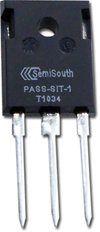 |
The key difference wasn't about tonal balance. At all. It was about energy transmission. The SIT simply sounded bigger. Decays and recorded reflections had greater visibility. Those not only illuminated space. Their harmonic halos added themselves to performer size. Greater vitality seemed connected to faster rise times too. This was emphasized on percussive events with high harmonic content like struck triangles and spiccato violin work yet everything was affected.
On a basic 'quantities' level which counts how much of what is delivered, these amps were very similar. The decisive offset was that hard-to-describe quality which words like immediacy and directness hint at. Think freshly juiced fruit versus organic bottled equivalent. If ingredients match, basic taste will be the same. Where the just squeezed stuff differs is with the pop of its fruit acids. That zingy twitchy tart intensity is the difference - and oxidation quickly kills it.
When Nelson Pass was asked whether he'd scale up the 10wpc SIT for standard consumption, he declared it "not an easy proposition as the SIT-1 device has a small die. A larger version
of the SiC process is beyond my willingness to spend.
The 2SK77 would be a candidate for more power if you could get any. I'm
informed that the Japanese fab line which could make them was damaged
in the quake. Likely a different foundry would be necessary assuming
that the gentleman who knows how to make them is still available and
interested.
Short answer: Very Big Bucks." Now enough with what in this context are mostly irrelevant exotica and personal curiosity. Let's compare Dan Wright's KWA-100SE instead, a 100wpc 2-stage Mosfet amp of the very good 'normal' sort. |
|
|
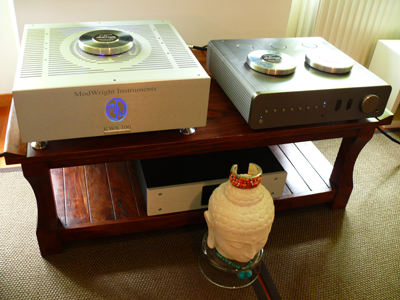
Versus the ModWright. (The KWA is the closest I've come to 'clone' FirstWatt's F5 for higher power. Until the advent of the SIT models the F5 was my favorite low-power transistor amp.)...
This was the GI's playground! Now the amps were of the 'same size' and fairly matched. While both took steps back from the fruity acid, the ModWright gave up just a bit less. In conventional terms the integrated was slightly warmer to energetically play it a tad less lively. This confirmed my mINT assessment. The latest ICEpower generation has made an about turn into greater warmth and textural thickness. This is not the lean zippy class D sound with its hyper-realist detail shrapnel from yesteryear. |
|
|
|
 |
If I could talk to B&O's engineers—or the equivalent at team Peachtree—I'd petition them for more effervescence on top. It's the one area where I still feel this power stage trails the best of the conventional competition. Perhaps it's a bandwidth issue with concomitant treble phase-shift inherent to class D? If so, ongoing advances over the last few years have clearly exorcized the ugly bits in its top end. This could be the core reason why the Grand Integrated no longer spells out switching to unsuspecting ears. That it generally was a bit softer of focus and grip at least at the civilized levels and into the benign 'first-gear' load I used is no different than many other amps play it. Most valve amps are just as bandwidth restricted on top to demonstrate equal limits on air. This suffocates some vitality and inner jump factor but not to the extent of being polite or genteel. 'Modestly plush' and converting to 'ballsy' at higher levels could be the best terms.
The upshot is clear. The GI incorporates an amplifier stage which is competitive with a recognized €3.500 amp but offers significantly higher power. For the latter a move upstairs to the power-appreciative Mark+Daniel Fantasia S was due.
|
|
|
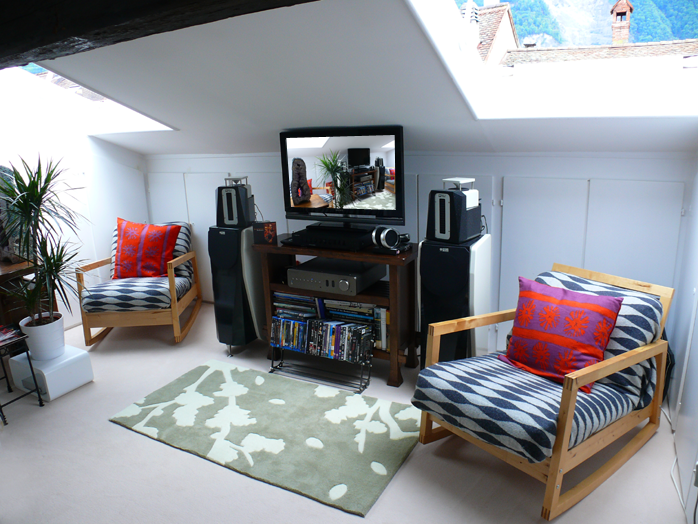
On the Fantasia. This system isn't set up for grand but intimate sound due to space constraints and exclusive night-time use. It also means nearfield sitting (good) and close front-wall proximity (less so). On immaculate music fare à la m.a. recordings, the gonads of these über 2-ways were now stroked to show off. This could approach nearly too much of a good thing when low-down weight began to bleed into the lower midrange. Another meter or more from the wall would have helped. By design this Beijing speaker combines beefcake appeal from its super Xmax woofer with downfire port and great speed innate to the 800Hz-up pleated Heil driver with auxiliary upfiring AMT above 3kHz. Switching to swashbuckler cinematic fare like John Carter, the same borderline opulence of the lower three octaves became the stuff Hollywood spectacles are made of. Particularly subtler dread-laden interludes which are nearly subliminally generated with low-level infrasonic massages showcased distinct signs of life below what we normally hear. Such gratuitous power is a sure-fire guarantee to build out the bassment of whatever you strap to it.
|
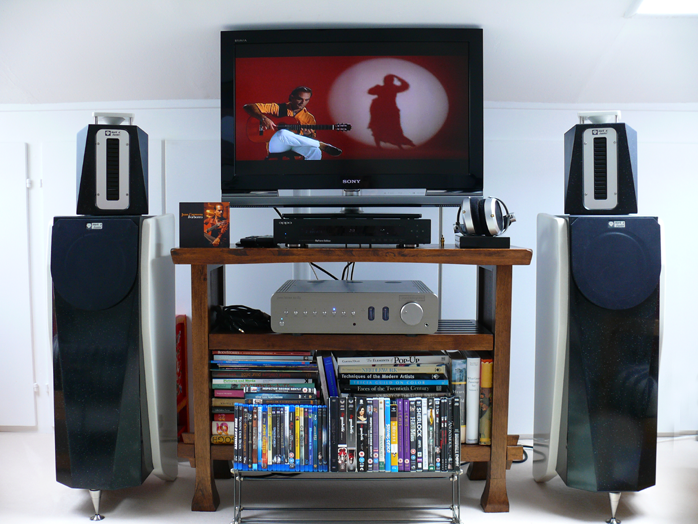 |
Juan Carmona's DVD/CD twofer 'Borboreo' |
Needless to say, the warmish voicing of the Peachtree coupled to a buxom speaker set up to add rather than subtract pounds made for a very robust showing. It completely undermined the AMT's usual propensity for leading the parade. That's not a function of tonal balance but uneven dynamic contrast which is higher for the pleats than cones. The GI's massive low-impedance power seemed to accelerate the cones. The result was meaty and very potent (I nearly wrote potatoes). Doing a few rounds between BNC and AUX2 inputs to compare the GI's DAC to the NuForce-modified Oppo's netted virtually identical results. This equality was so on the level as to warrant no additional comments.
|
 |
John Carter yanking GI Peachy's chain
|
The Grand Integrated seems ideally placed to bridge music/movie duties. In scenarios where the main speaker is willing if properly asked, it could well make a subwoofer unnecessary. Getting all required hardware in one trim cool-running box is quite the attraction when your idea of such a system isn't the bachelor's tower of power stack.
|
 |
  |
 |