This review page is supported in part by the sponsors whose ad banners are displayed below |
 |
 |
|
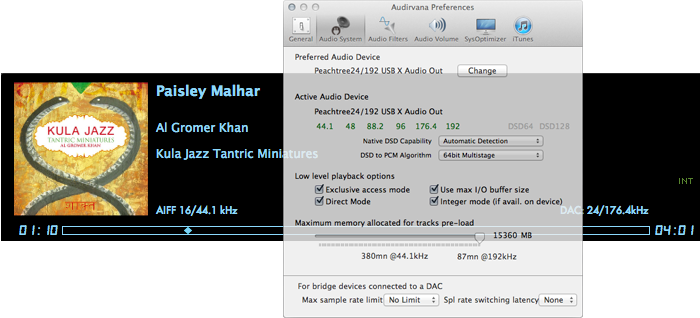
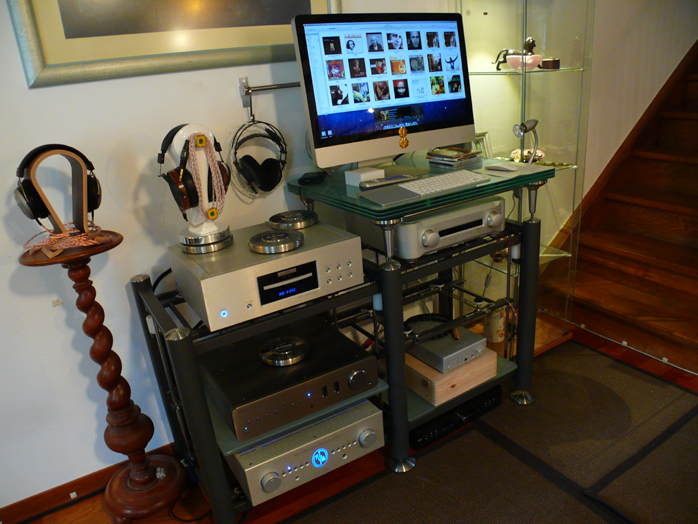
| As DAC. The XMOS USB transceiver instantly locked to my quad-core iMac without demanding secret handshakes. The device identified itself as Peachtree 24/192 USB X Audio Out. It also proved integer mode compadre. That meant I could run Audirvana 1.3.9.8 in direct mode for which integer is required. And that meant business as usual: the same player settings as my Eximus and Audiophilleo take (the latter feeds my APL Hifi NWO-M). The split KingRex uArt USB cable worked in battery mode as usual, 5V power lead not in the iMac but a Bakoon BPS-02 battery supply [right]. For this part of the audition, GI Peachy ran in fixed line-out mode. There its attenuator naturally still handles control over the headphone volume. |
|
|
 |
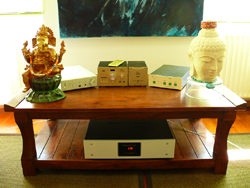 |
In a recent review I had shuttled through my three converters with variable gain. These are the Firewire Weiss DAC2, USB Antelope Audio Zodiac Gold/Voltikus and Eximus DP1. The exercise had reminded me again that not only do they occupy roughly the same price patch, they play accordingly. Assessing the GI's size as DAC would be easily accomplished comparing it to just one of them. My favorite of the lot is the April Music. Of course it doesn't upstage my 20 x AKM AK-4399 per channel rebuilt Esoteric UX-1. There a very special Lundahl transformer-coupled triode output stage adds organic textures, depth layering, ambient micro detail and elegance which nobody would expect from the Eximus at 1/10th the price. But at its sticker the DP1 remains my go-to DAC.
|
|
|
 |
The question now was, could the Peachtree keep up with a €3.000 DAC/pre/headamp which these pages, SoundStage! and The Abso!ute Sound had written up already to serve as a recognizable reference? Before I switched to variable DAC mode for both to compare them as digital preamps, ModWright's brilliant LS-100 line stage with Psvane's best 6SN7 and Synergy Hifi rectifier handled remote volume control.
|
|
|
| |
 |
The Ex had the edge on detail with its higher contrast between sound and silence. The GI had a subjectively higher amount of reverb or blend to sound more farfield. Yet its actual stage perspective of subjective listener distance was more forward whilst still behind the speakers. This was similar but far smaller in scope to the microphone perspective between the Scharoun Ensemble's take on Franz Schubert's pastoral Octet D 803 and the close-mic'd string quartet on Luz Casal's "Amado Mío" from Un Ramo de Rosas. |
|
|
The classical album presents more actual venue ambiance. Separation between instruments isn't as keen. Their precise locations aren't as locked in. Allocation is more amorphous and restricted laterally. In turn the organic billowy sense of performers within a reverberant acoustic is obvious from the first bar. The Spanish pop album is studio-polished crystal. Each instrument is acutely placed. Their locations are feathered out far more broadly across the stage. Transient bow-on-string action feels as though under a microscope. Artificial stage depth is more lit up. These are common effects from basic recording engineering decisions. In gestalt if certainly not degree they tracked the differences between DACs. The takeaway would surprise those arm-chair designer who predict sonics from chips. If I was limited to just one descriptor, I'd pick organic for the Sabre, resolved for the BurrBrown 1794A. Equivalent minor polarization would be found in wet vs. crisp, fluid vs. articulate. Not what you expected from existing Sabre lore? So much for arm-chair engineering. Incidentally this was without the 12AU7 switched in to give GI the highest S/N spec.
|
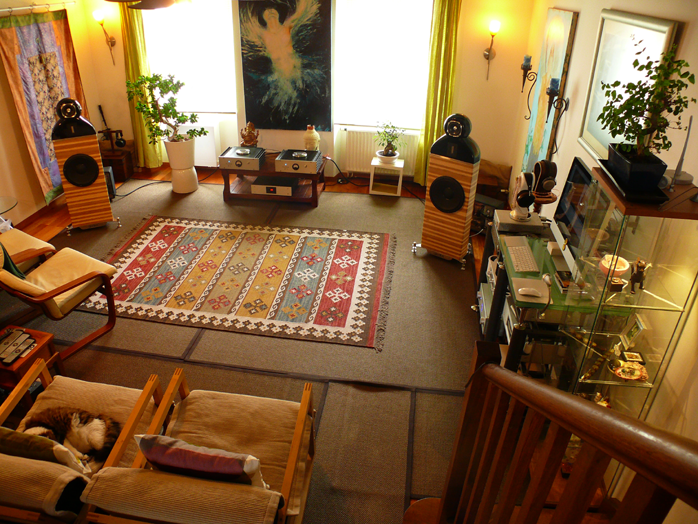 |
FirstWatt SIT1 monos, GigaWatt PC Evo 3 SE power conditioner, Aries Cerat Gladius speakers
|
Having myself heard various Sabre implementations to agree that this flavor converged a bit from the majority, I'd attribute it to team Peachy's finely honed craft at voicing their components to counteract cheap digital's propensity for needling. That's my private term for hyped transients with insufficient ring-outs to overemphasize staccato over legato and dry up or overdamp space. With their flagship machine this 'corrective' measure (if we can even call it that) applies so discreetly that it didn't truly move the performance below the Eximus. It was more of a sideways move to become another possible flavor. I thought that very surprising maturity for a built-in converter board. True, in the context of my regular system where a preamp alone costs as much as this entire integrated—and where a dedicated active preamp indeed improves over source-direct—I'd give the nod to the Korean machine. And for combining Peachtree's core quality with Eximus caliber resolving power I'd go to my NWO-M with Audiophilleo USB converter and throw all fiscal sanity out the window. But back on earth the upshot is clear. This full-featured integrated sports a DAC stage that would sell for between €2000 and €3000 as a standalone machine and be highly competitive. Clearly something in the Grand Integrated was thrown in for free. What?
|
 |
|
 |
As analog preamp. To isolate line stage chops, I reverted to my ultimate NWO-M source. This fed the GI and ModWright LS100. In tu:be no mode, the Peachtree was the clearly cooler more distanced and finely filigreed operator. The ModWright was more generous with textures, tone density—including the weightiness and burnishedness of cymbals and triangles—as well as microdynamic cresting and bass power. The basic juxtaposition was body and hereness versus space and thereness. In tu:be yes mode the Peachtree's spatial lucidity toned down a tad and things got a tick softer. The degree thereof was small and restricted to just these qualities. This completely bypassed the aspects one expects of a superior valve preamp whose glow bits generate actual voltage gain. If this unity-gain tube buffer is intended to soup up MP3 fare (I had Wael Jassar's Fe hadret el mahboub as a lovely 320Kbps Spotify version), I'd actually not bother with premium valves. |
|
That's because I compared the stock Chinese 12AU7 to a pair of Full Music/TJ and Synergy Hifi equivalents. To induce the Gemütlichkeit factor—German for 'coziness'—the fuzzier stockers went the farthest. GI Peachy really isn't an active tube preamp at all. To my mind the defeatable tube buffer simply compromises S/N ratio by design (and perhaps lowers rise times as well) to mellow out and fluff up overcooked compressed music. Then you might as well maximize the effect. Naturally the above context of ancillaries had no need of this. Thinking of the Peachtree as analog preamp should thus disregard its tubes to properly anticipate its very nicely lit-up clarity of the sort one also gets from a superior AVC like Bent Audio's Tap X.
How about using it as volume-controlled DAC?
|
|
|
|
| As digital preamp. For this it was back to the Eximus. Like the GI it now had to drive the 6-meter length of Zu Audio Event which connects side-wall stack to mono amps between speakers. Now the earlier flavors of fixed-output DAC mode reasserted themselves. With the higher-gain Eximus, articulation was more sculpted. Pizzicatos had more pizzazz and the metallic sparks firing off Anoushka Shankar's sympathetic strings on the flamenco bulería of Traveller had more harmonic energy. Simultaneously the vigorous piano which parallels the sitar exhibited more robustness and vigor. In short, the Peachtree didn't descend quite as deeply into the various virtual bodies. But again the offset was just big enough to accord the Eximus a small lead in fullness and drive. |
|
|
|
 |
  |
 |