This review page is supported in part by the sponsors whose ad banners are displayed below |
 |
 |
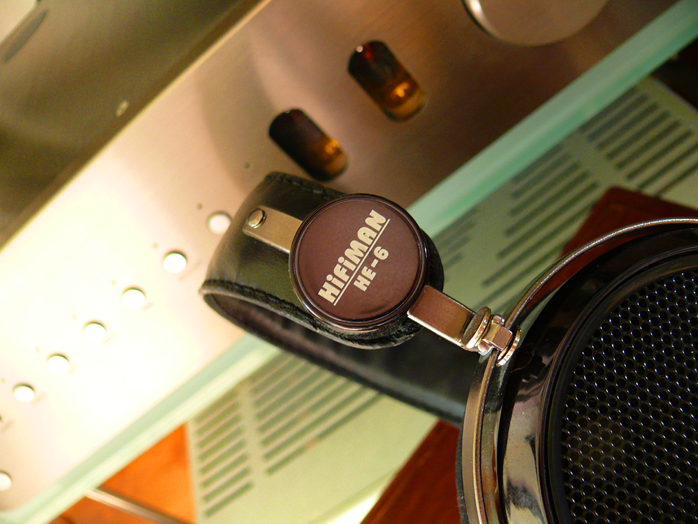
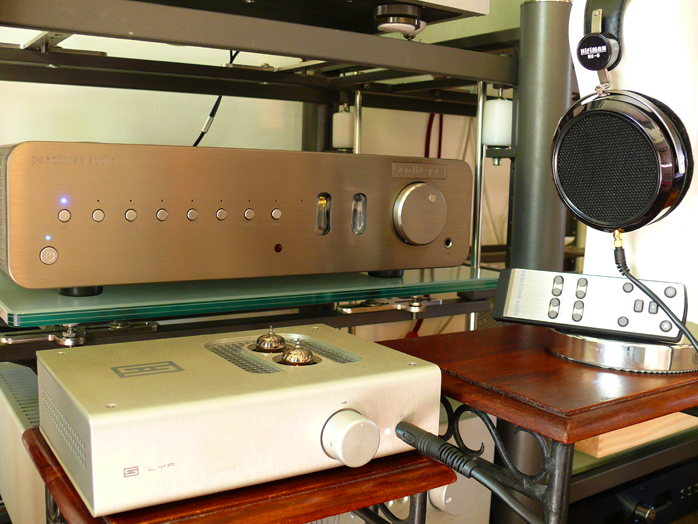
As DAC/headamp. At about $3.000 for the DAC/pre and another $3000 for the amp, we've exceeded GI Peachy's enlistment costs by $1.500 already. Still we have its headphone port to inspect. What type of load would it drive? The currently toughest is HifiMan's HE-6. It tends to require dedicated amps pushing out 3 or more watts into its 50Ω. Schiit's Lyr does twice that. It's the perhaps most cost-effective specialized HE-6 handler of the day. With sufficient voltage gain in the chain to overcome the planar's 83.5dB inefficiency, certain 6.3mm jacks one wouldn't suspect can be surprisingly effective. That's the case here. Between 1:00 and 2:00 on the dial the HE-6 played loud enough for my needs. At 4:00 my ears gave out. And there was more to go. Even orthodynamic headbangers playing Deaf Lepers should be happy.
|
 |
Many $1.000+ dedicated head amps can't do that. On pure grunt GI's ¼" jack thus is worth $449 Lyr notes. Our running math—of what one could spend extra if tasked to assemble a Grand Integrated from different boxes and various makes—thus hits an easy $2000 prior to extra cables, power cords and racking. Ain't integration grand? Of course grunt alone wins no beauty contests. What it does mean here is go-anywhere drive with all commercial headphones presently to market. For a Grand Integrated owner headphone listening will never be limited by brand or model.
|
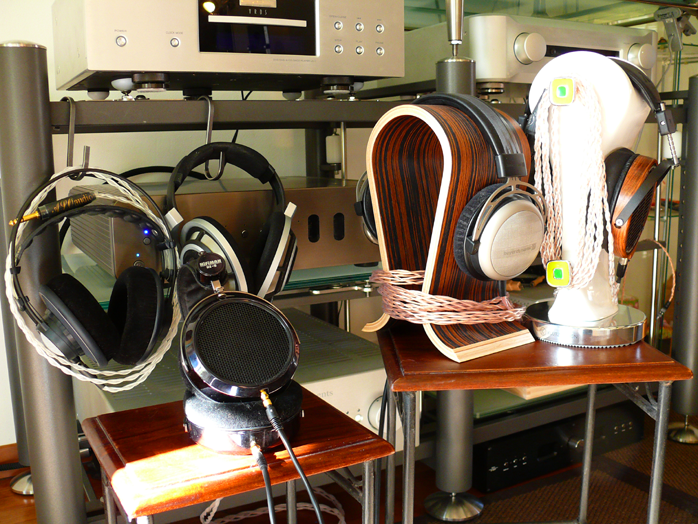 |
AKG-K702, Sennheiser HD800, Beyerdynamic T1, Audeze LCD2, HifiMan HE6 in front
|
|
|
To move from grunt to beauty specifics, comparisons began with a Lyr connected to GI's fixed line-out and the HE-6. As in all previous 'unfair' A/Bs of the earlier pages, this was again close and played in the same league with the very first competitor to shorten suspense. The Lyr had slightly higher color intensity but in trade was a tad fuzzier around the edges. The latter quality was far less but otherwise similar to how the SIT1 had differed. Except now it was in the Peachtree's favor. Its minorly cooler demeanor over the Schiit dealt with edge definition more articulately. Sans 12AU7. With the latter engaged and Spotify running some Arab pop, I finally cottoned to the valve buffer. The Schiit now exhibited some upper midrange/treble glare even over the chocolaty Audeze LCD2 which the GI completely avoided.
The glow bugs with yellow LEDs in their sockets really did have a purpose other than showboat display.
|
 |
The AKG-K702 is—or should be—notorious for affordable excellence that's directly proportionate to the output buffer driving it. That's not a function of achievable loudness as apparently current. Not enough of it and the K702 sounds boring and flat. The Peachtree showed no such issues to get the cost-conscious shopper $1000+ headphone performance from a $449 can. On 16/44.1 or better fare, the old tu:be or not question clearly showed that the valves reduce dynamics and thus grip. They are not fidelity enhancers. They are sound smoothers. No disrespect there. I love Wael Jassar, Karim Al Saheer, Amr Diab and other Arabian singers. Alas, recording quality even on CD can be sketchy, becoming yet more so on readily accessible MP3 streams. What to do? That's where the valve buffer earns its bread. Making it switchable was very smart. This 6.3mm port is so serious as to make the Grand Integrated's asking price commensurate with its DAC, preamp and headfi amp functionality alone. That would make the bridged top-line ICEpower boards the thrown-in freebies. Considering how their specs nearly track Bel Canto's Ref 1000 monos, that's not lightweight. In short, think of the Grand Integrated as combining a Weiss DAC2/Antelope Audio Zodiac Gold level converter with the same XMOS USB transceiver as used by Ayre and Eximus; a Schiit Lyr headphone amp; a superior volume control with ultra-tight channel tracking; remote control; and 500-watt Bel Canto/Wyred4Sound type monos.
|
 |
Conclusion. Raves are over the top and bad for your teeth. This assignment was meant to be more sober. But don't mistake a few pricks of comparative criticisms for damnation by faint praise. The comparisons simply isolated the standing of each function as well as may be attempted. Criticisms were minor down-to earth qualifications and against costly machines dedicated to just one or two functions. What ought to be sobering to their creators is how Peachtree's Grand Integrated manages to combine them all at such a high level; how they can include US-based assembly/QC and charge for the package what some competitors want in isolation. Sobriety is the real flavor of raves.
With their flagship product Peachtree has handily upstaged their well-acknowledged DAC expertise. They also beefed up headfi seriousness with anything drive and top-shelf sonics. Then they wrapped it all up in a bow that annihilates prior reservations about their integrateds' power stages.
|
|
|
Even if career doubters are bound to not handle the truth because it's inconvenient, this really is the equal excellence opportunity it purports to be. In both meanings of the word, Sir Peachy is the real deal. It affords the regular GI Joe and Jill an opportunity to partake on each count of its multi functionality at a very high level without considering any of them the weak link. Where the amp section is concerned, speakers of any persuasion and size may apply. That's not the usual domain of integrated amplifiers. But here all bets are off to explain why in this company's catalogue, it's an integrated that sits at the very top, not separates. It's not high-end audio for old goats as one gonzo hifi journalist once called our aging crew. It's modern lifestyle hifi whose sound values conform to high-end expectations, then add smarts and conveniences even high-enders would love to have if they could just admit to it. So now Peachtree Audio plays in the big leagues... |
 |
 |
 |
|
 |