 |
|||||||||||||||||
|
The DEQX PDC-2.6P as a digital-to-analogue converter |
|||||||||||||||||
| Specwise, the units have 24 bit and 192khz upsampling technology in common which would make for a potentially interesting shootout. So how did the DEQX's built-in DAC compare to the resident Bel Canto heavy-weight? I hooked up my SONY XA-5 ES transport to the S/PDIF coax socket via the remarkable Harmonic Technology Magic Digital Link and once again pucked up the Derek Trucks CD. Off the bat, Derek's guitar was placed center stage and rendered with superb detail. Bass lines were | |||||||||||||||||
 |
|||||||||||||||||
| very tight and fast, making the music sound bouncy and rhythmic. Compared to the Bel Canto however, there seemed to be less presence and delineation from the other instrumentation in this busy mix. The Bel Canto separated and resolved complex mixes more precisely whilst in the crucial midrange being tonally richer and lusher where the DEQX was subtly more detailed and leaner. I guess if I had to use a popular yet controversial audio analogy, I'd say that the Bel Canto was like a good stereotypical SET valve amplifier and the DEQX like a first-rate solid-state amplifier. Similar results were experienced when listening to the other cuts used for the evaluation. The Nils Lofgren guitar assault was very detailed and rich in minutiae and steel string phenomena. Nils was placed precisely within the large stage where he gives his all for the adoring audience. His guitar via the DEQX's built-in DAC sounded leaner and brighter than the Bel Canto's warmer, fuller, more rounded tonal presentation. I found the DEQX's built-in DAC to be very detailed, precise and easy to listen to. Its images were very well focused and placed within a generous if not massive soundstage. The midrange lacked the warmth, tonal richness and bloom that the Bel Canto so lovingly draws without losing dynamic detail and contrast. Down lower, the DEQX DAC had superb bass quality with tremendous pace, detail and a tautness that enhanced its overall sock-it-to-me gut expression. The DEQX as a digital crossover: the benefits of bi-amping When in the late stages of the writing process, head honcho Kim Ryrie contacted me asking for an opportunity to demonstrate the unit's capabilities as a crossover for bi-amping and subwoofing with a pair of respected monitors. I wasn't going to test this particular mode as the equipment required to do so was not at my disposal at the time. However, Kim persisted, saying that as a crossover and configured for bi-amping, the DEQX excels and is able to transform an already highly acclaimed speaker design. As we know, it is virtually impossible to manufacture a single driver that can perform equally well at all frequencies and although a contentious subject between divided camps, the possible exceptions may be Lowther and Fostex. When a driver is asked to perform outside its optimum frequency range, it begins to break up. The result is distortion, beaming etc. Similarly and in a common 2-way speaker with a typical crossover of 12dB per octave, both drivers cover the same frequencies for an octave or two above and below the crossover frequency. Once again beaming and in particular, intermodulation distortion can occur. |
|||||||||||||||||
 |
DEQX's ultra-steep crossovers of up to 300dB per octave completely eliminate driver interaction and therefore crossover-related phenomena. Another quite obvious benefit is that by limiting driver outputs to their optimum operating range, said drivers are working within their comfort zone in coasting, remaining able to reproduce large dynamic swings and maintain accurate pistonic linearity without raising a droplet of sweat. For practical reasons, it was decided that I should visit Kim at DEQX's Brookvale offices in the Northern Beaches district of sunny Sydney. On hand in the listening studio were a couple of stand-mounted speakers, one a custom design by DEQX, the other a high-end model by a renowned British maker. Behind the speaker position and at opposing corners sat a pair of relatively cheap 10" subwoofers. DEQX's Ian Thorpe helped configure the scenarios for the purposes of the audition. First we tested the custom design (sealed box, Focal tioxide tweeter and PHL mid/bass) in bypass mode, then switched to speaker correction Profile1, then | ||||||||||||||||
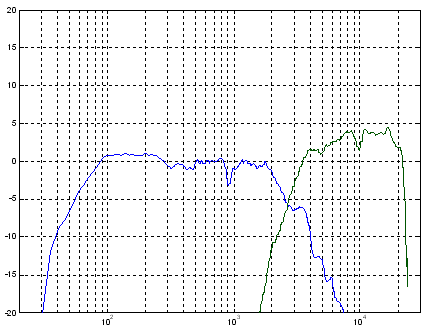
| A typical frequency response of a two-way speaker system, showing both woofer and tweeter after passive crossovers. The sum of the woofer and tweeter across the crossover range (typically over two octaves) target a flat frequency-response on-axis. |
|||||||||||||||||
| to correction-plus-equalized-with-subwoofers (P2) and lastly, to corrected-equalized-and-room-corrected-with-subwoofers (P3). DEQX's own multi-channel digital amplifier provided bi-amplification. The crossover was set to 300dB per octave and the subwoofers were crossed in at 120Hz, a little high but necessary with these monitors. In bypass mode, the lack of bass and dynamics mirrored expectations for a 6-inch sealed box in a medium-sized room. The treble range was hard and the midrange sounded congested, compressed and distant. The soundstage was restricted to the width of the space between the speakers and depth reached as far as the speaker's rear panel. There was no life to the music, just anemia from a transducer truly in the wrong place at the wrong time. P1 was a definite step in the right direction - a little more of everything, less hardness and congestion. However, things started to get truly serious with P2. With the subs in and EQ'd, the little speakers were no more. Big sound from small boxes as they say - big sound not only in terms of scale and dynamics but also in terms of an expanded soundstage with precise imaging and layering. The bottom end remained boomy, though, not surprising given that the subs were positioned right up against the corners. Big deal, let's press that P3 button to add room correction and see what happens. Kazooks! Not only were we now rid of that boominess but that sense of involvement talked about earlier returned for a sequel. When we summarize the resultant sound qualities of emotional involvement, humongous soundstaging, precise image focus, prodigious dynamic range, copious detail without a trace of hardness - what do we get? A room-efficient small speaker and subwoofer combo for small money that sounds a lot bigger and more expensive than you would ever have imagined possible since prior to the DEQX's trickery, all we had was a pair of mediocre stand-mounts and a pair of non-spectacular subwoofers. What a turnabout! |
|||||||||||||||||
| The above was repeated with the British pair except the crossover for the subs sat at 80Hz. Having a better-quality starting point meant that all of the gains described above were extended further for similar but magnified results: even bigger soundstage, accelerated dynamics, better detail and timbre, far more emotional involvement etc. I'm sure glad I took up Kim's and Ian's invitation. The biamped system with the DEQX as crossover was certainly very impressive, the gains reaped on a modest speaker system of a magnitude larger than obtained in my already highly tweaked setup at home. Mission accomplished without Tom Cruise - demonstration successful. I will in fact now agree with Kim - this particular application is one of the strengths of the DEQX system and a true eye opener. |
 |
||||||||||||||||
| All things to all men In the professional audio field, you can find several digital units that have been around for some years to in part tackle what the DEQX grabs by the horns. In fact, I own a few of 'em. The Behringer unit in particular has been favorably reviewed in well-known Internet forums and a number of audiophile publications including The Absolute Sound to name just one. I've also had the pleasure of having the very good Z-Systems RDP-1 digital preamp/EQ in my system for a number of weeks and am aware of great reports on the TacT RCS-2 and Lexicon units, both of which valiantly attack and indeed defeat the problems caused by inclement room acoustics on your loudspeakers' frequency response. Good as they are, neither seems to go anywhere as far as the PDC's complete solution. With digital speaker correction, comprehensive digital crossover options, parametric/graphic EQ plus room correction, the DEQX folks have thought of just about everything and covered all bases with bravura. As if that wasn't enough -- and for the price some audiophiles pay for a stand-alone unit -- you also get a bonus DAC thrown in that is no slouch and a preamplifier that even in bypass pleases with its transparency, smoothness and bass quality. When configured for biamping and active crossover networking, the DEQX is able to elevate modest equipment into the lofty realms of esoterica. Furthermore, all this is offered at a price that's reasonable and attainable to a wide cross section of the audiophile population. If only DEQX could squeeze an Espresso machine into this beast. Although daunted at the onset without pilot's license, once acclimatized I subsequently became very impressed with the DEQX PDC-2.6P and felt like a bona fide dog fighter chasing bad speaker/room interactions. DEQX has managed to transform the cliché "state of the art' into an unassailable truism. Kim Ryrie, mate - you may now have to wait for the rest of the world to catch up. Hand out some kangaroo harnesses with the following slogan hand-embroidered across the bib: "Now that we can do anything, what will we do?" ( Massive Change Exhibition, Vancouver Art Gallery). |
|||||||||||||||||
 |
|||||||||||||||||
 |
|||||||||||||||||
| Kim Ryrie from DEQX responds: Many thanks for the great review and the award. Just a few corrections. In the paragraph discussing speaker correction, it is mentioned that: "Once the test tones are calibrated -- microphone ear level at the listening position -- the frequency graph of the room (effectively, the sound your supposedly flat speakers are reproducing) will appear in the control panel". The test tones for 'speaker measurement' should actually be conducted in a clear space at a distance of typically 1 meter (3 to 4ft). The 'listening position' measurement is conducted only for room measurements. In the paragraph entitled, "The DEQX PDC-2.6P as a digital-to-analogue converter", it should be noted that the review sample wasn't running at 96kHz or 192kHz although it does incorporate two channels of 96K ADCs and six channels of 192K DACs. We do all DSP processing at the specified sample rate up to 96K. Although the DACs run from a 12 MHz clock, the actual sample rate of the review unit was running in 48k/24-bit mode. A no-charge software upgrade to 96K/24-bit upsampling is in development. Although Edgar found that the PDC was "no slouch" used just as preamplifier tested in bypass mode, in fact, the PDC sounds least good in the factory-set bypass mode that he was listening to. This is for two reasons: Firstly, when we do speaker correction, the entire electrical path from the PDC's DAC outputs through power amps, cables and speakers are simultaneously corrected as a system. The initial factory bypass selection is ultimately intended to mean bypass room correction but with speaker correction still active. Secondly, when factory bypass is selected, there is a factory preset allowance of 18dB of internal digital headroom. This amounts to 3 bits of resolution reduction that allows 'worst case' 18dB of EQ gain before clipping. Typically however, only about 3 to 6dB of EQ gain is required, so most of this resolution is reclaimed using the I/O manager's output gain settings. We neglected to mention this to Edgar and the manual will be updated to make this clearer. Following the room measurement, the auto room correction button is really intended to get you on the right track, although occasionally it finds a room that it corrects brilliantly all by itself. Although its hit rate will improve in time, as Edgar discovered, it's probably more fun to take what it suggests and adjust manually to taste, especially since you can see the actual room measurement underneath your target curve. Finally, many thanks for the Blue Moon Award. While I am always happy to be credited with the PDC's design, the reality is that this seven-year project has involved many very talented people. Of particular note is my founding partner Paul Glendenning who invented DEQX's proprietary low-latency FIR (Finite Impulse Response) long-convolution DSP process. Also, senior software engineers Brett George and Sasha Case are responsible for most of DEQX's 500,000 lines of software code, and our hardware guru Jon Keeble, ex senior Fairlight hardware designer, must take credit for the DEQX's 'first do no harm' transparency. On that subject by the way, for those who want to use external DACs, a low-cost option also provides digital outputs. Edgar's overview has been necessarily focussed considering the potential for permutations. More detailed operational information can be found on our website www.deqx.com. |
|||||||||||||||||
Many thanks Kim Ryrie Managing Director DEQX Pty Ltd, Sydney |
 |
||||||||||||||||
 |
|||||||||||||||||
|
Manufacturer's website
|
|||||||||||||||||
 |
|||||||||||||||||