This review page is supported in part by the sponsors whose ad banners are displayed below |
 |
 |
On the desktop the move from mINT to threesome netted - um, three things: more powerful midbass from the compact Strada 2 monitors; a deeper more expansive soundstage with even more focused imaging; and greater HF sparkle (think vitamin fizz tablet dissolving in water) which Anthony Gallo's famous 180°-dispersion super-dynamic tweeter tracked like a hungry hunter. Because these Gallos are the most dialed for speed, timing, jump factor and precision, they peg the needle quite deeply in the effervescent half of the dial. It won't surprise that Wyred's sonics proved most ideally matched.
|
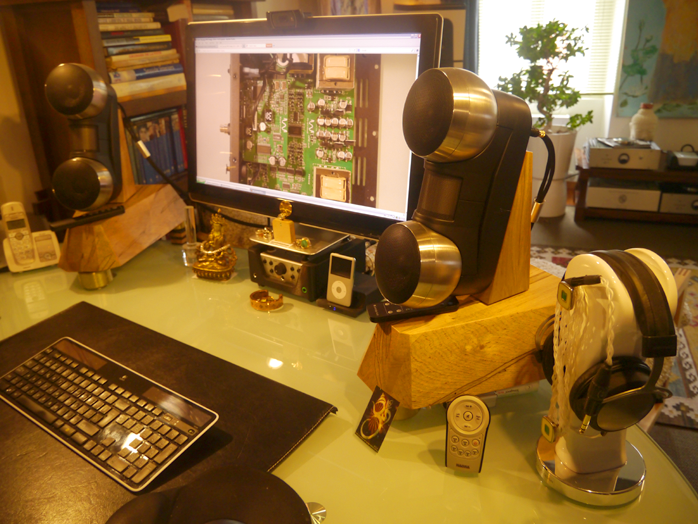 |
my usual desktop with mINT, 160GB iPod Classic and Cambridge Audio iD100
|
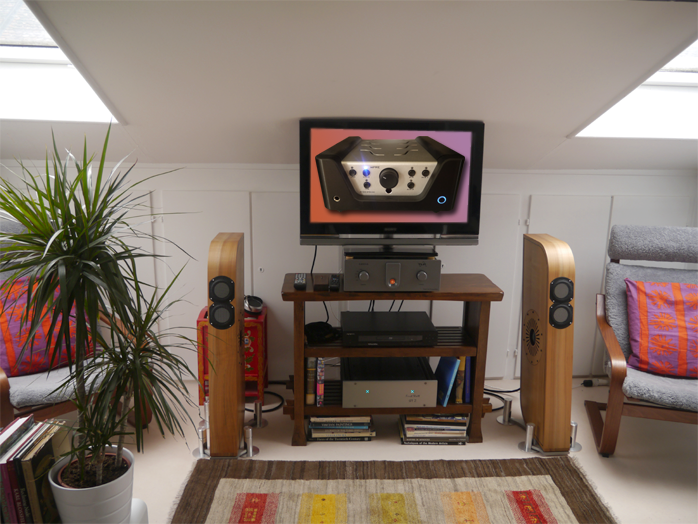
| In our upstairs mostly video system anchored by Sven Boenicke's individualistic B10 speakers whose horizontally opposed 'V-twin' mid/woofers deliberately energize the room's ambient field for a moist redolent darker sound, the mAMPs predictably got too lush. Here very fast and lit-up electronics like my incisive slightly forward and dry 6H30-based Greek TruLife Audio Athena preamp and the stereo version of the downstairs SIT1 amps are ideal. The mPRE would have been right at home but with its sibling amps couldn't shift the voicing needle sufficiently back into lucid mode to compensate for these speakers' mostly omnipolar dispersion. That produces more reflections than direct sound to major on bloom whilst being a bit shy on cutting power. |
|
|
|
 |
|
 |
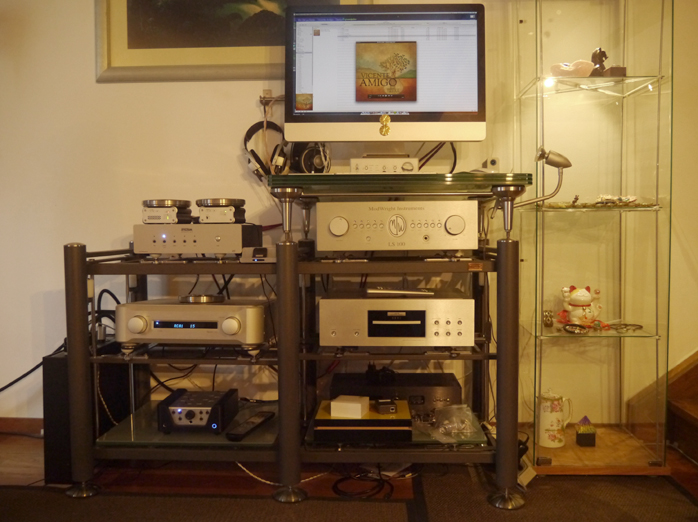
To suss out the mPRE's built-in DAC, I drafted into service my Esoteric C-03 as the resident transistor preamp. To it connected the Metrum Hex and via its fixed preouts the mPRE as just DAC. Both derived their signal from the SOtM USB bridge, the Hex via van denHul AES/EBU cable, the mPRE via Tombo Trøn coaxial S/PDIF. This made for instantaneous remote source switching without having to relaunch PureMusic 1.89b for changed USB destinations. Whilst the different cable formats might have contributed their own micro flavors, the intention wasn't an iron-clad converter shoot-out. I merely wanted an approximation of where in the scheme of things the mPRE's DAC would fit. |
|
|
|
|
|
| Despite the mPRE's digital cable costing rather more than the machine itself, the Metrum Hex—three writers on our team had crowned it 'super DAC of 2012'—retained a very comfortable lead with its <€200 Dutch pauper's leash. It was more vigorous and decisive on transients. It had the greater image density and more robust embodiment. It staged more broadly. This became particularly noticeable at lower volumes when the already paler more distanced Wyred shrank further between the speakers. Extrapolating whilst counting my high regard for the deck as preamp, I'd call the DAC the feature most in line with what it would cost solo. If however I tapped the mPRE over its XLR out with the volume control fully open* and then trimmed the extra output in the Esoteric preamp which ran at zero gain, I could cheat a bit to minimize the performance offset. |
|
|
___________________________________________
* Unity gain occurs at ~1:30 - 2:00 on the volume control unless one is in XLR-in:RCA-out mode. Then it becomes ~3:00. "We delayed the onset of active gain intentionally to insure that the normal listening ranges had enough control over fine intermediate values despite the associated perception that the outputs are 'weak'. The transition from passive to active simply occurs a bit later. When used as XLR-out DAC with bypassed volume control (i.e. not via the fixed RCA outputs), gain is a high 17.2dB (Vrms FS)." Gain allocation—how much occurs in the source vs. how much attenuation is required in the following preamp—is a very valid voicing option. Fixed-out mode over the main RCA or XLR outputs into an external preamp which uses the mPRE solely as DAC should thus experiment with different settings to determine what sounds best as these sockets add gain over the fixed RCA outputs.
|
 |
|
 |
Back in trio mode—Hex as converter, mPRE as balanced pre—I reconfirmed just how brilliantly the monos' generously lush demeanor was counterbalanced by the petite preamp's vim and vigor. This added up to a very compelling mix of ying and yang and a just as compelling reason why one ought to consider these three inseparables. They belong together. It's highly doubtful you'll chance upon better synergy.
This leaves the 6.3mm port. Like the mINT's it's a cut above the equivalent sockets of Bel Canto's C5i—owned and replaced by the mINT—and the previously reviewed Peachtree iDecco/iNova. To do better you'd need something like a Burson. Unless you were a very serious rather than occasional or 'lite' headfier, I'd not bother.
|
|
|
|
|
My personal crystal ball predicts that 2013 will finally see class D get its full due as various publications write up Bruno Putzeys' Mola-Mola NCore 1200 monos. Well north of $10.000/pr they compete squarely and without conditions against the very best of traditional topologies priced to match. Having reviewed the Atsah equivalents, I'm certain. Marja & Henk on our staff also emailed identical findings about a pair of OEM NC1200 samples. Add Devialet's D-Premier and Wadia's new Intuition 01 and for this breed the fullness of time has finally come.
With B&O's 3rd-generation ICEpower audibly matured too and being championed as such by competitors Bel Canto and April Music for just two, in this company Wyred4Sound is first on price. Once we consider the mPRe, it would seem to combine core elements of the $2.000 STP-SE preamp with the complete $499 µDAC1 - quite a mix of quality ingredients.
|
| Just because certain makers keep hitting hard and true doesn't mean one gets to pull a different yard stick. Over the years the Wyred brand has received its fair share of awards from us. I was thus thrice careful to revisit the subject. Yet what is consistency if standards grow flexible to appease that old perception-is-reality concern?
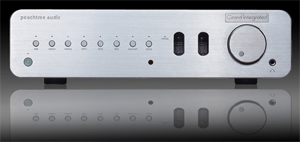
So I thought very calmly of the mTRIO's closest competitor. In my book that's got to be the $4.499 Peachtree Grand Integrated. It packs the same XMOS, Sabre and B&O hardware with very similar features and specs. |
|
|
|
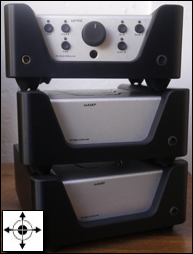 |
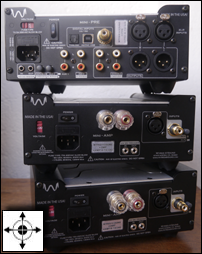
Where the Grand tucks it all in one chassis, Wyred's $2.897 approach spreads out across three which isolates the digital and preamp circuits from B&O's SMPS. Even with two additional power cords and interconnects, EJ Sarmento's pricing advantage can't be ignored. It takes no direct A/B to see how this math works out. And though I hadn't lived in the US for some seven years to eliminate patriotism, there was the added wrinkle of purely domestic manufacture. Hence today's conclusion really was quite inevitable. I'm in fact convinced that our trio would stand up supremely well to April Music's $6.500 Stello AI700 whilst adding DAC/headfi functionality to further sweeten this very sweet deal. Those are today's famous last words then...!
|
|
|
 |
 |
 |
|
 |