This review page is supported in part by the sponsors whose ad banners are displayed below |
 |
 |
|
 |
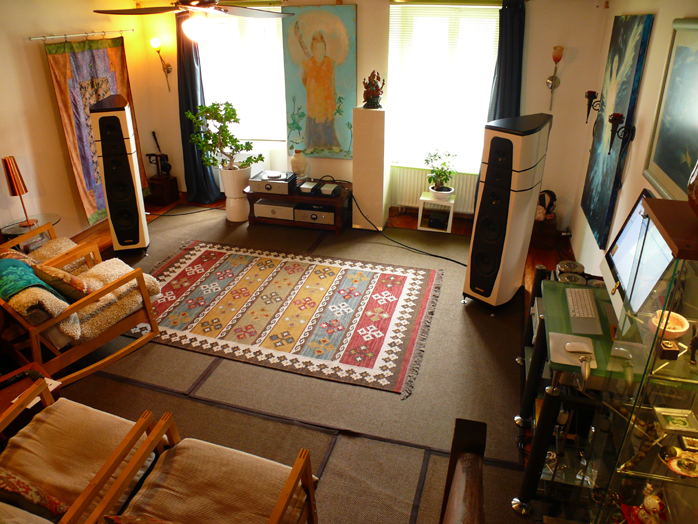
mAMP. After reviewing AudioSolutions' Rhapsody 200, I knew I'd found my long-sought conventional speaker. To assess high-power amps, boxes coming on song with a measly watt to require very little control over gnarly impedance swings and wicked phase angles don't make for an ideal testing ground. I simply had to find a properly challenging speaker I liked enough to want to own. Having driven my 5-driver 3-ways with AURALiC's brilliant Hypex monos and Simon Lee's stout Stello Ai700, I already knew how none of them had exercised complete control over this seriously underdamped twin-port loading which hits 20Ω at 17Hz with a 3.45Ω nominal rating and swings to 2.8Ω at 9000Hz. The only amps to completely annihilate all port-induced boom and looseness had been the $9.000/pr British Acoustic Imagery Atsah monos based on a stock Bruno Putzeys NCore 1200 platform. |
|
|
 |
|
| Marja & Henk concluded likewise whilst reviewing the smaller Rhapsody 130 with their pair of Dutch NCore monos. On iron-fisted speaker kung fu those proved superior to a single Devialet D-Premier. What exactly it is about the NCores to make for such mega results on our stubborn Lithuanians we don't know. All our comparator amps had properly low output impedance. Any unreasonable hopes I might have secretly harboured for an eNCore on the cheap were squashed when Wyred's minis joined the ranks of amps which had me stuff the ports again as I already do for all my resident amps. By following in the footsteps of the $5.000 Meraks and $6.500 Ai700, there was zero shame, just a real-world reminder not to expect miracles with speakers that want to be dominated with a virtual choke hold. |
|
|
|
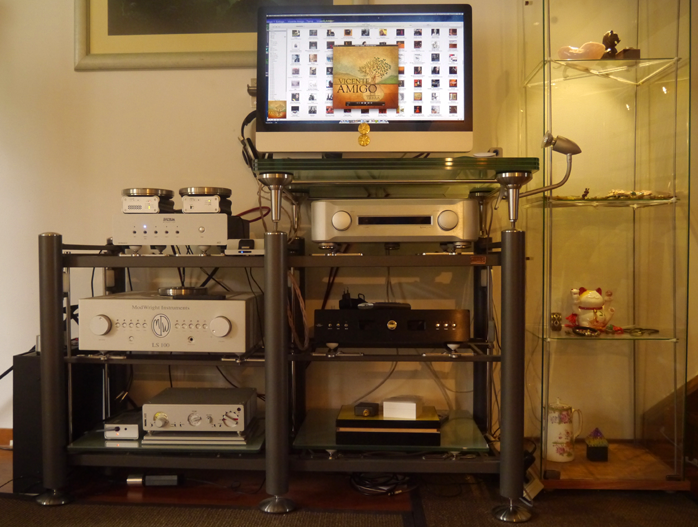 |
the front end with SOtM's best USB bridge, Metrum Hex and Nagra Jazz all connected balanced
|
 |
I began by inserting the monos into the standing system above. When the RCA connection between Jazz and mAMP suffered ground loop hum but XLR was deathly quiet, the latter became the default choice. As my previous 3rd-gen ICEpower reviews covered, the sound one gets today is the literal antithesis of early bleached needly hyper-pixilated class D. If anything it's become slightly too warm and thick. This explains why trade show demos with Accuton-fitted ceramic Mårten Design speakers elicited such applause. It's a perfect salt'n'sugar affair. On my speakers which I've routinely described as voiced like vintage Sonus faber with US-style bass and boisterous dynamics, sugar was prevalent. My tastes wanted for an infusion of piss'n'vinegar which a mere preamp swap didn't quite manage. |
|
|
| For me system voicing is mainly about setting your ideal balance between tone density and effervescence of the upper harmonics. Too much of the former and thick meatiness suffocates overtone finesse. Too much of the latter and things get too energetic and lean. Think Zu Druid V with push/pull valve amp vs. Voxativ Ampeggio with ultra-quick transistor amp. And you might be loving their presentations. Everyone's midpoint is different. At present mine is educated by the FirstWatt SIT-1 and Bakoon AMP-11R when fronted by a premium valve preamp like Nagra's Jazz driving speakers like the Aries Cerat Gladius or soundkaos Wave 40. Within that 'ear set', my first attempt at bedding the minis lacked spunk and incision. I wanted more speed, more incisiveness, more resolution. |
|
|
|
|
|
|
 |
Out with the Lithuanian speakers, in with the Cypriots. Better. I still missed the overall illumination and charge I get from the SIT-1s and their excellent whisper-level intelligibility—the Wyred Bros congealed faster at low volumes—but overall pace had quickened and articulation improved. This benefited both excitement and insight. What's more, these were $899 200-watt monos, not $5.000 10-watters. Perspective! About which, on these not cruising-for-bruising less misbehavin' 12-inch sealed woofers, the bigger wiry muscle and higher damping netted more potent bass than the SITs manage if not with the same nuanced sophistication. Where the vertical power Jfets arguably warrant addition of a subwoofer to give these speakers some minor assist below 35Hz, the mAMPs inspired no such lust. The extra extension squeezed from this load felt perfectly sufficient. |
|
|
| mTRIO. Still mining for microdynamic impact and knowing that Nagra's valve preamp was texturally slightly soft (making it a superb complement for the blazing SITs), the Jazz was next to go. Once the mPRE took reins for the full team Wyred effect, the game kicked into high gear. Now it was luv! Just as robust and meaty as before if not more so, I now enjoyed noticeably better top-end extension. With it came true inside-out dimensionality. That's self-revealing spaciousness where the listener isn't forced to penetrate into the thicket of things from the outside in. Bass too was patently grippier and more articulate. This showing now truly obliterated any notion of added sub action. Whether it was the fully balanced signal path from source to amps or the built-in synergy between the club m kit... this was not my usual sound from these speakers but as such just as compelling and self-validating. |
|
|
|
 |
with Aries Cerat Gladius and mPRE
|
 |
I was in fact taken aback by how the mPRE insertion transformed the mini monos. My read on those morphed from another warmish perfectly civilized but somewhat polite and thick-ish ICEpower implementation to a super ballsy onion-layered presentation that combined scale and mass with dexterity and shove. On the density/effervescence meter, the needle still dipped into the density half but suitably close to the transition mark where all prior sense of drag and somewhat homogenous gelatination had been completely shed and teased out into very visible resolution. Obvious wall-of-sound aspects remained other than what I usually pursue but the mPRE's contribution of higher separation and sorting power with more top-end energy and grippier LF brooked no complaints. This style of presentation simply wanted to be listened to a click or two louder than my usual recipe. That's more lucid, airy and quick but also texturally leaner to exhibit a looser weave.
|
|
|
|
My currently favored voicing—anyone's audiophile journey is bound to make different stops—excels at conveying the microdynamic ripples, bow-on-string action and overtone fizz even bite with its associated projecting power you'd expect from a string quartet up close. The mTRIO majored on recreating the mass, low-down heft and rollicking power of a bigger live venue where sound reinforcement is calibrated to scale up performer output so it can pressurize the large space and reach the far rows. That's a fatter more power-zone weighted flavor. It's meatier and bigger than purely acoustic and as such far closer to what amplified music done right often sounds like in a club or hall like Montreux's Stravinsky. |
|
|
| |
|
|
|
 |
Comboclusion. By acknowledging exceptions, we can talk generalities to make an easily appreciated point. Wyred4Sound's mPRe/mAMP separates seem ideal to harness ceramic speaker sound at its best. Transient zippiness, associated textural bleaching and some lightness of tonal bloom are all compensated for. Obviously a vintage paper sound would be treated equally to risk overemphasizing like with like. Here everyone is their own chef. We can also say that the full-on monaural amp concept, equally dual-mono and fully balanced passive/active preamp and system architectures combined with very low noise make for brilliant soundstage specificity, precise sorting and good layering including a surprising height perspective. This is a very big expansive sound particularly so laterally. It's also very chewy and robust to gravitate toward power music and higher SPL. |
|
|
 |
  |
 |