|
This review page is supported in part by the sponsor whose ad is displayed above
|
||||||
 |
||||||
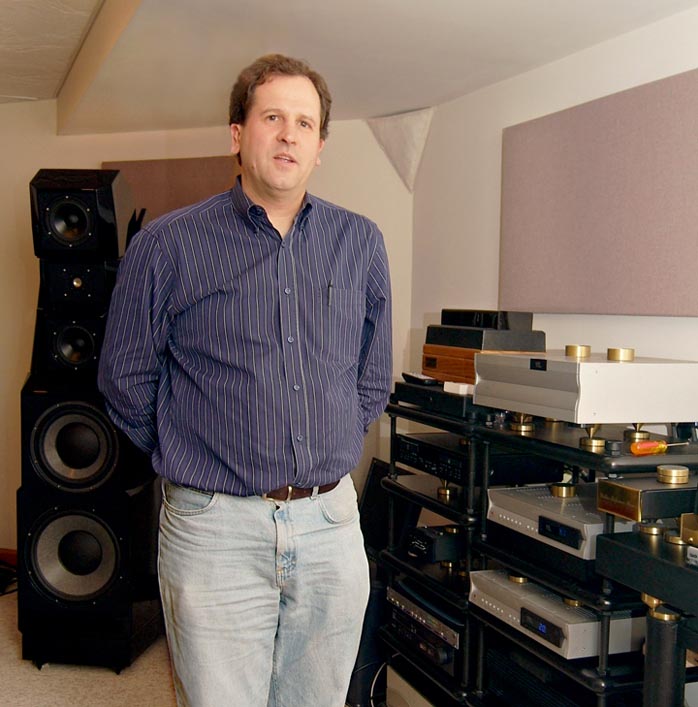
| How would you describe the design leap from the 2.5 and 5.5 to the 7.5? Actually before that, we had some strangely named products like The Super Deluxe and the Ultimate. However, they had no remotes - great phono stages but no remotes. Were their designs similar to the current version of the 7.5? In those days, the phono that we were doing was all RIAA done through the feedback loop so you did not place more passive components in the signal path than necessary. The filter was all in a feedback loop. My dad liked that idea. He also liked the idea that the balance control was in the feedback loop as well. Again, one less part one was not running through. Since the balance control was a potentiometer like a volume control, it's a wiper on a resistive element. They get noisy and you have high contact resistance. Therefore, you lose resolution through those parts. So he was right putting the balance control through the feedback loop and just vary the feedback on that channel. The problem was that it changed the sound on that channel. So going back to the beginning, we had a very rudimentary approach. A plain Spartan kind of front panel with very ambitious sounding names but no user functionality to speak of - just a few knobs. He went from that to the 2.5 and the 5.5. My dad and I split up and I had to add a remote control for volume and mute. The 5.5 added a balanced output, actually with a differential gain stage. You put a single-ended signal in and it goes out balanced. The balanced out gives us a couple of unique features, allowing us to drive long interconnects, which would be more typical for someone using a 5.5 system. The 2.5 generally would sit on the rack with the amp; but the 5.5 is typically used with higher powered amps that would sit near the speakers. Also with the balanced out, you get a phase switch by simply flipping pins two and three and you can do a phase flip on the remote. You need the switch on the remote because you have to be in the listening position to hear the effect. So the only thing stopping the 5.5 from being a fully balanced preamp is the volume control - you'd need a four-deck volume control which has to track properly, otherwise you lose common mode rejection. Why the jump to the 7.5? With the 7.5 and the one-box version the 6.5, our goal was to establish a benchmark for preamps. We were not really known for preamps before. Yes, we had preamps but amplifiers were the bag we were known for – high power and very high value for the money. Although we sold a lot of preamps, in the market you'd typically find a CJ or Audio Research preamp paired with VTL power amps. We wanted to establish a reference product and also focus on what to do with the power amps to bring them to reference status. With a 7.5, the issue revolves around the sonic bottleneck that the volume and balance controls are causing. Many of the early versions of the 7.5 failed to beat the 5.5 (which is an amazing sounding preamp for $3,800). We now use a different buffer stage than during the old days of a standard cathode follower which was okay but one phase is passive. It's an active pull down and a passive pull up that does not give you even clipping. So we changed our buffer stage as well in all of our models; none of them use a cathode follower. Was there an active decision to assault the state-of-the-art for preamps? Yes, the company made a strategic change of direction with the goal to assume the reference position. How do you take a company perceived in the marketplace as a high-value company and change that perception to a reference quality company? People believed that VTL products had great midrange, great bass but not a reference top end. Some felt there was more resolution elsewhere. Therefore, one of the goals of our reference line was a more extended and faster top end. During your initial design phase, the Levinson Reference 32 had introduced a two-box design with processor control. Was the 7.5 a response to the Levinson? It was not so much to attack Levinson in the marketplace but to provide a comparable tube-based unit to top tier dealers who up to that point primarily dealt with solid-state products like Levinson. They knew they had to sell to music lovers but many music lovers demanded tubes. So we positioned our product to sell alongside Levinson to music lovers, not necessarily to hands-on hobbyists. We did not go after the tube specialists, who are dealers that carry everything in tubes, a dozen different tube lines which change monthly as different reviews come out. The Audio Research dealers would be very hard to get into, with the dealer then forced to sell one competing tube line against another. Levinson dealers, with the 'Levinson approach', taught us a lot about user functionality, especially when it came to custom installations. We learn a lot by listening to our dealers and our customers. So we ended up developing a line of products for music lovers who did not necessarily want to be 'hands on' with their gear. What were some of the original design considerations? We had to develop a product that a dealer could sell side by side with the Levinson line so that when a customer wanted the best, the dealer could offer a solid-state reference product or a tube reference product. With that said however, it is a lot easier to make a tube reference preamp sound better than a solid-state preamp than viced versa. It's a much simpler circuitry and a 7.5 is about as simple as it gets - a single gain stage and a buffer and that's it. Tack on the volume control and the input selector and you have the essence of the 7.5. I was previously talking about the sonic bottleneck of the volume control - how we broke through by using resistors and relays and software to get three functions out of one pot. We have volume and balance just with software changing the appropriate relays without running through additional pots. The offset is the same. The software knows which inputs were selected and it knows what offset was dialed and sets the pot accordingly. |
||||||
 |
||||||
The 7.5 uses many relays, were you concerned with multiple contacts, diode effects and the sonic degradation caused by these contacts? We believe in minimizing any contact links. However, relays are a lot better than a wiper because their contact resistance is very low. The big drawback with relays is zipper noise from the pot when you turn it fast, which is basically the inductive kick of the coil. When it opens and closes, the relay has no effect on the sound. People get used to it when they realize that the clicking sound is normal. Really, it is tricky software to make a "make before break" volume control with timing and to slow down the pot so that a user won't spin the pot too quickly and change a huge amount of relays. The relay system will not tolerate any DC from the upstream components; if the CD player is putting out any direct current, you will get huge clicks in the system. In one way this is a problem; in another way it is good because if you have that problem, you certainly want to be able to find the cause and address it. How does one transition a pure analog company to one that produces digital circuits, computer software and complex control systems? When my father was in the company, he was definitely an engineer who knew tubes. He doesn't know transistors and he certainly does not know software. We had to redefine the company and hire people with different experience. We have a Tektronix man who has seen and done everything there is with tubes - you name it, he has seen it. Another engineer is a MOSFET power supply guy because that's what he uses in his switching power supplies; he knows what transistors can do and he breathes that technology. A third member of the team does hardware control; he did the auto bias and isolation of high-voltage circuits away from microprocessors. You need a software person and then you need board layouts and grounding. It is far beyond what my dad was doing with tape and film - five different engineering skill sets in order to meet the demands of today's customer. The Levinson Ref 32 uses digital control and signals, how do you control the input selection, volume and balance? I'm not quite sure what the 32's implementation is because when I look, I don't see how they can be keeping processor noise out of the audio section. With the 7.5, large round cables carry all the DC power supplies. Plus we have two big SCSI computer cables. There is no logic or digital signals in these cables, just clean 5V DC. We needed 50 pins and that's why we use the 50 pin SCSI connector. You press a button in the control unit, it closes a switch and sends a 5V signal to a relay through the appropriate SCSI connector. The thing that the Levinson people wanted was input naming and very fine resolution to their volume steps. We use 95 steps in our volume control with 0.7dB per step. Originally, we looked at selector switches with resistors. However, the largest switch available had only 31 positions. Therefore, if you had a total attenuation range of 60dB, you got 2dB steps which would always be too soft or too loud. With 95 steps, the volume steps are much smoother and closer grouped. You use a different display than the Levinson. Is that for visual or sonic reasons? We went through a lot of trouble to avoid the kind of display that a lot of people use. A matrix in a multiplexing display is very noisy. The lines on the dot matrix displays are always scanning. We use very quiet LEDs and latching shift registers. Our display sends the command to the shift register, latches and there is no noise after that. Even though the control box is completely isolated, we still wanted to minimize the noise output of the display. Does the 6.5 share the same circuitry as the 7.5? What are the differences? They are very similar except the 6.5 does not have the same large output coupling caps. The power supply is essentially similar to the 7.5 but located underneath. The power supply in the 6.5 is bigger than some power amp power supplies. We used to make the Tiny Triode amp and the power supplies in the 6.5 and 7.5 are bigger. So the difference between a 6.5 and 7.5 is the physical isolation of the power supply and the larger output coupling caps for the 7.5 to lower impedance into lower frequencies, producing better bass. Also, the volume control relays are shielded in the 7.5. In the 6.5, we did not have the room for the shielded relays, therefore the zipper noise in the 6.5 is louder. Of course it is a single chassis and therefore less expensive. For us, the 6.5 is our sub $10,000 product comparable to the ARC Ref 3. People want to compare the 7.5 to the Ref 3 but it's the wrong comparison. The 6.5 has maybe 80 to 85% of the 7.5's sound. The 6.5 is going to be a very important product for us. The 7.5 established a benchmark yet the 6.5 delivers much of its performance. Lets' talk about the Series II upgrade. The original's response extends to 100kHz and I understand that the Series II goes out further. The Series II is just a ¼dB down at 200k. The Series I was 1dB down at 100k. So we were able to do far better using the 12AU7. 200k is about the limit as far as we want to go out. You don't want to go much farther because you get yourself into trouble with ultrasonics. But overall it's desirable to have a very wide frequency response and for us, overcoming the MOSFET gate capacitance was a major issue. The wide frequency response gets a somewhat strange response from people. Some people say that since you can only hear to 20k, it does not matter. It's not so. The Series I of our 5.5 preamp was 1dB down at 60k. When we came out with a version II of the 5.5, it was further out and we could hear it! Yet both preamps were flat to 20k and most adults can only hear to approximately 16k. How are we hearing a dramatic difference between two preamps, one flat to 60k and one flat to almost 100k? Absence of phase shift in the treble. The new 12AU7 circuit also lowered the gain... Yes, you can see the musical colors with a 12AU7 although it is not a colored device. It has a wider frequency response and allows you to see the tonal colors as opposed to colorations. I believe the 12AU7 is a real interesting tube from that perspective. It has 20dB gain balanced and 14dB gain single-ended. Some competing preamps have only 5dB of gain, putting much emphasis on the output of the CD player, knowing they have high output levels. With dCS, for example, you can switch between a 2V and 6V output. You no longer need 20dB single-ended gain, which was the standard when the Series I launched. We were at 26dB and some listeners complained that even at a volume setting of one, it was too loud. The 12AU7 drops the gain by 6dB. The problem with low-gain preamps is how they put a lot of emphasis on, let's say the phono stage to make up that gain. But the world is changing; speakers are becoming more efficient and amplifiers more sensitive. Back to the Series II, we took the foundation of the 7.5 Series I and moved it forward partly through better coupling. Some of our vendors came forward with better passive components that clearly sound better but are much more expensive - in some cases, double. I understand that you recommend against using a power conditioner with the 7.5? The 7.5 does not seem to like a line conditioner. A customer would call and say that his 7.5 sounded flat and lifeless. The user would wonder if the tube might be failing, which in this case is highly unlikely given the low current draw of the tubes. We knew that his tubes could not be wearing out so why was the unit sounding flat? I finally asked how did he have it plugged in? Sure enough, it was plugged into a power conditioner. I had the customer plug it directly in the wall and re-listen. In our tests we learned that the 7.5 is very revealing of the power cable. Insert a high quality cord and it is audible. Plug it into the wall and bingo, it immediately sounds better. It might not be logical since this is a precision regulated power supply. Certainly a conditioner should not make it sound inferior but with the 7.5, plugging it directly into the wall often gives the best sound. Therefore, we recommend starting from the wall and using that as the baseline. You may want to try conditioners, that's fine, but don't assume that a conditioner will always make it better. Our reference is a Nordost Thor, not a conditioner but a power distribution system used with Valhalla power cables. Did you voice for a specific sound? We probably would bring Bea into this discussion; she does a lot to of the listening and feedback. We both go to a lot of live music. She's very knowledgeable on both sides - a degreed electrical engineer with a background in computer science. She's an engineer who is not influenced by measurements. I will discuss with the engineers how to address a certain problem, they come back with options and we develop a great idea. I'll give the go-ahead to build it and take it out to the listening area. I know what the measurements are but won't tell Bea. She will listen and say, "Wow, it has a great top end; the bass and all the elements are there; but you know, this thing sounds boring and I don't want to listen to it." Then it's back to the engineers; it might be a perfectly designed and measured circuit but if you don't have emotion, it's back to design. We always look at the number one culprit - how much feedback do you have and where is it? You struggle between the measurements versus the emotion in the music. Our process is a continuous shuttle between listening and design. What is your source for listening and design? We use LPs for our listening. They will tell you what a system can do. We listen to large scale symphonic for integration, tonality and the full musical picture. We listen for total colors with chamber music in smaller groups such as a quintet. We listen to voices often backed by a Big Band like Sinatra. Our reference point is Disney Hall in LA and Davies Symphony Hall in San Francisco. These are American orchestras with power and drive especially in the top end and bass. They are not a European-sounding orchestras. You could say the 12AU7 almost sounds like a European orchestra, with continuousness and bloom in the midrange, while a 6550 might have more of the power in the bass and the top end. It might be like a New York Steinway versus a Hamburg Steinway. Sometimes music will build you up; sometimes it will drain you. Ultimately, the only reference is live music. I did not want a design with any coloration, even though someone else might like it and think that it sounds good. Then you're designing hifi or a fashionable coloration. Something that might reach out and grab you in the store might ultimately be fatiguing over the long term at home. Paraphrasing the Stereophile review, which asked the question if the original was perfectly neutral and the second is different or has a discernible sound, is one of them wrong? I think the question is, if the Series I was perfect, is the Series II more perfect? I believe it's really the reviewer trying to come to terms with the sound of the Series II. It takes a lot of time to really figure out what these preamps can do. It has always been the problem with linearity and neutrality. A buyer walks into a store and listens to a neutral component and says, "it sounds great but it doesn't reach out and grab me and say buy me with high-frequency brightness or bass punch." It's when a neutral component is in your system for awhile and then you take it out, only then do you realize its impact. Neutrality is something that kind of sneaks up on you; it's not something that is noticeable on a quick demo. Luke Manley |
||||||
 |
||||||
| Quality of packing: Strong cardboard with solid foam inserts Reusability of packing: Can be reused at least once. Ease of unpacking/repacking: Very easy. Condition of component received: Flawless physical condition. Shortly after delivery, one tube developed a slight noise problem and was quickly replaced. Completeness of delivery: Includes control unit, power supply, power link, two SCSI connectors, remote control (with batteries), power cable, owner's manual and warranty card. Quality of owner's manual: Excellent, spiral bound Website comments: Not flashy but very Informative. Comparative product information, specs, features, VTL philosophy and history. Links to reviews, press releases and VTL news items. Upgrade info and section on tube biasing. No pricing. Warranty: "VTL amplifiers and preamplifiers are covered by a limited warranty against defects in materials and workmanship for a period of 90 days from date of purchase by the original purchaser only, solely when purchased from an authorized VTL dealer. The warranty period begins on date of first sale to the end user, or one year after shipment from the VTL factory, whichever is the earlier. A further optional limited non-transferable five-year warranty is available to the original purchaser only upon proper registration of ownership within 30 days of date of first purchase." Global distribution: Company manufactures in USA and has full international distribution. Human interactions: Exceptional helpful and courteous. Other: For those in the market for the best, it's a must listen. Pricing: Reasonably priced for a top-end two box design Application conditions: Although pictured as such in both this review and on the VTL website, the user is warned to not operate the units physically stacked one atop the other. Final comments & suggestions: None. |
||||||
 |
||||||
 |
||||||
 |
||||||