This review page is supported in part by the sponsors whose ad banners are displayed below |
 |
Sumptuous x 3? The tri-Nagra system most assuredly veered deeper into the kind of flesh+blood turf usually associated with push/pull valves. But really, this was the marriage of triode preamp with Mosfet power amp. It suggested that driving the MSA directly off the CDC to eliminate the PL-L might move backwards again into slightly leaner, faster and more lit-up energetic territory. Where the below combination exceeded what most all-tube systems can provide was a low noise floor. The Nagras are very quiet. This creates high ambient retrieval of the spiderwebby stuff that's behind and around the performers to suggest—or with premium recordings actually impose—recorded space in (or on) your own acoustic.
|
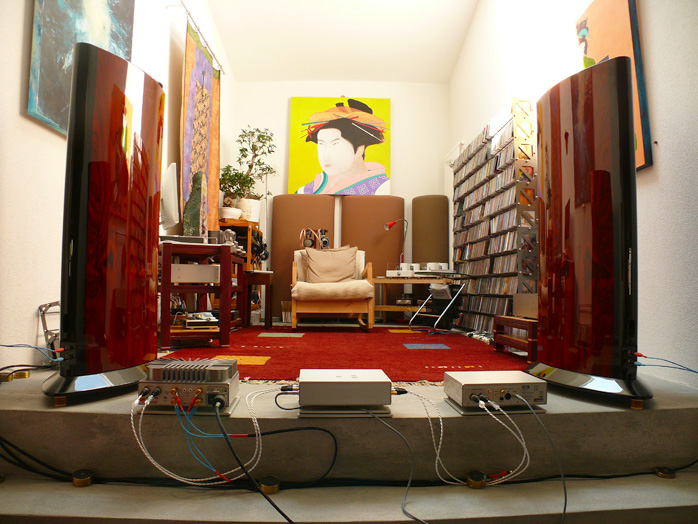 |
The three Nagras were connected with balanced Crystal Ultra cables since I don't have two pairs of LiveLines. |
By now the sound had grown plumper and meatier particularly in the bass where mass went up, articulation down. The midrange too had assumed more weightiness to subjectively shift attention away from the treble. The overall trend was deeper into richness but also heaviness. This made the music more material and dense but also less translucent and fleet-footed. What remained were the dynamic reflexes previously noted with the MSA. While transients of this presentation were softer and rounder than I'm used to, the general dynamic response maintained sufficient excitement to prevent getting too mellow which is a side effect that often accompanies this general trend.
|
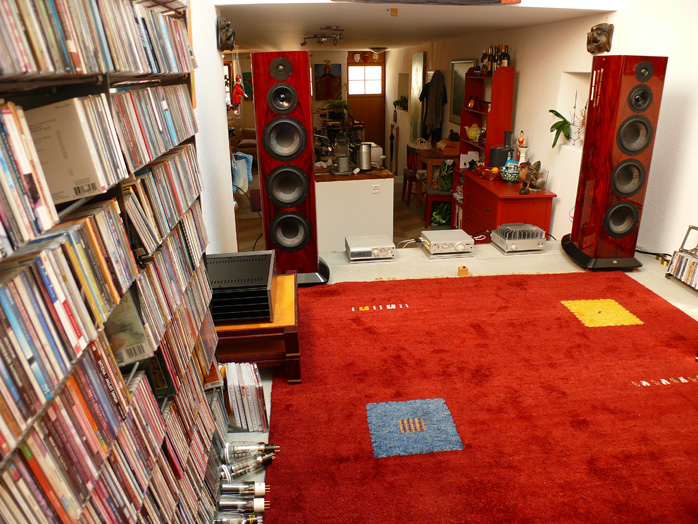 |
The arrangements of the PL-L's sockets demanded a left-to-right array of the components. |
Eliminating the PL-L from the equation introduced greater inside-out illumination; what I call lucidity. By shedding fat and minor fuzziness, the sound became lither, nimbler and more sharply present. It now exhibited greater distinctiveness between bowed and plucked strings, between stick and skin. Attack articulation improved. This confirmed expectations. It also underscored an earlier assessment. Of these three machines, the PL-L weighs heaviest on the sumptuous scale. While lovers of standard classic fare could favor the preamp's inclusion—I'd exclude period ensembles whose naturally thinner more nasal tonalities wouldn't completely benefit if you want to stay real—I'm quite certain that for more modern harder-hitting music, most listeners would prefer direct drive. It's a nice €8.670 savings too. Put differently, the MSA has plenty of tone density to not require active preamp intercession. This is a case of the better preamp is no preamp.
If just the CDC had USB or Firewire inputs; any digital inputs for that matter. Even an S/PDIF socket could be 'converted' to USB on the cheap via an M2Tech hiFace. With the player's analog-domain volume and balance so conveniently controlled from the seat, such connectivity would bring this machine squarely into the 21st century. To my way of thinking, it would make it relevant again to outgrow its present more or less fossilized status.
|
|
|
The general upshot: MSA = tube pre/transistor power sound from one box. That's the essence. Meanwhile PL-L+MSA = all-tube system. Practically and even with the MSA set to its lower 2V input sensitivity, I never managed to get much past 9:00 o'clock on the PL-L's dial when the CDC was at full output. As set up delivered, the PL-L was unnecessarily packed with gain*; or the CDC with built-in preamp stage too potent to be teamed up. Customers intending to use the PL-L will anyhow opt for the CDP. This saves €2.000 and perhaps even pockets a small up tick in resolving power when the extra volume control is eliminated.
______________________
* As I later learned, this can be trimmed with the PLL's internal gain adjustment.
|
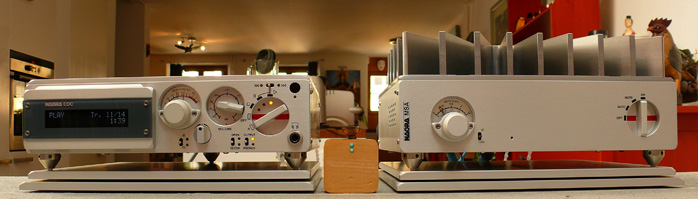 |
House sound: What my experiments with Nagra's threesome suggest also relative to prior trade show demos is that their engineers maintain an unusually firm vision on the sound they're after and know how to enforce that vision quite irrespective of output devices. If they ever design a class D output stage, I'm certain it still would have that Nagra sound. While one certainly shouldn't expect the forthcoming 300B Nagra to sound like a 20-watt MSA—what would be the point?— the MSA very unapologetically and cleverly sounds like a sand amp the glowing bottle brigade would approve of. Just don't think SET. Think push/pull à la Octave Audio with an extra sprinkling of warmth.
|
|
|
MSA conclusion: Perhaps because it's newest in the catalogue, the amp was the most modern of the supplied Nagras. Its socketry orients normally, its power output is neither puny nor overkill, it runs cool and its onboard SMPS is highly efficient. Serious coin was spent to machine its massive but perfectly finished heatsink. This maintains the traditional Nagra footprint without frankensteining cosmetics into an Aleph 3. The MSA is a prime candidate for passive preamps (to accommodate multiple sources including analog) or source-direct operation (particularly with quality analog attenuation like Nagra's own CDC, the Ancient Audio decks or USB converters like Eastern Electric's MiniMax and Antelope Audio's Zodiac+).
As Nagra's CDC demonstrated, being iconic can occasionally mean dead ends or failing to remain current. The PL-L retains functional idiosyncrasies of the past to show how being iconic can turn on itself. The MSA on the other hand shows adaptation, modernization and how to stay relevant all without giving up on carefully groomed company culture. This includes the famous tube-oriented flesh+blood Nagra sound to which was added the stone quiet operation, load-invariant behavior and current drive which transistors excel at. Of the three Nagras submitted, the MSA was by far my favorite. It exhibits known Mosfet virtues of good tone, minimizes liabilities like haziness, then pays special tribute to excellent dynamics and high speed. It's a very compelling mix of desirable qualities in a beautifully crafted elegantly dimensioned wrapper. MSA = macht sehr an!
|
|
Quality of packing: Tops.
Reusability of packing: Many
Ease of unpacking/repacking: Easy.
Condition of component received: Flawless.
Website comments: Marginal considering company reputation and resources.
Human interactions: Friendly but very slow.
Pricing: High as is normal for all luxury brands.
Final comments & suggestions: The CDC/CDP begs for digital inputs—S/PDIF, USB and/or Firewire—to modernize its appeal and functionality. The PL-L's socketry needs to be relocated to the back to not only match Nagra's own current-gen products but everything else on the market. The MSA's XLR inputs should be paralleled by RCA to eliminate those wobbly XLR/RCA adaptors. The remote would be friendlier if the controls to assign different components were named rather than numbered.
|
 |
|
 |