This review page is supported in part by the sponsors whose ad banners are displayed below |
 |
PL-L vs DM36.5: Priced at around €8.000 each, the Nagra and ModWright preamps are direct competitors. My twin-box tube reference from America would help put the Swiss into quick perspective for today's limited purposes. Noteworthy for being current year 2010 machines, both eschew the now near ubiquitous numerical volume control in favor of motor-driven pots which at least via remote are less precisely administered. The DM36.5's lower gain and shallower taper do offer more flexible adjustments. With its bigger badder boxes, the ModWright also offers higher return on raw material investment. The Nagra retaliates with its laboratory finishing and snazzier metal remote. On socketry it's a near draw. The ModWright merely sports an additional RCA input, a tape out and HT bypass feature. The Nagra adds balance control, the ModWright remote polarity inversion. In theory, these machines compete for the very same customer. In practice, the PL-L's non-standard size and sideways layout could make it more appealing in an all-Nagra context.
|
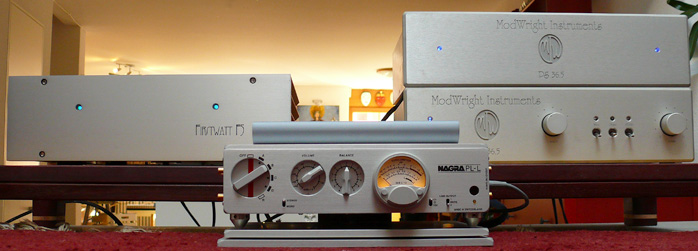 |
The ModWright would usually be separated on two shelves. To only deal with one variable, my customary F5 amplifier replaced the MSA for these initial PL-L sessions. |
Nagra's two 12AX7 + one 12AT7 vs. ModWright's twin 6H30 with dual each 5AR4/GZ34 rectifiers and 6EA7/6EM7 voltage regulators diverged less than anticipated. Both are low-noise devices with high S/N ratios and acute resolution. The Nagra was tonally somewhat more saturated and had more of what our strange audiophile lingo refers to as wetness. The ModWright's top end was brighter, more lit up and in hue silver or Platinum to the Nagra's gold. That aspect seems directly related to Dan Wright's choice of the Russian 6H30, the so-called super tube. It prefers top-end energy and attack sharpness over ultimate smoothness. On-string action with the American thus had a tad more virility, incision and particularly at lower frequencies deeper striations. With massed ensembles, this led to subjectively greater separation. With edgy hard recordings, the Nagra's mellower treble delayed the onset of purist scorn. It was another mild case of prettification.
|
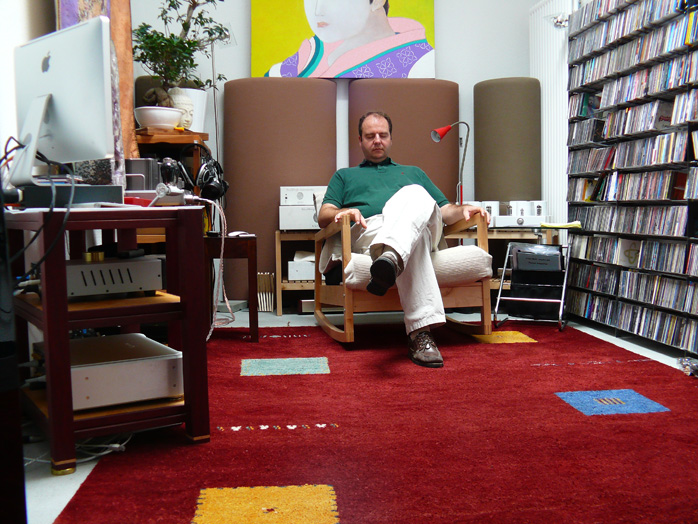 |
Nagra's Matthieu Latour in the listening seat |
The Nagra might have had a slight edge in dynamic responsiveness. Voltage swings seemed to occasionally kick in more rapidly but this fell under the header 'perhaps'. It would suggest itself when the Nagra played, then be questioned again when the ModWright followed to inspect the same passage. Certain regardless was that both ModWright's overbuilt traditional power supply and Nagra's far more compact modern SMPS proved equally viable. It's high time that the audiophile club made a full-fledged member in good standing of properly designed switch-mode supplies. Anything less is ill-informed snobbery.
|
|
|
CDC vs. iMac/DAC2: Ditto PC audio. It can be bona fide high-end. At triple the cost but with drastically cut-back functionality—just loading a CD felt so unbelievably quaint—Nagra's elite CD player enjoyed zero sonic advantages and justifications. Once I had dialled in the precise input level offset on my Esoteric C-03 preamp to switch on the fly (this actually took the longest to get right), I sought rather in vain to clearly distinguish between both front ends. The only very mild qualifier I managed revolved around insistent. I felt my reference stack had a skoch more of this attribute. After plenty of musical chairs involving Renaud Garcia Fons, Dulce Pontes, Hüsnü Senlendirici and Luciano Pavarotti, I was ready to call it quits and a draw.
|
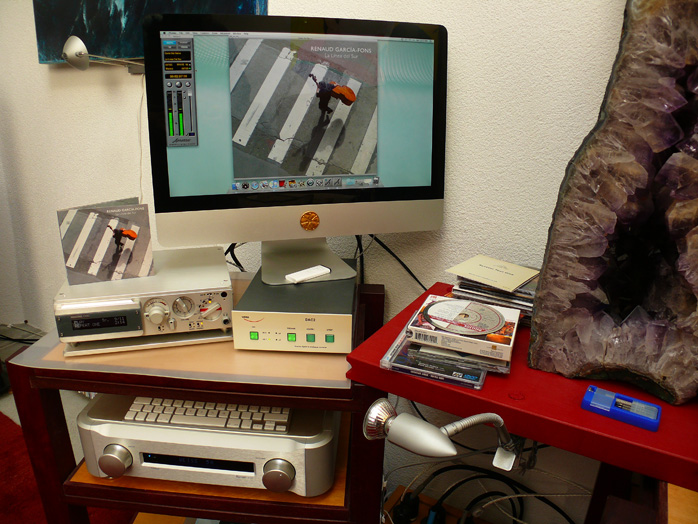 |
Then the phone rang and I throttled back playback levels to late-night standards. Upon return, the Nagra proved to fade quicker into the fogs. That peculiar insistence or separation power of the Mac/Weiss combo began to dominate to greater degrees as playback volumes diminished (this was with the Nagra's own attenuator fully open). Because I do a lot of pleasure listening well past dinner, I'd have to give the sonic nod to my computer/converter combo [€1.700 + €3.000]. At regular and higher levels, the CDC was a virtual stand-in.
I simply was incapacitated to even begin to justify its exorbitant price based on raw performance. Of the three Nagras on loan, the CDC was least compelling not because it was most expensive. It was so because one can duplicate the results for 35 cents on the dollar. That's quite blatant. Needless to say, parallel findings don't prevent Rolex from selling five-figure watches that keep no better time than Casio. Unlike that Rolex, the CDC's raw manufacturing cost consumes a far higher percentage of the final sell price. Its luxurious sled simply keeps no better time than CDs ripped to hard disc via an iMac's cheap DVD/ROM slot drive. On a devil's advocate note, anything as flamboyantly mechanical as Nagra's drive also attracts suspicion over trouble-free operation in the long term. A top loader like Bel Canto's €2.950 CD2 player which also is based on Philips' excellent CD2/PRO transport would seem inherently less prone to eventual complications.
|
 |
What further soured the CDC pill was discovering that Nagra's headphone output was far from being commensurate with iconic stature. Figuratively speaking, my T1s and HD800s diagnosed too much Mosfet mist and not enough crystalline clarity. While the sonics were pleasantly warm and utterly non-offensive, a sub $1K Burson Audio HA-60 or KingRex HeadQuarters would be quite superior to mention just two. Further, the front-panel controls particularly for play, pause and mute are clunky by requiring the turning of the wheel. It's all one massive throwback to analogue times that will strike some as charming and inspired, others as outmoded and ridiculous. The CDC thus requires a high degree of techno lust before it becomes a compelling acquisition proposition. It'll never be a smart purchase. It will be exclusive however. For some that's sufficient.
|
|
|
Adding up the parts: Relative to the reputation of Nagra's house sound as sumptuous, I found each individual component only modestly so. In sequence from least to most, I'd array this threesome as CDC, MSA and PL-L (with the player's headphone output a distant fourth but that's merely a feature, not discrete component). Matching up the PL-L with my F5 or conversely the C-03 with the MSA veered no deeper into the 'lush life' than replacing the MSA with either the M2 or KWA-100 amplifiers or the PL-L with the DM36.5 preamp. The real question was, how would individual modesty combine in an all Nagra setup? |
  |
 |
|