 |
|||||||||
 |
|||||||||
| Now tell us about the review process from your personal perspective. | |||||||||
| To review in the traditionally expected sense requires listening with the head instead of the heart. That's the exact opposite of listening for pleasure. The obvious danger? Readers are misled. They start to believe that they first have to learn to listen like a reviewer. Only then will they, the "non-critical" music lovers, catch up with all those fancy mysteries alluded to by the rainfall of reviewer diction. Let me ask you this: If love was as critical as reviewers seem to be, would you ever fall in love? Probably not. How could anyone live up to such ornery inspections? But for every good reason not to lose your head, there's one much more potent one why you should: Life's not worth living if love doesn't make an appearance at least once every so often. So damn the whole critical attitude. Jump off the cliff and into your heart despite all the danger signs. It's in the getting lost that something very valuable is found. Let go of control and find yourself held rather than abandoned... |
|||||||||
 |
|||||||||
| The dilemma is blatantly clear. Music's about passion and feelings, two notoriously unreliable and highly subjective forces. The language and process to describe the relative value of hardware purportedly designed to serve this noble enterprise? Cut'n'dried like a physical exam that measures weight, height, body fat, blood pressure and other -- vital or not so -- signs of health or the lack thereof. In a very fundamental way, this whole concept of audio reviewing is ass-backwards. |  |
||||||||
|
|||||||||
| Come again? Why do you have your ass screwed on backwards? | |||||||||
|
|||||||||
| So I can the better talk out of it. Butt, seriously - think about it. The more readily "measurable" parameters -- soundstage width, depth and height, relative frequency response linearity, ultimate loudness capability, obvious distortion or colorations, slam, bloom, air and timbre -- are all very secondary values as far as the raw enjoyment of music goes. After all, who doesn't remember zoning out to crappy car stereos? No soundstage, no bass, no treble, response skewed to hell by tone controls, lies of timbre but knee-deep truths of distortions, ringing and tin-can colorations, all running amok like insane banshees - yet, goosebumps galore. In the interest of high fidelity, we obviously need to report on all such abberations as we spot them. But what else should we talk about in the interest of musical enjoyment? What yardstick should we use that offers any semblance of repeatable reliability such that it translates with a wide variety of readers? What gets me off might turn you off. What lights my wick might burn down your house or smell funny. It's a truly unsolvable conundrum. For a long time now, I've wrestled with it in public through my various columns in SoundStage! and now audioMusings. Should you talk about how certain components made you feel - if you could successfully subtract the usual variables of mood and emotional vulnerability? As long as the music's to your liking, everything will sound great to you then. Why? As they rightfully should when listening for pleasure, your critical faculties relax, your mental activities suspend while the stage sets for emotional adventures. The esteemed Jonathan Scull used to experiment in that direction, He naturally got flak for rarely disliking anything. I always saluted him for preaching the fun over the furry-brow factor. If you're first and foremost a music lover as he clearly is, you're predestined to more or less like everything. Anything other and you're a fake! As a music lover, you simply don't notice the warts and wrinkles. Your whole being is on fire, oriented toward the face of love. And off you go... Then there are the more anal-retentive types with their exacting reports that can truly quantify only that which is measurable but which, by its very definition, excludes what this hobby is all about: Limitless flights of the imagination, mental and emotional responses, meditative escapes to elsewhere. |
|||||||||
|
|||||||||
| A whole bunch of sorry excuses not to get on with your job. Or so it would seem to me. But seeing that you do write reviews now and then, how do you embrace this mess? |
|||||||||
| Not very well, I'm afraid. I do attempt to split the difference though. I then use secondary means such as this to open up the larger panorama into which any and all equipment reviews should be placed. I also insert liberal reminders throughout my reviews that these are opinions, not facts. It hopefully counteracts the terrible tendency for anything printed -- whether virtual or in real ink -- to assume an endless half-life of its own. |
|||||||||
|
 |
||||||||
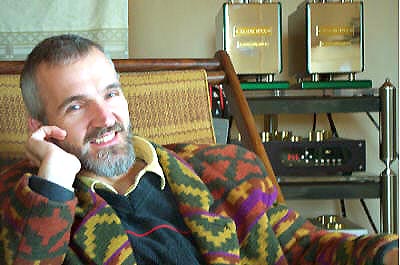
Lastly, I put a lot of personality into the writing. It's more fun, sure, but more importantly, it undermines impressions of well-calibrated machines printing out irrefutable test scores. It's clearly just one guy's opinion. But this "solution" is not a stoic formula. It's an ongoing process of experimentation, to observe what seems to work better gauged by reader and industry feedback. Truthfully, the critical portion of listening for reviews is my least favorite part. I have to do it. I can't make shit up. But I'm always looking forward to putting that sweaty reviewer's cap back into the washing machine. Add a lot of disinfectant into the water, then get back into listenig for fun without any funky head coverings that cause scalp itching and blood flow constrictions. My favorite part of reviewing is the actual process of writing. I never take notes. I listen and let my subconcious collect my observations. At a certain point, a complete image has formed. I always know when the log's complete. Armed with that, I now sit down in front of the keyboard. The writing literally commences on its own, pre-formed and -shaped, a process that's well-oiled now that I've been doing it on such a regular basis for so long. When I need examples to portray certain qualities, I grab particular CDs I used during the review period and set aside for this purpose. I listen again, return to the computer, write out the paragraph, go back to confirm the written word against the experiential reality, then wrestle with more concise ways of having the words overlay the experience as precisely as possible. In many ways, that's where I derive the greatest satisfaction - in this spontaneous unfurling of internalized impressions, seeing how they manifest on the screen of their own accord, then going back later to tighten things up. For me, writing is the creative part of the process. It's looking for new and entertaining ways to essentially describe recurring obervations that may differ in hues and shades but, fundamentally, are the same thing all over again. |
|||||||||
|
|||||||||
| What do you experience when you're listening for fun, not when you're mining the tunes for parlayable impressions? |
|||||||||
| I can't think and truly listen at the same time. It's an instant state of no-mind. That's similar to meditation but also different. The freed-up attention doesn't pursue internal states or energy spaces as in formal Zazen but simply holds a space into which music pours. At times, inner responses become so powerful that attention follows them for a while. Then music recedes a bit more into the background. But mostly, it's a full-contact sport, every facet of attention turned to the music, distractions surrendered as they arise. Because this lowers the defenses and leaves one very open, selectivity with the music and one's own momentary ability to absorb and digest become important. Often what happens is a literal expanse in the middle heart. It begins to feel liquid like quicksilver. From there, a stream of energy rises through the top of the head which expands too. There is a sense of connection with something far above the physical body. Sometimes there is a downpour, too, meshed into which are seeds that unfurl later as concepts, ideas, sudden knowings. Music becomes oceanic to feel like waves flowing in and out, with me a part of it. In the center of it is this inside upward pull, like incense in perfectly still air doesn't flicker or wave but curls up straight like an arrow. |
|||||||||
|
|||||||||
|
|||||||||
| So in its own way, music then is like a meditation for you? | |||||||||
| Very much so. And since I formally meditate on a regular basis, whatever new internal spaces are unlocked in that process become available during music listening as well. Meditation goes even farther because the "distraction" of focusing attention outwards becomes completely inward-directed. But the absence of thinking occurs very spontaneously with music which simply takes its place, as though a part of me was actually thinking it. In meditation, thoughts fade when the presence of the heart activates - but that doesn't always happen right away. | |||||||||
|
|||||||||
 |
|||||||||
So you could say that listening to music allows me to enter a meditative state nearly faster than in formal Zen while the latter, when pursued lengthily enough, reaches realms of otherness -- or a temporary dissolution of the structural "I" -- that in depth and extension go quite beyond the music experience. Truly, these two are complimentary activities that nurture each other. Together, they form a circle that's a very important part of my life. Sharing it through my writings expands this cycle to flow into the greater world, outwards from this listenig room and small adjacent walk-in closet that's been converted into my meditation room. The many reader e-mails and phone calls simply close the loop of this expanded circle. Very ordinary, really, but magical too. I've long believed that God talks to us through our passion. When we get to live our passion -- whatever it may be -- we tend to be at our best, both at our most inspired and most empowered to embrace challenges. The audio industry in particular is like a magnet for colorful, passionate, dedicated personalities. Nobody in their right mind is in it for the fast or big buck. No, people involved in it do it for the same silly, non-critical reason that you should listen to music for - not to be a serious "I'm right, you're wrong" expert but to be inspired, touched and moved in unreasonable ways. That's the key, remember? Unreasonable. Set aside reason and enjoy. The best things in life happen for no good reason at all. They're gifts. And certainly music is one such unreasonable gift. Hence kudos, compliments and sincere gratitude to the thousands of musicians and performers who enrich our lives every single day if we just care enough to tune in, zone out and drop the lot. Beam me up, Scotty... |
|||||||||
 |
|||||||||
 |
|||||||||
 |
|||||||||