 |
|||||||||||||||
 |
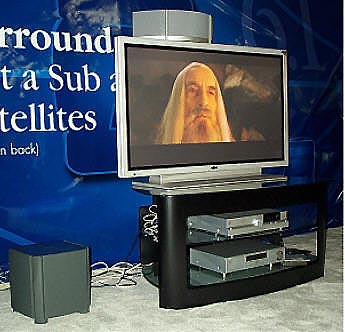
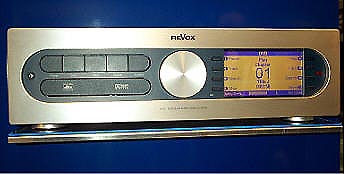
"While in Rome, do as the Romans do". Well, I was in Minneapolis, not Rome. But, Walter Fields of NBS Cables does operate out of Minneapolis. While not displaying at CEDIA, he made himself available for a visit. It'll shortly be chronicled in this industry features section under "Xtreme Audio: Walter Fields of NBS Cables". Using a single EIMAC, A.U.S. Co. 3CX3000 output tube [left], the forthcoming zero-feedback NBS SET, at 300 watts, will output a bare 1/10th of what the tube is capable of and still be the world's most powerful single-ended triode amp ever made. And with a unique switch-mode power supply, power won't be its only take-note feature. Niroson by Nirotek America Corporation displayed what to my Home-Theater allergy of too-may-boxes could be the perfect antidote - a packaged system comprised of the 6.1 channel AV receiver, 2 triple 3.5 midwoofer/triple 1" ceramic-coated dome tweeter speakers that combine L/C/R modules; and a compact triple-8" active subwoofer with twin "steel cap" passive radiators and 150w onboard amp. Selling for $2,000, the fit'n'finish and sheer simplicity of this complete system -- just one speaker in front, one aft -- appealed to this reporter in spades. On a shocking side note, the firm's Lee Adams confided that Mr. Niro Nakamichi has threatened to pull the plug on the very upscale Niro components. If true, it might indicate that their release was perhaps always only intended as a media blitz, to recreate a true High-End cachet for the brand that would eventually benefit core products priced for the mid-market instead. Speaking about simple, here's High-End's answer to the previously covered NAD all-in-one solution: the M-51 by Swiss firm Revox. Completely modular, the M-51 can be outfitted as shown with a CD/DVD player, a 5.1 decoder module, a tuner module and a multi-room module ($7,500). The internal amp outputs 5 x 60 watts into 4 ohms so efficient speakers are called for when not using Revox models. |
||||||||||||||
 |
|||||||||||||||
 |
|||||||||||||||
| The M-51 multiroom module extends the existing Revox system by up to 4 zones. This can expand the M-51 options into up to 32 different rooms at the same time. All M-51 in/outputs can be individually renamed, and when new modules are connected, they log on and integrate automatically with the installed native firmware. A large yellow/orange-on-blue display is menu-driven, with the main functions displayed first, and hierarchical submenues embedded in deeper layers. For hi-tech integration and ease-of-use married to famed Swiss broadcast-quality performance, this Revox machine had all the earmarkings of being very special indeed. How many more times can I say "I want one"? Talk about being kids in the candy shop. Attending a show like this makes you feel that young again... |
|||||||||||||||
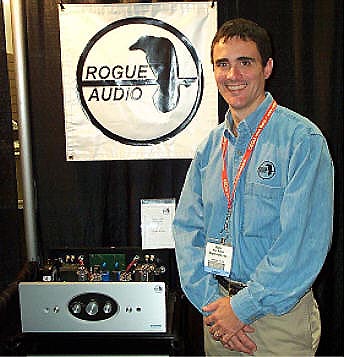 |
The "make my day" rogues of Rogue Audio introduced their Magnum range of across-the-line upgrades. Shown here is the Tempest Integrated ($2,695 in Magnum regalia) that offers 60 watts of thermionic output power and uses a quartet of KT88 driven by another quartet of 12AU7s augmented by yet another duo of 12AX7s for the inbuilt phono stage. The Magnum upgrades for the amplifiers (M-120, 88 and Tempest) include ultra-high performance new output transformers; larger power supplies; power supply modes; premium quality interstage coupling capacitors; precision Dale-Vishay resistors; upgraded binding posts; gold-plated tube sockets; upgraded input and output tubes; Harmonic Technology wiring; and the Magnum faceplate accompanied by a blue LED. The equivalent upgrades for the 99 and 66 preamps include larger power supplies and power supply mods; ultra-high quality coupling and output capacitors; |
||||||||||||||
Harmonic Technology silver wiring; gold tube sockets; upgraded tube sets; additional Dale-Vishay resistors; and the new faceplate and LED. The Magnum upgrades are retrofittable to existing units. The price differential is as follows: Sixty-Six $1,395/1,495; Ninty Nine $1,995/$2,395; Tempest $2,195/$2,695; Eighty-Eight $1,595/$1,995; and the M-120 monos $2,995pr/$3,495pr. |
|||||||||||||||
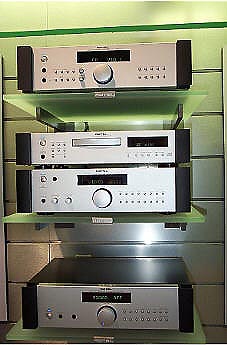 |
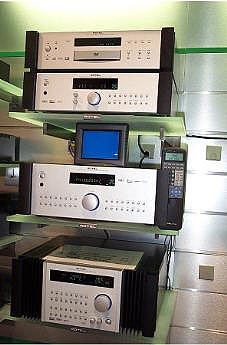
Rotel's new 2002 line-up had very refined Euro-chic cosmetics and showed everything in Full Monty style: From the RSP-1077 processor to the massive 5x100w RMS RSX-1065 home theater receiver [bottom right], from the RA-1070 100w integrated to the RDV-1080 CD player, from the RQ-970BX preamplifier to the RB-1090 380w stereo amp and finally the RT-1080 tuner. If any of these offerings sound half as good as they look, prospective shoppers would be wise to investigate this new line very closely. Rotel's always been a value/performance star, and their display indicated that they're committed to staying their course. |
 |
|||||||||||||
 |
High End Guru Monster Writer Jonathan Scull made the rounds on behalf of Noel Lee and seemed well settled into his new gig. If you've enjoyed his writings for Stereophile and just like to say "Hi!", click on his name to launch an e-mail. I'm sure he'd love to hear from you. |
||||||||||||||
 |
|||||||||||||||
 |
|||||||||||||||
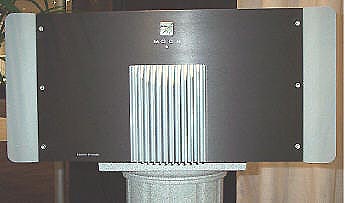
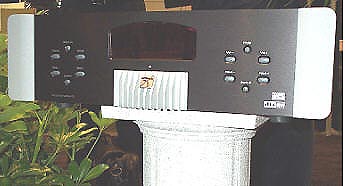
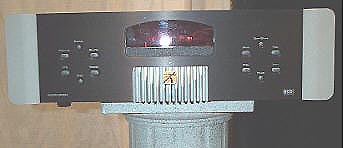
Sim Audio's Costa Koulisakis presented the new Stargate preamp/processor [upper left], the Aurora 5-or-7 channel amp [upper right] and Orion DVD transport/player [lower left]. The Stargate offers Pro Logic II, AC-3, Dolby Digital EX, DTS 5.1/NEO:6/ES-6.1 and 7.1 matrix music modes. Number crunching is compliments of four Crystal CS43122 DACs and CS5396 24/96 A/Ds for the analog inputs. The Aurora outputs 200/400 watts RMS into 8/4 ohms per channel, sports a massive 1.9kVA power transformer with 162,000uF of power supply capacitance and offers balanced as well as single-ended inputs. |
|||||||||||||||
 |
|||||||||||||||
| Weight is a back-breaking 85 lbs and dimensions are 19" w x 8.75" h x 26" d. The Orion is a modular design with optional 24/192 DAC and Faroudja DCDI "Diagonal Correlation Deinterlacing" line doubler circuits, SRS Labs TruSurround 3D processing for 2-channel audio and a Philips ASD1 transport mechanism with twin laser pickup. The Orion weighs in at 30 lbs and measures 19" w x 5.25" h x 13.5" d. Stereophile threw a little last-minute off-board bash. I didn't at all envy Lanny settling the bar bill when everything was said and done. Here I ran into reviewer Paul Bolin who turned out to be just one of the nicest guys you'll ever want to meet. Paul was still in a misty-eyed aftermath of his recent encounter with the Halcro amps. He confessed to being just happy that returning to his LAMMs was less of a come-down than he had feared when the UPS men took away the imposing Aussie towers. |
|||||||||||||||
 |
Stillpoints is a new company formed between Paul Wakeen (formerly of Media Access, the distribution arm of Aurios by Vistek Inc.) and Larry Jacoby, one of the founding fathers of Wadia. Ex-Wadia CAD engineer Deb Folz helped with the design work as well. Stillpoints ($275/set of 3) are new isolation bearings that use a 5/8" ceramic-based ball riding atop a ring of four smaller 3/8" balls contained in a black Delrin body with steel plate and Lexan label. Unlike the Aurios Media Bearings, the new Stillpoints require no setup or leveling of their support structures. It's "set down and go" according to Wakeen. |
||||||||||||||
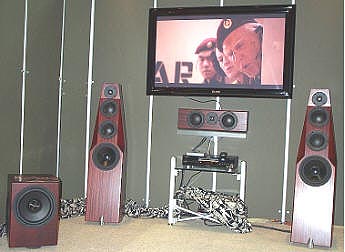
| Totem Acoustic -- what a concept! -- played not only music but some of the best I heard anywhere during CEDIA. Kudos to Vince Bruzzese for remembering and demonstrating what audio is all about! While his Wind loudspeakers weren't new, it was the first time I had seen them "in the raw", one-on-one. |
 |
||||||||||||||
At 44.5" tall, they were significantly smaller and more living-room friendly than seeing their ads had led me to assume. One of the current audio trends repeats the "small is good" slogan ad infinitum when it comes to speakers. Still, we need even more manufacturers to chime into this chant. |
|||||||||||||||
 |
 |
||||||||||||||
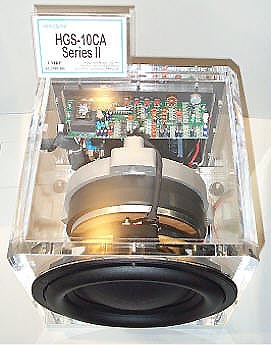
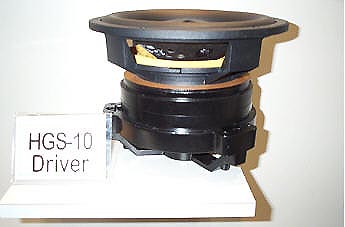
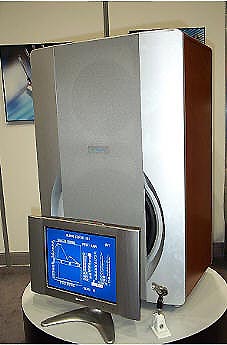
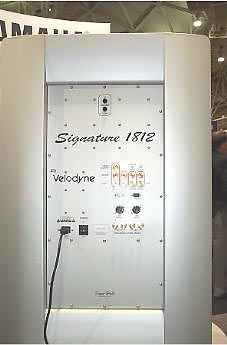
If pictures speak louder than words, these Velodyne drivers left me - well, speechless. And to conclude this show report with the mightiest rumble this side of live cannons, I present you with Velodyne's Signature 1812 subwoofer, a statement from a company known to like its bass firm. |
|||||||||||||||
| On a final note, Don Moses, previously of Wadia that carried his middle name, launched a new company called WallStar. They demonstrated a pair of 150w amplified 2-way speakers that derived their signal from a wireless transmitter plugged, via digital interconnct, into either a Sony or McIntosh CD player. Intended for music or surround sound applications, these new high-resolution zero-loss wireless transmitters eliminate costly in-wall wiring and could be the perfect solution for renting customers unwilling to permanently improve their landlord's property with sophisticated custom installations. For more information on this venture, e-mail Lance. |
|||||||||||||||
 |
 |
||||||||||||||
Don explained the inner workings as follows: A 5.8GHz microwave C-band transmitter accepts either digital or analog signals (the latter are up-converted to 48 or 96kHz digital for transmission) before multiplexing, scrambling and encrypting them. This signal is then demodulated by the receiving DSP chip that performs multipath correction, crossover EQ and time-alignment before D/A converters "better than Wadia" send the signal to the speaker's internal power amp that drive the transducers via a mere 3 inches of wire. The digital crossover is a true Gaussian design and not only allows for perfect phase- and time behavior but also incorporates a "Virtual Image Shift" function that overcomes the over-your-head syndrome of wall-mounted speakers situated higher than the listener. WallStar's transmitter can also transmit its signal via micro-coax or CAT5 to the receiver. The demonstration used the RF interface as the most elegant solution. And with this look at the future -- digital crossovers and sundry hi-tech advances -- our CEDIA 2002 report concludes. |
|||||||||||||||
 |
|||||||||||||||
 |
|||||||||||||||
 |
|||||||||||||||