This review page is supported in part by the sponsors whose ad banners are displayed below |
 |
 |
Super monitor? Whilst I'd like to hear Raidho's competitor with the proprietary ribbon tweeter for some triangulation, relative to my usual speaker fare and as in plainly hearing more, the Mythology 1 moved my going resolution barrier right up. That made it a very contemporary proposition in line with a modern über converter like Nagra's HD DAC which simply digs deeper into the pits. To compensate for what I felt were subtractions on vintage values for tone mass and blackness required the right amp—mid-power class A push/pull with passive voltage gain—and for our large space some very mild subwoofer fill below 40Hz (far less for more bass per se and primarily for its grounding effect on the overall presentation).
|
 |
What makes the M1 a super monitor? Not merely its playback quality—and serious sticker while we're at it—but also its bandwidth quantity. In a 5x8m room it'll behave completely full-range. In anything smaller it's likely to get slightly fulsome in fact. Which means that most people even of the very ambitious sort won't need anything bigger. And to me that's the essence of what makes a monitor into a super monitor: reference performance, compact size. How it might compare to direct competitors remains for a monitor specialist to sort out.
I'd be surprised if Enigma's twin-tweeter solution didn't dominate those leagues. Whilst Magico today uses custom drivers often built by Morel, they didn't launch that way. Wilson for decades sourced their tweeter from Focal. Crystal Cable still uses off-the-shelf if premium drivers. Giant Focal of course roll their own. But so does newcomer Enigma. Their Taiwanese manufacturing roots allowed them to go fully custom for all three transducers in their Mythology 1 and do so from day one. Caramba! That's resourceful and must be acknowledged. Ditto for the complete packaging job. It includes the purpose-built though optional stand and the included cable jumpers for the ESL unit where even the tech is proprietary.
|
|
|
|
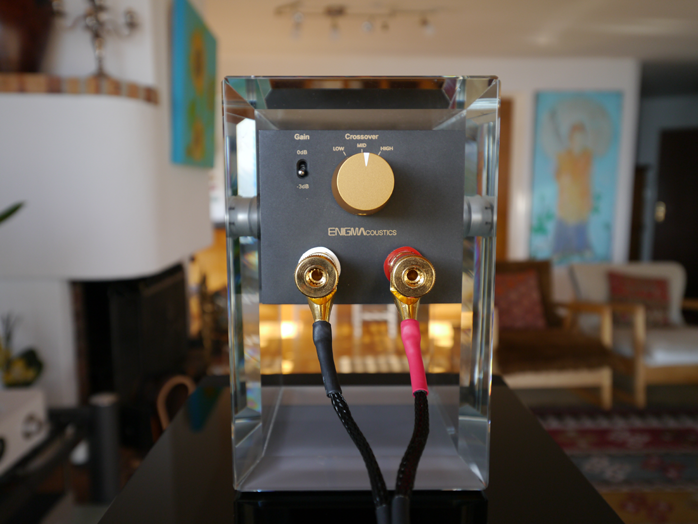
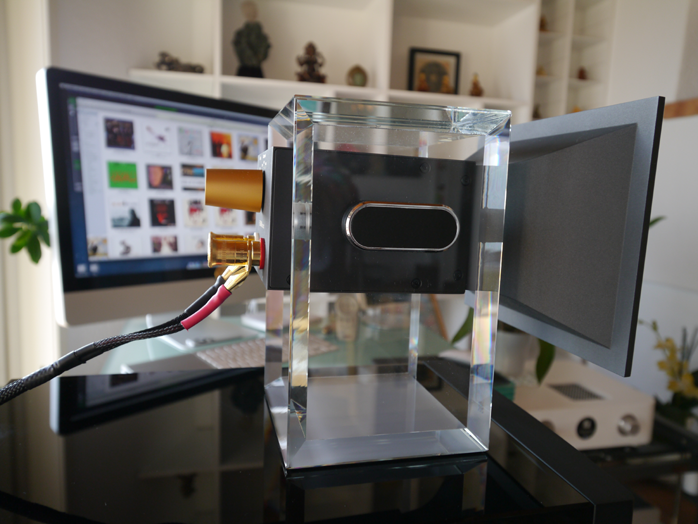
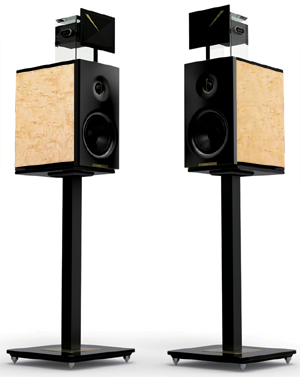
The one thing Enigma don't have (yet?) is a fully integrated version to eliminate Sopranino's glass casing which softly suspends the actual tweeter housing; and the external cable connection and terminals. Because the company launched with Sopranino as demonstrator for their self-biased nano coating, they designed a form factor that'd interface with a large variety of existing speakers. It's perfectly self-explanatory why M1 was styled to add it as is. But perhaps we'll eventually see a 'super' version—given the above that'd have to be super squared—which unifies the two inseparably. Not that it's important. With such performance and luxury finishing, one quickly forgets.
|
 |
Here's something else to forget.
Compact speakers lack in the dynamic department. Obviously they don't move air like mondo woofers or many paralleled smaller ones. But unless you're into the Symphony of a Thousand at front-row SPL—that would be Mahler's Symphony No. 8 in E-flat major—what's actually more relevant is acceleration. How effectively can a speaker parlay all the intermediate volume levels between quietest and loudest when the latter remain domestically acceptable? Now a quality small high-revving speaker will actually respond faster than a big lumbering one. In those terms the M1 is very aspirated and dynamically twitchy. With your volume set just so, you could find yourself looking for the remote when things swell to momentary higher peaks than expected. This happens without the deplorable room lock pressurization effects big speakers can cause. Things stay clean without impact debris lingering in their wake which would cloud over the terrain. That's about speed without acoustic compression. You'd need a very large room and very stout levels indeed to upset the M1 into compressing on its end - certainly larger and louder than we have and use. In a space large enough to naturally diminish or eliminate 'room gain' in the warmth region, the ideal amp for the M1 could be something like a German ASR Emitter or Japanese SPEC Corp. model.
|
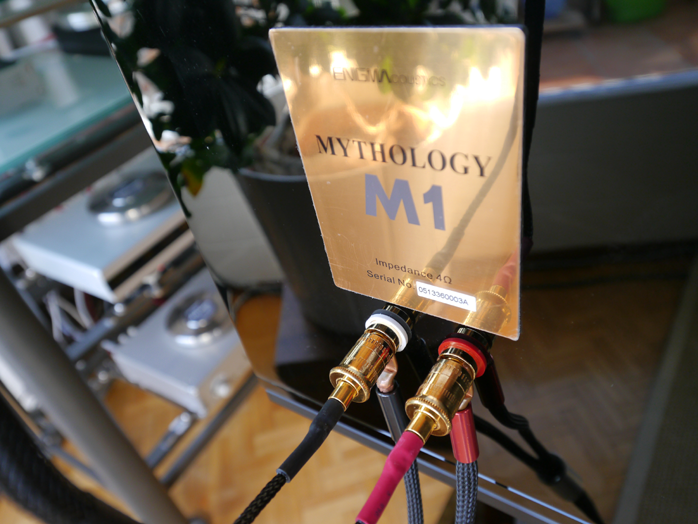 |
Protective plastic coating over the gold decal still in place.
|
To take the pulse on ROI, I checked on listed pricing for the competition. $26'500 for the Magico Q1.
$19'900 for the Wilson Duette 2 with stand. $15'070 for the Stenheim Alumine with stand. €13'000 for the Crystal Cable Arabesque Mini. €9'500 for the Focal Diablo Utopia with stand. €18'000 for the Raidho C1.1 with stand. In this company only the French sat lower. If one backed out $3'900 for the Sopranino but bought the stands, the M1 would come to within less than $1'000 of the Focal. EnigmAcoustics clearly have done their home work to be as attractive as possible in this class. Perception being what it is, US headquarters shift attention away from Taiwanese production. NuForce do that too. On the speaker front Usher have certainly demonstrated that Taiwan can be a most excellent source for first-class build and performance. Now EnigmAcoustics add themselves to that list in the luxury class.
|
|
|
|
|
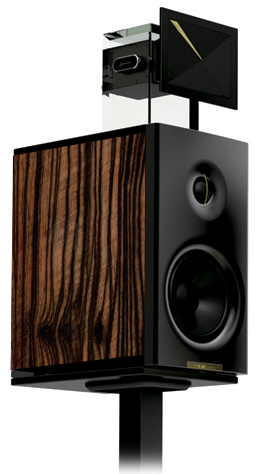 |
Wrap. It's as easy to snob a costly monitor speaker as it is to snub a compact two-seat sports car for having barely enough trunk space to do meaningful grocery shopping. Neither are targeted at the majority. For the car to really justify its sporty focus, you'd want the remaining stretches of the German Autobahn which aren't speed limited; or some picturesque canyons for brisk corner carving.
But the Mythology 1 needn't be driven hard (loud) to set itself apart. Its brand of resolution in fact kicks in just as early on the volume dial as a high-efficiency widebander behind a minimalist low-power amp. Where things admittedly get more selective to perhaps become our hifi equivalent of too crammed a trunk or that special stretch of asphalt is popular grungy music. With the M1 grunge goes to the dry cleaner. Of course a family of four doesn't buy a two-seater cabriolet unless it's a second car. By a similar token fans of heavy metal and math rock wouldn't go after an exotic monitor speaker.
For that precise reason trade show dems of high-end speakers generally shun such music. For that you'd be far better off with a bad-ass JBL or Cervin Vega. That's as obvious as it is basic. Even so it justifies mention to be complete. On a similar note back on hifi shows, it's common to hear oversized speakers in undersized rooms make predictably bad sound. The Mythology 1 is for those who've outgrown that set of silly tendencies.
|
|
 |
Though it's twice as costly as my big 5-driver-3-way tower from Lithuania whose cubic volume would swallow it up four times over or more, the M1 is the clearly superior speaker. It has the better in-room bass which only on extension comes in second; the far better top end; and in general resolves on a much higher level for a more refined advanced sophisticated reading of our tunes. Whilst the Rhapsody 200 will ultimately play a lot louder, that's potential we never tap. |
|
|
 |
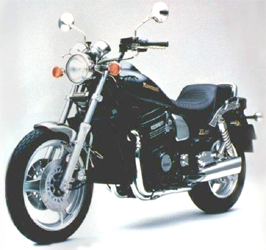
It's as useless and theoretical as the fact that the 1000cm³ Kawasaki Eliminator I drove whilst living in L.A. could do 0-100km/h in 3.2 seconds. Perhaps on a drag strip. With a professional racer. And special tyres.
Back on speakers,
side by side with my AudioSolutions tower the M1 might be a visual disconnect that doesn't belong in the same discussion. But in a domestic setting not adolescent mind, that too wins by a land slide. Should you pursue ultra resolution and super refinement in the luxury sector; should you key into capacious soundstaging with extreme sorting; desire the perhaps ultimate top-end air; want very visual playback; and fancy all of that over warmth, mass and grand impact...
... then
a Mythology 1 is a seriously smarter choice than a big monkey-coffin speaker and on so many levels. Hence our award. That became an inescapable albeit very well-considered conclusion to an exciting assignment that even had my wife all ears (and then some if you remember).
|
|
 |
 |
 |
|
 |