This review page is supported in part by the sponsors whose ad banners are displayed below |
 |
 |
Bandwidth effects? Spectral, Goldmund, Norma, Bakoon, Crayon & Co. are firm. Never mind Redbook's and human hearing's 20kHz brick wall filters. Amplifiers must exceed the audible bandwidth by at least x 10 to avoid phase shift. That makes their minimum target 2 to 200'000Hz. Class D amps don't make it that far beyond 20kHz. Comparing the Merak monos to Tommy O'Brien's Digital Amplifier Company Maraschino monos, I'd noted lesser HF purity for the latter. The Meraks run linear power supplies with fat Plitron toroids plus Lundahl input transformers. The Maraschinos get off-the-shelf outboard SMPS of the sort you'd find on a laptop. I thus suspected that their ultrasonic switching noise dumped back into the power line, perhaps even radiated into free air was the culprit. I doubt this would have been an issue with lesser tweeters. The M1 simply put a rather high-magnification loupe on this.
To suss out whether class D's upper bandwidth limits in general had any say in it, I lassoed in Goldmund's wide-bandwidth DC-coupled Job225. Again, this wasn't about reproducing 50kHz or higher signal which we'd not hear. It was about the effects exploded amplification bandwidth has on the upper reaches of the audible range even if that means 16kHz max in a personal case.
|
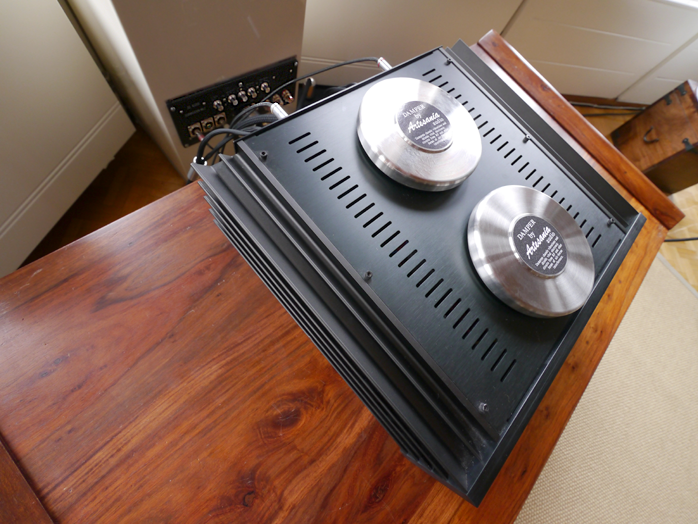 |
In digital signal transmissions two voltage states represent 1 and 0. Here we need far higher MHz bandwidth to have the leading and trailing edges of these square waves approach instantaneous switching. Thus bandwidth signifies circuit speed represented by rise time aka slew rate. With the Job225 in the chain, purity definitely went up. So did a sense of overall squeaky cleanness. Was that a function of steeper rise times and a faster circuit? In concert with the M1 things simply got too skeletal. There could be no faulting its timing precision or articulation. Those were extreme. Yet warmth and fluidity were in rather short supply. Out then it was with the entry-level Goldmund, in with Nelson Pass' FirstWatt F6. Sonically it's a SIT twin. The decisive difference is three times the power and class A push/pull rather than single-ended operation.
|
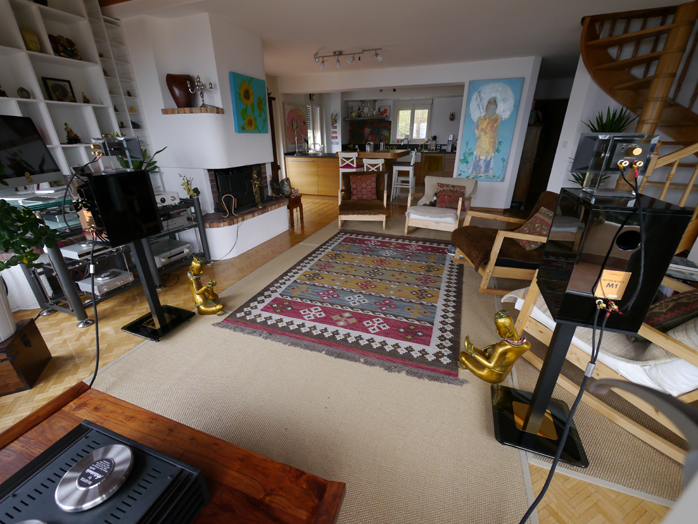 |
Now I had Job-type treble purity and elasticity with greater warmth. This was really really good. Still, I dreamt of just a tad more fullness or gravitas. What to do? In with Zu's Submission subwoofer, albeit set to a very low output and the lowest possible filter setting at 20Hz. That number would only seem silly if you assumed a brickwall filter. In reality its 4th-order low-pass clearly leaks above its setting. Nominally set to 20Hz thus really meant a bit of fill to 40Hz. And that did the trick. Whilst theory snickers—what information is there at such long wave lengths to matter?—experience knows better. A true infra sub adds weight and scale to material that would seem to have marginal LF content at best and more likely none at all. Whilst the Job225's DC-coupled amp had the wirier tauter bass, the F6+Submission combo's was weightier and went lower. Those were the extras. The real bonus was the effect that had on the overall presentation whose black levels increased for greater warmth. What both the Goldmund and FirstWatt amps had over the more powerful class D contenders were finer dynamic gradations. It's as though both increased effective dynamic range. There were bigger amplitude ripples in the water.
|
|
|
|
At this juncture Wei called from California to make himself available for further questions. Though I was clear on all the basics by now, I had a few minor curiosities to gild the lily as it were.
|
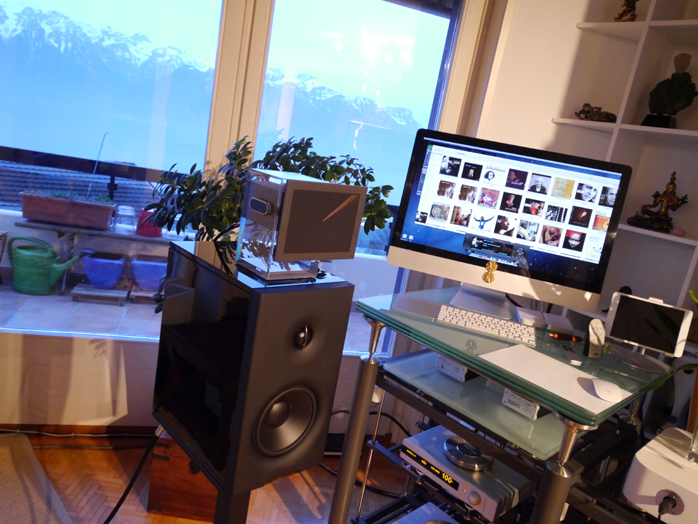 |
Now I learnt that, a/ at present the side panels weren't swappable should someone wish to change the finish from gloss black to Maccassar Ebony or Bird's Eye maple though he'd inquire with engineering about the viability; b/ at present the stand's center column was available only at the fixed height I had because that's what they felt was optimal for a standard seated position; c/ the speakers and super tweeter were developed and engineered in California and built exclusively in Taiwan; d/ a Sopranino with rather higher efficiency was in the works already to meet increasing demand from hornspeaker owners; e/ the company would show with Golden Note's Demidoff Diamond amplifier at the Munich HighEnd show 2014; f/ John Atkinson of Stereophile was putting Sopranino through its paces also on his test gear to generate some educational independent measurements for it.
|
 |
Wei then suggested that I also listen to the M1 sans super tweeter. When I said that I had already; that I would personally be perfectly happy to listen to it that way; and that I thought their big dome tweeter the main attraction and the ESL just the icing on a cake complete by itself... he seemed very pleased. Which pleased me. It's not every day that a company's press contact maintains such a realistic perspective. After all, their main job is to promote the whole works and make you think you're missing out if you're not pursuing the leathered-up ride with the chromed rims and speed stripes.
|
|
|
|
|
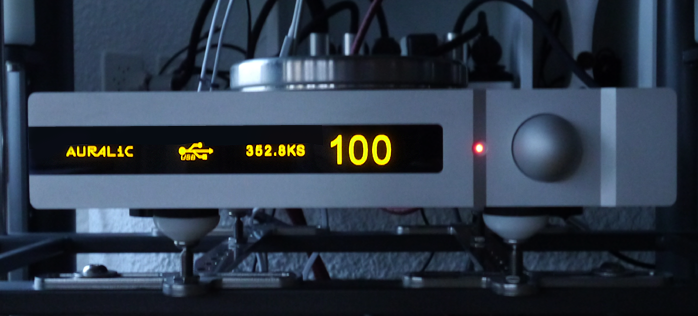
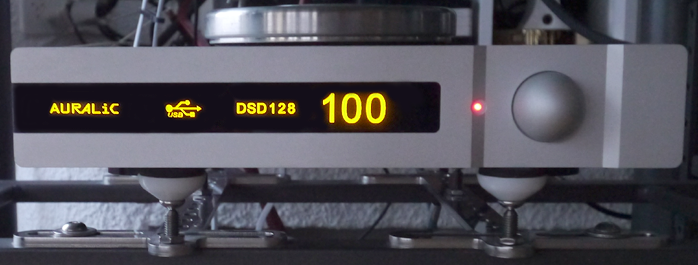
More bandwidth effects? High-resolution files (unless 'remastered' upsampled Redbook to resell under a different guise) promised to exploit Sopranino's extended reach perfectly integrated with the M1's main tweeter to the final degree. Since we don't actually hear beyond CD's ceiling at least not with our ears—TakeT designer Takei-San believes we register higher frequencies with our skin and I've read suggestions that our skull bones do—would such files show off anything improved about whatever I actually could hear for their treble? I have one very well-recorded track in 16/44.1 Redbook, 24/352.8 DXD and DSD64 and DSD128. For no-end top end, in-room presence and sheer finesse of ambient recovery, the DXD track took the crown. Perhaps more relevant, the difference between Redbook and hi-rez regardless of format was more obvious than it's been for me. Not that I own many hi-rez titles. I shop for music first, sound quality fourth. Given my tastes, hi-rez tends to be slim pickings still. But running through my collection of Channel Records, 2L, Opus 3 et al cuts, I felt that the Mythology 1 went the extra distance to justify the added expense for better-than-CD downloads.
|
 |
|
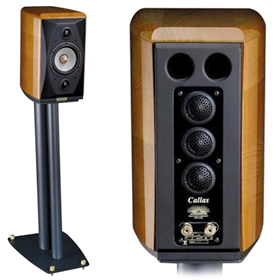 |
Here it's useful to reiterate something that due to audiophile presumption is otherwise easily misconstrued. I remember a review of the Opera Audio Callas monitor shown at left. Because it uses 5 tweeters per side, the writer expressed surprise that the treble wasn't exaggerated. But why should it have been? Surely a designer would trim the output of his paralleled tweeters so that their compound HF signal balanced his mid/woofer. Audiophiles simply think that more than one puny 1" tweeter must be bright whilst a colossal 15" woofer strangely doesn't trigger concerns for dark.
Again, 'bright' as in forward, aggressive, strident, sharp, piercing or hard is so not the case for the Mythology 1. It's most refined, teased out and informative. Be it piano, the sympathetic strings on Anoushka Shankar's sitar, the very busy harmonic cloud hovering above massed strings well recorded as a Rachel Podger or Claude Chalhoub album... that's where you hear the extra tweeting. |
|
|
 |
|
 |
Where the 'out-of-band' ESL enters is not only enhanced spaciousness (which obviously must have been recorded to be retrieved). It also seems to benefit leading-edge definition. And that's particularly terrific at low levels—and by the same token for low-level content embedded in material played back louder—because it heightens clarity.
|
 |
  |
 |