This review page is supported in part by the sponsors whose ad banners are displayed below |
 |
 |
|
 |
Reviewer: Srajan Ebaen
Financial Interests: click here
Source: 1TB iMac (AIFF) via FireWire into Weiss DAC2, iPod Classic 160GB (AIFF) via Peachtree Audio iDecco as DAC
Preamplifier: Esoteric C-03
Amplifier: FirstWatt F5 and J2, Trafomatic Audio Kaivalya monos
Loudspeakers: Zu Essence
Cables: ASI Liveline
Stands: 2 x ASI HeartSong 3-tier, 2 x ASI HeartSong amp stand
Powerline conditioning: 1 x Walker Audio Velocitor S, 1 x Furutech RTP6
Sundry accessories: Furutech RD-2 CD demagnetizer; Nanotech Nespa Pro; extensive use of Acoustic System Resonators, noise filters and phase inverters, Advanced Acoustics Orbis Wall & Corner units
Room size: The sound platform is 3 x 4.5m with a 2-story slanted ceiling above; four steps below continue into an 8m long combined open kitchen, dining room and office, an area which widens to 5.2m with a 2.8m ceiling; the sound platform space is open to a 2nd story landing and, via spiral stair case, to a 3rd-floor studio; concrete floor, concrete and brick walls from a converted barn with no parallel walls nor perfect right angles; short-wall setup with speaker backs facing the 8-meter expanse and 2nd-story landing.
Review Component Retail: $2.600/pr as reviewed global price ($1.800/pr for first 30 pair); $1.800 for basic version - shipping extra
|
 |
Three foot tall. 12" by 12" across. Depending on attitude, that's either stumpy or petite for a full-range floorstander. Shape is a truncated flat-top obelisk. Most relevant performance specs are 16-ohm nominal impedance and 101dB sensitivity. Drivers are one crossover-less 4th-generation 10.3" treated paper-cone widebander from 30Hz to 10kHz, one horn-loaded 'Definition' tweeter on a 1st-order Mundorf silver/oil cap filter at 10kHz. Ancillaries are cold-forged silver alloy hookup wiring in a unique cable geometry, Cardas posts and aluminum billet trim bits. Unusual but invisible is the internally rotated Grieve/Zu cartridge. Venting is to the floor.
The new Soul is a Zu to the sole. It looks and reads like a rethought tweeter-on-top Druid. But why one more Zu with this exact driver complement? Why not a perhaps TangBand-based 6-inch or 8-inch version for a change? Well, the Soul goes for $1.800/pr. Globally. $2.600/pr buys the massaged Superfly edition. Throwing out dealer/distributor markups and shaving remaining margins closer to the bone, Zu's Soul comes in well below the original Druid. Inverse inflation. Presumably superior to the Druid—for starters, why otherwise bother with a more complex non-parallel box—it's capitalism at its aggressive competitive best. I don't know Zu's fine print beneath this project. Common sense imagines something like marketing ain't our strength but we do know speaker design. Let's throw everything we've learnt at one really mean budget wonder and dare everyone and their grandmother to not pay attention.
|
|
|
To combat doubt over their often challenged sensitivity specifications, Zu for once provides their own measurements. Despite its motorcycle exhaust-derivative rear loading claims, the Soul's impedance curve really behaves more like a conventional bass reflex, albeit with a highly elevated median of 16 ohms.
|
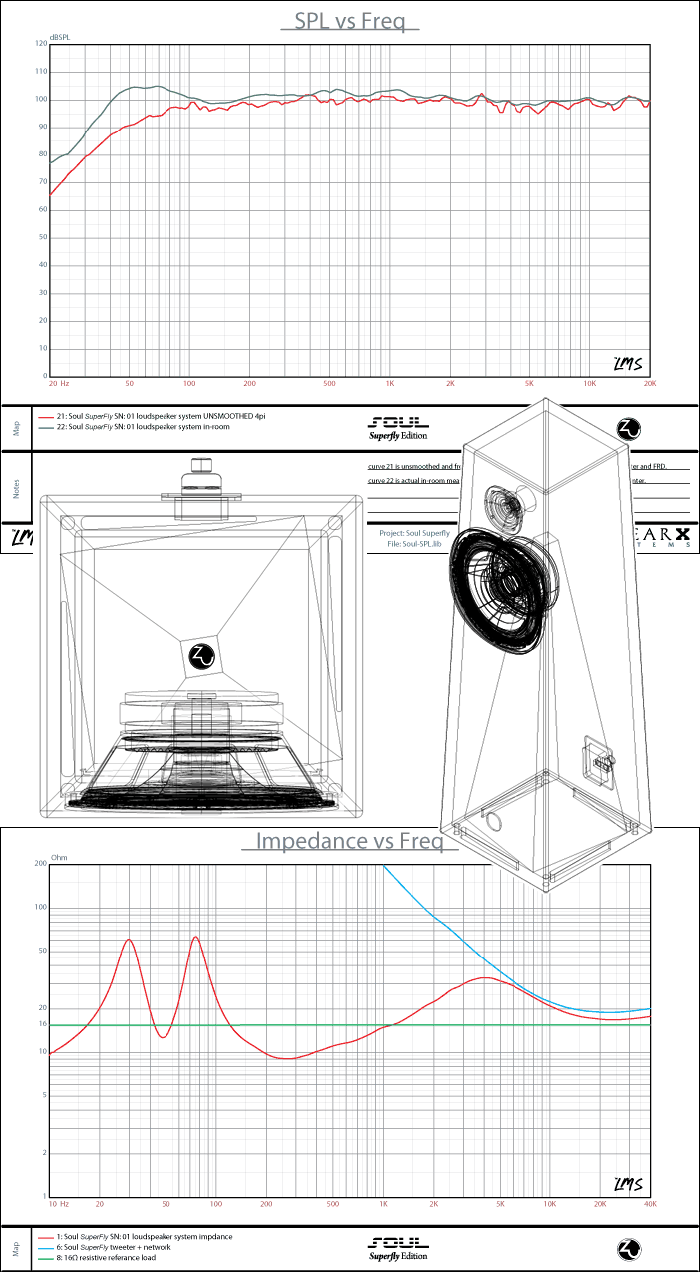 |
Rotated for even less internal 'parallelism', the pyramidal foam core is inherited from the Essence. This geometry creates some deliberate air compression of the rear wave by gradually shrinking the space it must traverse before escaping at the bottom. Functionally it simulates a straight inverted horn whose walls aren't solid and thus semi transparent to lower frequencies. Obviously this cone also scatters and absorbs reflective bounce without the usual fiber fill.
Conceptually simple, the Soul combines two inexpensive drivers with some wire and a minimalist high-pass filter. That's not much different than many super expensive single-driver speakers. What it lacks are their exotic bragging rights of Voxativ, Feastrex and Lowther name tags. What it retaliates with is promise of more bass extension, more bass output and more overall power handling than most such exotica. Then it completely thrashes the exotics on price.
|
Having owned the original Druid with Method subwoofer, the Definition upgraded to Definition Pro status and finally the Essence and Druid Credenza—review of the triangular Presence thrown in for good measure—I wasn't exactly over the moons to weigh in again. The attitude changer was the exclusively direct and lean pricing. HighEnd Munich 2010 once again reiterated how our industry is pricing itself out of the game. For ongoing coverage, the press is as much to blame as the makers who hawk silly-priced techno glitz whose stickers bear no relation to actual build costs.
|
|
|
Here was an opportunity to do the opposite and some penance. Given personal familiarity with the brand, I could also determine how much or little performance was sacrificed to hit the attractive price point. The Superfly was first out of the gate. Perhaps Zu needed more time to transform certain aluminum billet items into Lexan equivalents which will be more appropriate for the standard Soul's truly stripped pricing. I thus signed up for a Superfly. Designer colors and gloss coats are optional to increase costs. The lean and mean thing is called cosmic carbon. It's somewhat of a chameleon finish that shifts hue with light changes to dance between various grades of anthracite and black. The name of this finish neatly ties to environmental concerns over carbon footprints. Perhaps. Regardless, the Soul's footprint is small, both on the floor and wallet.
Count me in I replied to Sean Casey's email inquiry about reserving a review pair from the first batch. Other earmarked reviewers include Steve Guttenberg,
Thad,
Art Dudley, Sam Tellig and Jeff Day, i.e. the usual group of hi-eff simpaticos in our field. 30 Superfly pairs sold for a promotional $1,800 before the SE model stabilized at the intended and current $2,600.
Given my copious previous coverage of the brand, don't expect anything profuse on the Soul. After all, the motto really is lean and mean - all around.
|
|
|
Basic tech: Having worked with the same Eminence-based widebander platform since the original Druid, Zu has continuously refined, modified and adapted it to their various speaker models. In the Essence, sensitivity had to be padded down to meet the less efficient ribbon tweeter. This created a more 'mainstreamish' take on their house sound. In the Soul, a new driver is back up to original sensitivity spec. It's been retuned by shaving off diaphragm mass and increasing flux density in and around the voice coil gap. Lighter moving mass plus stronger motor translates to higher dynamic contrast ratio. Retained is the cylindrical Essence phase plug with concave face dimple.
|
 |
That plug geometry improves off-axis response for the inner cone which couples directly to the voice coil. Instead of a ribbon tweeter, we're back to the original phenolic lens/waveguide unit. The Soul really is a direct Druid descendent, albeit modernized with a revoiced high-pass filter, a full Zu/Grieve cartridge, a different enclosure and a 4th-gen high-output widebander with roll rather than pleated suspension. With the 10-incher as far up the baffle as possible without trading places with the ear-height tweeter—Soul's acoustic center at 30'/76cm—one would expect a lowish soundstage height until factoring in the 2-degree slanted baffle. It mildly angles the drivers up. While the Soul is short and its widebander relatively low, stage height isn't really compromised. The Grieve loading always relied on a precise floor gap to function properly. The Essence circumvented possible user error by fixing the gap with its lacquered twin plinth. For the Soul, that detail was too complex. "The Soul instead has asymmetric slots on the bottom. The only requirement is that the cabinet sit at least 1/4 inch off the floor. We recommend and show long spikes since the Soul simply looks cooler when floating above the floor." |
|
Just as you wouldn't jam a rear-ported speaker butt up against the wall to obstruct its vent, so the Soul's pressure release system can't be blocked by parking the speaker directly on the floor. That's common sense. More in due time...
|
|
 |
|
 |
|