|
This review page is supported in part by the sponsor whose ad is displayed above
|
||||||||
 |
||||||||
 |
||||||||
 |
||||||||
Remembering back to our first of anything can be interesting, be it our first girlfriend, car, job - or as audiophiles, that first system. Going back even further, I remember the first stereo system I ever heard. The speakers were Fisher XP-7s and I believe the receiver was a Fisher also. The turntable was a Garrard, which seemed fitting as we lived in England at the time. My brother and I, then 10 and 12, were brought by our parents to a party at a friends of theirs. Pre-warned, we had books to read and 45s to play. We were shown to the den and found that's where the stereo system was located. We played Ricky Nelson, my brother's favorite singer at the time - plus every other record we had at least five times that night. I recall that their stereo sounded very clear compared to our mono Webcor. And the best part? We had the stereo to ourselves all evening. My first stereo system came along before my first serious girlfriend and after my first car. The speakers were Altec Lansing Valencias, with a Marantz 2270 receiver and a Dual 1219 turntable. I believe the cartridge was an Audio Technica. I remember this system as being somewhat sedate-sounding - decent bass response but clearly not very musical in the midrange and nearly bland in the treble. My next system had a pair of Klipsch corner horns with a La Scala center speaker. The preamp, tuner and stereo amp were all Mitsubishi D10 through 30 series. I still had the Dual turntable. Even with the Klipschorns tucked into the corners and 220 watts a side pushing them along, they were not as strong in the bass as the Valencias but did provide my first soundstage. The midrange and high end showed signs of life. Finally, there was some clarity and detail to the music that helped define the individual instruments, a clarity that was missing in the previous system. Overall this system was better, but I also recognized that while I made improvements in one area, I lost them in another. Several systems and speakers later, I was closer to what I thought was a pretty good system. It was then that I realized I was hooked. This system had a pair of B&W 808 speakers, which replaced a pair of B&W 801Fs. The amplifiers were British H&H stereo pairs running in bridged mode. The turntable was a Luxman PD-300 vacuum turntable with an SME arm and a Koetsu Black cartridge. The CD player and preamp were Luxmans and a Nakamichi Dragon cassette deck finished the equipment list. This was my first system to really have a presence. Presence to me means that you are feeling the music, that it's more than just the collective sounds in your ears but a way of feeling the sensations of the music especially in the bass. While this system was a good improvement, the B&W 808s with the H&H stereo amps were like a 70s big block Corvette - lots of horsepower and torque but not a lot of finesse in handling it all, even though it was a fantastic ride. For the past few years, I have been actively working on assembling a system that best represents my truth in how the music should be represented. Much to my mailman's chagrin, I have subscribed to all of the audiophile magazines in the English language. From what I have read and heard, I have come to the conclusion that I will listen and respect other people's opinions on what they think is good quality in sound and workmanship for a piece of equipment. When it comes to speakers, I can only follow my own ears. My next speaker purchase was the beginning of an interesting progression that ultimately led me back to the original speakers, a pair of B&W Matrix 800s. The first pair of 800s was driven by my new venture into the tube world, a pair of VTL 300 monoblocks. The Luxman CD, preamp and turntable were still around, including the Nakamichi Dragon. The B&W Matrix 800s were large, six feet two and a heavy 240 pounds with a clearly unique look. They were not aesthetic wife pleasers in most home decors but it was very clear that they had the potential to stir your musical soul. Sadly, due to a company transfer, I never had the opportunity to really work with the 800s and I sold the complete system before I moved. I did learn from the experience that the 800s had a huge soundstage, a magical warmth and clarity of detail in the midrange and treble that could present the smallest of nuances in the music. No matter how far back or to the side of the soundstage you were, the detail and clarity stayed with you. Sadly, the presence of the music, not surprising with the VTLs, was veiled and soft. The potential of these speakers stayed with me though. After a few months in our new home in Greenville/SC, spurred on by the frequent arrivals of the latest audio magazines, I decided that it was time to start assembling a new system. My initial problem was not only deciding what to buy but where to buy it. Greenville was clearly not the place to find high-end equipment. Debbie, my wife, is a musician who plays the organ and piano and has her college degrees in music. She has never complained about the aesthetics of the system within the room as furniture but she is very astute in her comments about the quality of the sound. Deciding that travel was required to complete this purchase, we headed for New York and Sound by Singer to hear their JMLab Utopias. A trip to Atlanta gave us the opportunity to listen to the B&W Nautilus 800s, the 801s and the 802s and a few other speakers. It was interesting that through all of the speakers we heard, Debbie still liked the old B&W Matrix 800s the best. At the end of the day, we ended up with the JMLab Utopias, an Ayre K3X phono preamp and stereo amp, a granite-base Oracle Delphi Mark V turntable with turbo power supply and a Graham 2.2 deluxe arm fitted with a Koetsu Urushi. Everything was wired with MIT cables and wires. Out of the crates and all hooked up, I was seriously questioning my ears as the sound coming out of the Utopias reminded me of my parent's flat, boxy-sounding Webcor. After 50 to 60 hours of use, there was a glimmer of hope. After 100 hours, I was feeling better. At 150 hours, the real music was beginning to show up and it was at 200 hundred hours that the Utopias came to life. I found them to be very clean, clear and concise in their detail, especially with jazz or the blues, where the percussion came through as clearly as the clarinet or saxophone. |
||||||||
 |
My friend, Dave, who was the manager of the local home theatre and stereo store, dropped by one night with a Denon CD player that he wanted me to try. He also brought a CD with him by Keb Mo called Slowdown that he used for testing. I loved Keb Mo's sound and Dave was astounded with the sound coming from the system. After several hours of listening that night, Debbie, Dave and I discussed our reactions. Dave and I loved the detail of the speakers but found the bass and presence lacking. Debbie commented that she thought the Utopias were bright and lacking in bass, which was especially noticeable on some of her pipe organ music recordings. After a discussion with Dave who was a Pass dealer, I decided to change over to an all Pass system - preamp, phono section and X350 stereo amplifier. The end result was the same: no presence and soft bass. The next step was to remove the X350 and replace it with demo X-600 monoblocks, which to Dave's and my amazement, made virtually no sonic change that we could hear. Next came the move to listening to new speakers that included the then new JMLab BE Novas, which replaced the Utopias. However, they were brighter than our Utopias with no change in the bass or presence. We auditioned the Piega C-8, the Wilson Watt Puppy 6s, the Wilson Benesch ACT One, the Eggleston Andra, B&W Nautilus 800 and a pair of NHTs. Nothing in this group persuaded us to buy new speakers. JMlab's introduction of the new BE Novas prompted me to sell my Utopias and the rest of the system to get the best price on our Utopias before the BE Novas became readily available. Within a few months of selling off the system, we were transferred to Atlanta/Georgia. |
|||||||
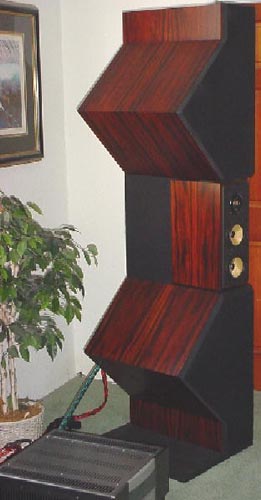
| Due to the move and my new job, I did not start feeling the pangs of being without a system for a few months. I was still receiving and reading all of the audio magazines, trying to decide on what to buy this time around. I was browsing through AudiogoN and I found an ad that quickly got my attention; a pair of Rosewood B&W Matrix 800s. I called and spoke to Joe from JM Sound in California. We had a long discussion about the B&Ws and after a short exchange with Debbie who quickly reminded me that we should have never sold the first pair, we worked out a deal with Joe and bought them. While waiting for them to arrive from California, I decided to buy a Convergent Audio Technology Ultimate One Mark Two phono preamp, a pair of Bryston 7BST monoblock amplifiers and an Ayre CX-7 CD player. Assembling the speakers and hooking up the system took the better part of a day, but finally the time came to dust off Keb Mo. After letting the system play for a few hours to warm up, I sat down and listened. Keb Mo still had a great sound but it seemed bright and edgy. I spent the next several weeks changing speaker wires, finally ending up with copper to try to diminish some of the brightness. I moved the speakers to nearly every position possible within the room but there was no improvement. I asked Debbie about each change on what she heard and her response was the same - still too bright and edgy. I remained convinced that the real sound we were looking for was within the 800s but I had just not found the right equipment to bring it out. My reasoning for buying the CAT was that it would be clean and articulate while providing a superb phono section. The Brystons could provide the current that the B&Ws needed to get the bass and presence into the system, which combined, should give us the sound we were looking for. The end result was not there. The tweeter seemed much brighter than our first pair, the bass was slow and a little muddy and the midrange seemed bloated. After several nights of thinking this over, I came to the conclusion that the Brystons were the biggest part of the problem. They contributed to the overt brightness while not adding any punch, control or presence to the bass. I called Joe again at JM Sound and told him what I thought the system was doing. I explained that I wanted to sell the Brystons and the CAT and go to an all-new tube preamp and tube monos. Joe suggested that I try the Canary products as they were very high in quality, and they had a sound I just had to hear to believe. I agreed and bought the Canary CA803 monoblock preamp along with the 140-watt CA160 monoblock amplifiers. The Canarys arrived and I diligently hooked them up, biased the amps and once more put on Keb Mo. The brother was sounding really good, even with zero hours on the Canarys. The edge had gone away and the brightness, while still there, was at a much more palatable level than before. The bass was reasonably tight and controlled as the Canarys did a commendable job with the two 12" woofers. The 800s can be quad-wired with a post for each of the two woofers, one for the two 5" mid-range drivers and one for the tweeter. I decided to tri-wire the speakers by running one wire to the tweeter, one to the midrange and one to the lower woofer with a jumper to the upper woofer. Keb Mo was sounding even better now. The soundstage improved, the placement of the instruments was now very discernible and the clarity and detail in the tweeter improved a little more as the brightness was further reduced. Surprisingly, the bass also tightened a little more and the hint of presence was lurking around the corner. I was on the right track - the system would only get better as the tubes improved with time. |
||||||||
| After several more nights of listening, the tube hours were now approaching 25 with the sound gradually improving. I had an idea concerning what I was hearing, or more specifically, what I was not hearing. It had always seemed strange in the first pair and in this pair, that with two 12" woofers, there was no real bass or presence to the music. It did not make sense. Finally, I came to the conclusion that the problem may not be with the midrange or the brightness in the tweeter but rather, a substantial lack of bass. It was this | ||||||||
 |
||||||||
| lack of bass that was exaggerating the midrange and treble. I decided to bi-amp and biwire the speakers by biwiring the Canary CA160s on the midrange and tweeter and finding transistor monos to drive the woofers. I made another call to Joe at JM Sound to see if he had any transistor monoblock amplifiers that could match the Canary CA160s' .60 volt input sensitivity. A few hours later, Joe called with some interesting results. He had a pair of demo Vincent monoblocks that matched the CA160s input within .1 of a volt. He said they had 300wpc into 8 ohms, which would mean closer to 600 watts with the B&Ws running at 4 ohms and, like the Canarys, they were of very high build quality. Even better, Joe said I could try them and send them back if I did not like them. Five anxious days later, the Vincents arrived and, good to Joe's word, they were of high quality build and weighed a hefty 80 pounds each. I hooked them as planned to the woofers while driven the mids and tweeters from the Canary CA160s. Keb Mo was once more dropped into the CD player and I let the system warm up for an hour before I dared listening to it. I turned the dual preamp volume controls to the same spot, sat down and hit play. There is no way you could know how I felt when I heard this huge gorgeous sound coming out of the speakers. The soundstage was enormous, the bass was really tight, controlled and there was so much presence that you could feel it throughout the room. The brightness in the tweeter was replaced by clarity, superb detail and an accuracy I never thought possible. The sound was overwhelming. I said nothing about this when I asked Debbie to listen to the system. She was clearly astounded and immediately wanted to hear some of her organ music. It was quickly evident that we were hearing low bass notes that we had never heard before. Needless to say, I called Joe and told him that he was not getting the Vincents back. Candidly, in all my years in audio, I have never had a change that so profoundly affected the system and my enjoyment of the music. Does this mean that I am through testing and adjusting, as far as the B&Ws, Canarys and the Vincents are concerned? Yes, but the rest is still wide open. I am awaiting new silver ICs, new speaker wires, power cords and cryogenically treated tubes for the CA160 monoblocks. Based on recommendations from a friend, my next venture will be into AC power conditioners and Stillpoints. After that, we will see what the mailman brings... |
||||||||
 |
||||||||
 |
||||||||
 |
||||||||